
The Confidence Loop: How Solving Puzzles Makes Everyday Challenges Feel More Manageable
Why Puzzles Can Make Life Feel More Manageable
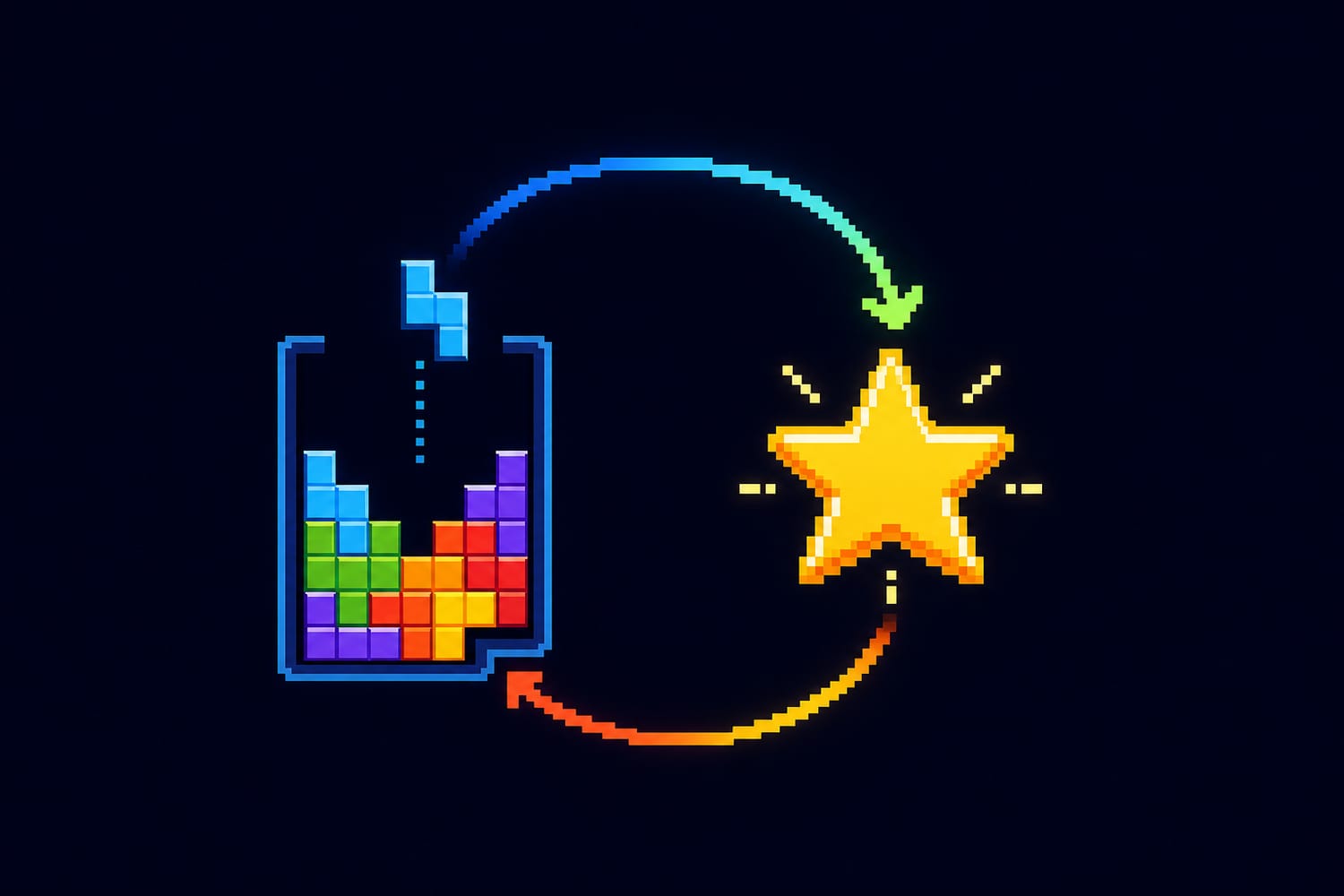
Solving puzzles can create a practical confidence loop: you face uncertainty, take a small action, learn from the result, adjust your approach, and eventually make progress. Repeating that process provides evidence that being stuck is temporary—and that difficult situations often become manageable when approached one step at a time.
A crossword clue, Sudoku grid, jigsaw, maze, or block game may look very different from a school assignment, household problem, or demanding project. Yet each asks you to work with incomplete information. You rarely see the entire path at the beginning; you discover it through observation, experimentation, and correction.
That experience matters because confidence is not simply the feeling that everything will be easy. Useful confidence sounds more like this: “I may not know the answer yet, but I can begin.”
Understanding the Confidence Loop
Psychologists use the term self-efficacy to describe a person’s belief in their ability to perform a task or achieve a desired result. The American Psychological Association’s definition of self-efficacy emphasizes that this belief can influence motivation, emotion, and behavior.
Puzzles can support self-efficacy by creating a repeatable sequence:
- Meet a challenge: The puzzle presents something you cannot immediately solve.
- Take an action: You test a word, move a piece, mark a possibility, or examine a pattern.
- Receive feedback: The action fits, fails, reveals a clue, or narrows the options.
- Adjust: You keep the useful information and change what is not working.
- Make progress: One correct step makes the next step easier to see.
- Remember the experience: You collect evidence that persistence and strategy can produce results.
That final stage completes the confidence loop. The next time you encounter difficulty, you are not starting with nothing. You have a memory—perhaps many memories—of moving from confusion toward clarity.
Puzzles Turn “I Can’t” Into “What Can I Try?”
A well-designed puzzle begins with a gap between what you know and what you need to discover. Instead of treating that gap as a disaster, the game treats it as the whole point.
This can encourage a valuable change in language. “I can’t solve this” becomes “I haven’t solved this yet.” That small shift does not deny the difficulty. It simply leaves room for another attempt.
Consider a jigsaw puzzle. At first, hundreds of pieces may appear almost interchangeable. You do not respond by trying to understand the entire picture at once. You create order:
- Find the corners and edges.
- Sort pieces by color or texture.
- Build a recognizable object.
- Compare shapes more carefully.
- Step back when one area becomes confusing.
The same process works with many everyday challenges. A crowded schedule can be divided into priorities. A difficult lesson can be separated into concepts. A messy room can be organized one section at a time. The puzzle solver’s advantage is not knowing every answer—it is knowing how to reduce a large problem into approachable parts.
Mistakes Become Information, Not Verdicts
One of the healthiest lessons in puzzle play is that an incorrect move does not define the person who made it. It simply tells the player something about the current approach.
If a crossword answer conflicts with several crossing words, the answer probably needs revision. If a Sudoku placement creates a contradiction, an earlier assumption should be checked. If a jigsaw piece does not fit, its color, shape, or intended location has been misread.
In each case, the mistake contains information.
This distinction can be powerful outside puzzles. “My method failed” is very different from “I am a failure.” The first statement invites investigation. The second closes the door.
Research on problem-solving competence recognizes that successful performance involves more than knowledge alone. Confidence, perseverance, motivation, tolerance for uncertainty, and emotional regulation can all affect how someone approaches a difficult problem. Puzzles provide a relatively safe place to practice these qualities because most errors can be undone, reviewed, or used to guide the next attempt.
For more ways to respond constructively when a strategy stops working, explore how puzzle play can build cognitive flexibility for everyday problem-solving.
Staying Calm Helps You See More
When people become worried, their attention may narrow around the fear of getting something wrong. An experimental study found that induced worry could reduce confidence in proposed solutions and impair aspects of real-life problem-solving.
Puzzle play cannot remove every worry, but it can demonstrate why a calmer process is often more productive. When a puzzle solver slows down, previously overlooked details may become visible. A player might notice an unused clue, question an assumption, or recognize that the puzzle requires a completely different strategy.
This creates another useful loop:
- Notice frustration.
- Pause before reacting.
- Review the available information.
- Choose one reasonable next step.
- Evaluate the result.
Practicing this sequence during play may make it easier to remember during a test, technical problem, disagreement, or busy day. The real achievement is not never feeling frustrated. It is learning that frustration can be managed without abandoning the task.
Readers interested in this emotional side of play can learn more about how puzzles develop frustration tolerance and calm under pressure.
Different Puzzles Build Different Kinds of Confidence
Not every puzzle creates the same experience. Variety helps players discover that problem-solving has many forms.
Word Puzzles
Crosswords, anagrams, and word searches reward vocabulary, association, and alternate interpretations. They teach players to consider context and remain open to meanings that were not immediately obvious.
Logic and Number Puzzles
Sudoku, logic grids, and number challenges reward careful deduction. They show that progress can come from eliminating impossible options rather than instantly finding the correct one.
Visual and Spatial Puzzles
Jigsaws, tangrams, sliding tiles, and block games encourage mental rotation, comparison, and attention to detail. Research into jigsaw puzzling has found that the activity engages multiple cognitive abilities, particularly visual-spatial processes.
Timed Puzzles
Fast-paced games introduce manageable pressure. Players practice deciding what deserves attention first, recovering from mistakes quickly, and continuing even when conditions are imperfect.
Cooperative Puzzles
Shared puzzles add communication to the challenge. Players must explain ideas, listen to different perspectives, divide tasks, and sometimes accept that another person spotted something they missed.
Together, these formats reinforce a broad message: there is rarely only one useful way to think.
Choosing the Right Level of Difficulty
Confidence grows most reliably when a challenge is demanding but possible. A puzzle that is far too easy may be relaxing, but it offers little opportunity to practice recovery or persistence. One that feels completely impossible may produce discouragement rather than growth.
A balanced puzzle routine can include:
- Easy puzzles for relaxation, fluency, and quick wins
- Moderate puzzles for steady skill-building
- Difficult puzzles for experimentation and deeper learning
- Unfinished puzzles for practicing when to pause and return later
Hints can also be part of effective learning. Using help does not erase your effort, especially when the hint reveals only enough information to restart your thinking. The goal is not to protect a perfect record. It is to remain actively involved in finding the solution.
The hint ladder approach can help players request gradually stronger assistance without immediately revealing the answer.
Carrying the Puzzle Mindset Into Daily Life
The transfer from puzzles to life is not automatic. Becoming excellent at crosswords does not guarantee that every unrelated problem will become easy. Research on “brain training” and broad skill transfer is mixed, so puzzles should not be presented as a magical way to upgrade every mental ability.
The useful bridge is deliberate reflection. After solving a puzzle, ask what made progress possible:
- Did you break the challenge into smaller sections?
- Did you stop and review the evidence?
- Did you question an assumption?
- Did you try a new strategy?
- Did you ask for a limited hint?
- Did you return after a break?
- Did someone else offer a perspective you had missed?
Then apply that method intentionally. Before starting a complicated task, identify the smallest useful action. When a plan fails, separate the result from your identity. When uncertainty feels uncomfortable, remember that incomplete information is a normal starting point.
This is where puzzle confidence becomes everyday confidence—not through a mysterious mental transformation, but through conscious reuse of effective habits.
Confidence Is Built One Piece at a Time
Puzzles do not promise that every challenge has a neat answer. Real life contains uncertainty, conflicting priorities, and problems that cannot be solved by logic alone. What puzzles can offer is repeated practice in approaching difficulty without immediately retreating from it.
Every solved clue and corrected mistake becomes a small piece of evidence: you can observe, experiment, adapt, and continue. Over time, that evidence may change the way a new challenge feels. Instead of appearing as one overwhelming obstacle, it begins to look like a collection of smaller questions.
That is the confidence loop at work. You try because you believe progress may be possible. Progress strengthens that belief. Then the next challenge feels just a little more manageable—not because it is necessarily easier, but because you have become more willing to begin.

