
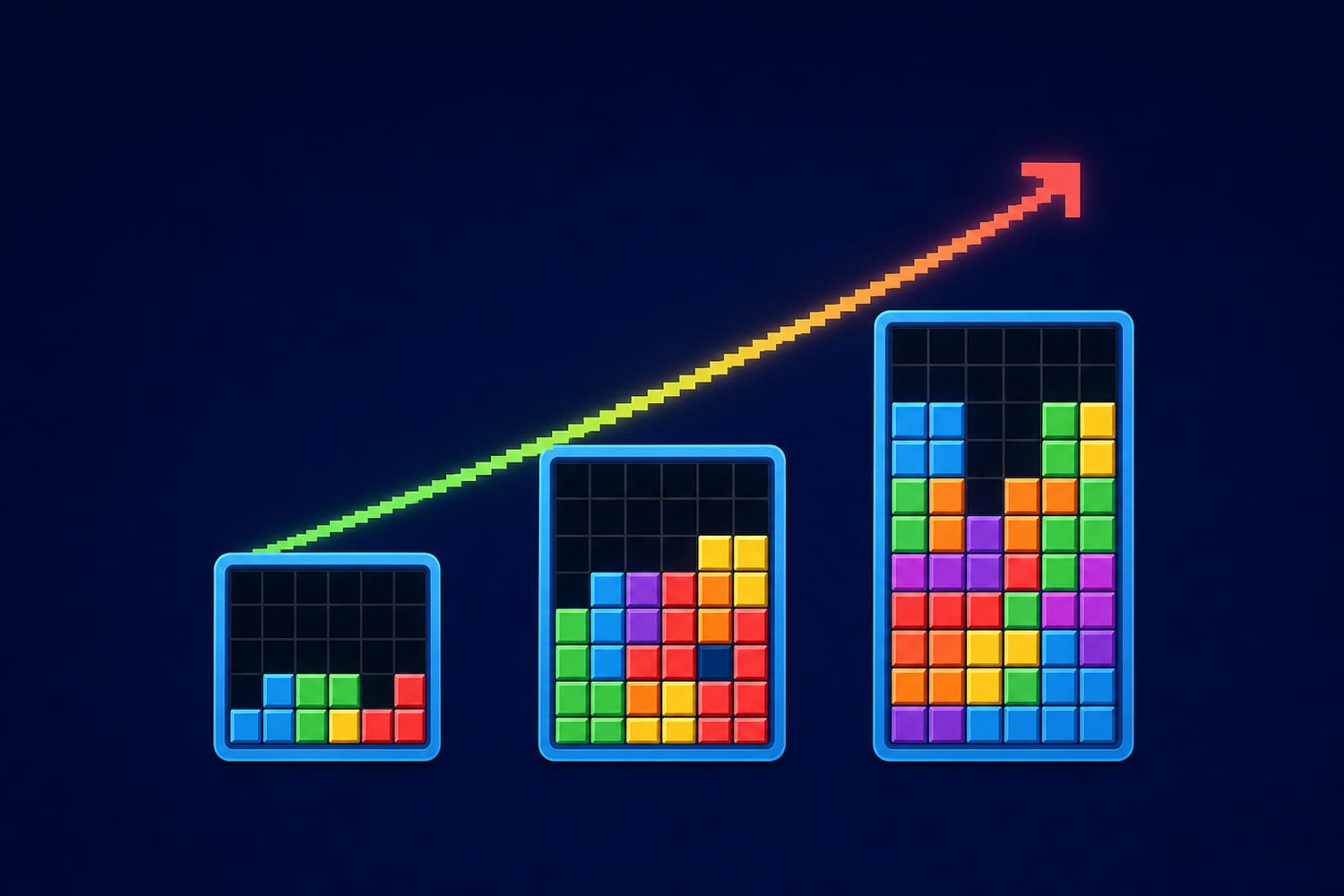
The Difficulty Curve: How Puzzle Games Get Harder Without Feeling Unfair
Difficulty Is a Conversation Between Game and Player
A good difficulty curve raises the challenge as the player’s understanding grows. Instead of simply making every level bigger, faster, or more complicated, thoughtful puzzle games teach an idea, let the player practice it, and then explore its consequences. The result feels demanding but fair because each obstacle builds on knowledge the player has already earned.
Difficulty, then, is not merely a number assigned to a level. It emerges from the relationship between what a puzzle asks and what a player currently understands.
A beginner may struggle with a rule that an experienced player recognizes immediately. Meanwhile, an expert can be surprised by a simple-looking puzzle that requires an unfamiliar way of thinking. This is why the perfect challenge cannot be measured only by grid size, number of pieces, or time allowed.
The real goal is to keep the player thinking, learning, and feeling capable of eventual success.
A Difficulty Curve Is Rarely a Smooth Slope
The phrase “difficulty curve” suggests a neat line rising steadily from easy to hard. In practice, successful puzzle games often resemble a mountain range with climbs, plateaus, peaks, and restful valleys.
If every puzzle is harder than the one before it, players receive no time to enjoy what they have learned. Continuous escalation can also become exhausting. Designers therefore use easier levels to introduce mechanics, reinforce skills, or provide a satisfying breather after a demanding challenge.
A common progression looks like this:
- Introduce: Present a new rule in a simple, safe situation.
- Practice: Ask the player to use that rule with limited complications.
- Test: Remove obvious guidance and require independent understanding.
- Twist: Reveal an unexpected use for the familiar rule.
- Combine: Mix the rule with mechanics learned earlier.
- Master: Build a challenge that requires planning across several ideas.
Imagine a game about redirecting beams of light. The first puzzle might contain one beam, one mirror, and one target. Later levels could add several mirrors, colored filters, barriers, switches, and multiple targets. The controls have not become harder, but the relationships between the elements have grown richer.
This step-by-step approach is closely connected to the idea of an invisible tutorial, in which players learn through carefully arranged play rather than long explanations.
How Designers Increase Puzzle Difficulty
Puzzle games can become harder in several different ways. Strong designers vary these methods instead of relying on one form of pressure.
More Possible Choices
A small puzzle may offer only two or three reasonable actions. A harder one might offer ten, forcing the player to identify which possibilities matter.
However, more choices do not automatically create better difficulty. If most options are meaningless, the puzzle may encourage random guessing rather than careful reasoning. Good choices should reveal information, advance a plan, or create an understandable consequence.
Longer Chains of Reasoning
Early puzzles often require one insight: move a block, complete a word, or identify a pattern. Later puzzles may require several connected deductions.
For example, the player might need to open a gate, preserve a key, reposition a bridge, and create a safe return path. Each step can be simple by itself, while the complete sequence demands planning and memory.
Tighter Resources
Move limits, restricted space, limited hints, and fixed sets of pieces can all increase difficulty. These restrictions work best when they encourage efficiency rather than demand a single lucky guess.
In a block-fitting puzzle, a large open board gives the player room to correct mistakes. A tightly packed board requires earlier decisions to account for later pieces. The challenge comes from planning ahead.
Combining Familiar Rules
One of the fairest ways to raise difficulty is to combine mechanics the player already understands. A switch is easy to operate. A movable box is easy to push. A door is easy to recognize. Put all three together, however, and the player may need to determine which box holds which switch and in what order the doors must open.
This produces complexity without introducing hidden rules. The puzzle is difficult because familiar elements interact in a new way.
Adding Time or Execution Pressure
Timers, falling pieces, moving hazards, and limited reaction windows test speed as well as reasoning. Tetris is a classic example: the basic rules remain consistent, but increasing speed leaves less time to evaluate the board.
This kind of difficulty must be used carefully. A player may understand the correct answer but be unable to execute it quickly. That is a different challenge from deduction, and designers should know which skill they intend to test.
The Difference Between Hard and Unfair
A hard puzzle says, “You have the necessary information, but you must use it well.” An unfair puzzle says, “You could not reasonably have known what the game expected.”
Fairness usually depends on several promises:
- The goal is understandable.
- Important information is visible or discoverable.
- Rules behave consistently.
- Actions produce clear feedback.
- Failure teaches something useful.
- The solution does not depend on an unexplained exception.
Suppose a puzzle contains red blocks that cannot be moved. If every red block has behaved this way, the player can plan confidently. If one red block suddenly moves without explanation, the game has broken its own language.
Surprises can still be fair. A puzzle might reveal that an object has a second use, but the discovery should follow logically from established rules. The best twists make players say, “I never thought of that,” rather than, “I was never told that.”
That distinction is central to how designers make puzzle games feel fair through playtesting.
Feedback Turns Failure Into Information
Failure feels less frustrating when the player understands why it happened.
Clear animation, sound, color, movement, and interface messages can reveal the result of an action immediately. A gate visibly opening connects it to the switch that caused the change. A piece snapping into place confirms that it has been positioned correctly. A warning sound can signal that time is running out.
Without feedback, players may repeat the same failed idea because they cannot see its consequences. The puzzle then feels mysterious for the wrong reason.
Low-cost recovery matters too. Undo buttons, quick resets, checkpoints, and optional hints allow players to test theories without repeatedly performing steps they have already mastered. These systems do not necessarily remove the challenge; they can concentrate it on the interesting decision.
The design of an effective undo button and second-chance system is therefore part of difficulty balancing, not merely a convenience.
Why the Best Curves Include Breathing Room
Players do not improve at a perfectly steady rate. Sometimes a concept becomes clear instantly. Sometimes understanding arrives after several attempts or even after taking a break.
Research into challenge-skill balance in games has found that engagement is connected to how closely challenge matches a player’s ability. In one study involving puzzle complexity, participants played levels near, below, or above their usual ability, illustrating why a well-matched challenge can support the deeply focused state often called flow. The open-access study on puzzle difficulty and flow offers a closer look at this relationship.
Designers support this balance by placing lighter puzzles between major tests. A calmer level can:
- Reinforce a recently learned mechanic.
- Give the player a quick success.
- Provide space to notice an elegant interaction.
- Reset attention before another difficult sequence.
- Introduce a new idea without immediately testing mastery.
These valleys do not weaken the curve. They make its peaks more enjoyable.
Playtesting Reveals the Real Difficulty
Designers are unusually poor judges of their own puzzles because they already know the intended solution. They understand every symbol, shortcut, and hidden relationship. A first-time player does not.
That is why difficulty is shaped through playtesting. Designers observe where players pause, what they misunderstand, which strategies they attempt, and when thoughtful experimentation turns into random clicking. Completion time can be useful, but behavior often reveals more.
If ten players fail at the same location, the answer is not always to make the puzzle easier. The level may need clearer feedback, a better visual clue, or an earlier puzzle that teaches the missing idea. A developer-focused guide to designing and playtesting video game puzzles similarly emphasizes observation, flexible level ordering, and occasional breathing room.
Fair Difficulty Also Means Giving Players Options
No fixed curve can suit everyone. Players differ in age, experience, memory, perception, motor control, available time, and preferred style of play.
Optional hints, untimed modes, adjustable speed, clearer visual cues, skippable challenges, and separate difficulty settings can make a game accessible to more people without changing the default experience. Microsoft’s Xbox accessibility guidance on game difficulty recommends giving players multiple options and, where appropriate, control over individual sources of difficulty.
These features recognize an important truth: fairness is not about proving that every player can overcome an identical barrier. It is about preserving meaningful problem-solving while removing obstacles that are unrelated to the puzzle’s central idea.
The Invisible Craft Behind a Satisfying Challenge
A great difficulty curve helps players become capable of solving puzzles that once appeared impossible. It teaches before it tests, combines before it overwhelms, and gives players room to recover after demanding moments.
Most importantly, fair difficulty protects trust. Players accept being confused, surprised, and occasionally defeated when they believe the rules are dependable and the answer can be discovered.
That is the hidden craft behind the best puzzle games. They do not simply place a mountain in front of the player. They quietly teach the player how to climb.

