
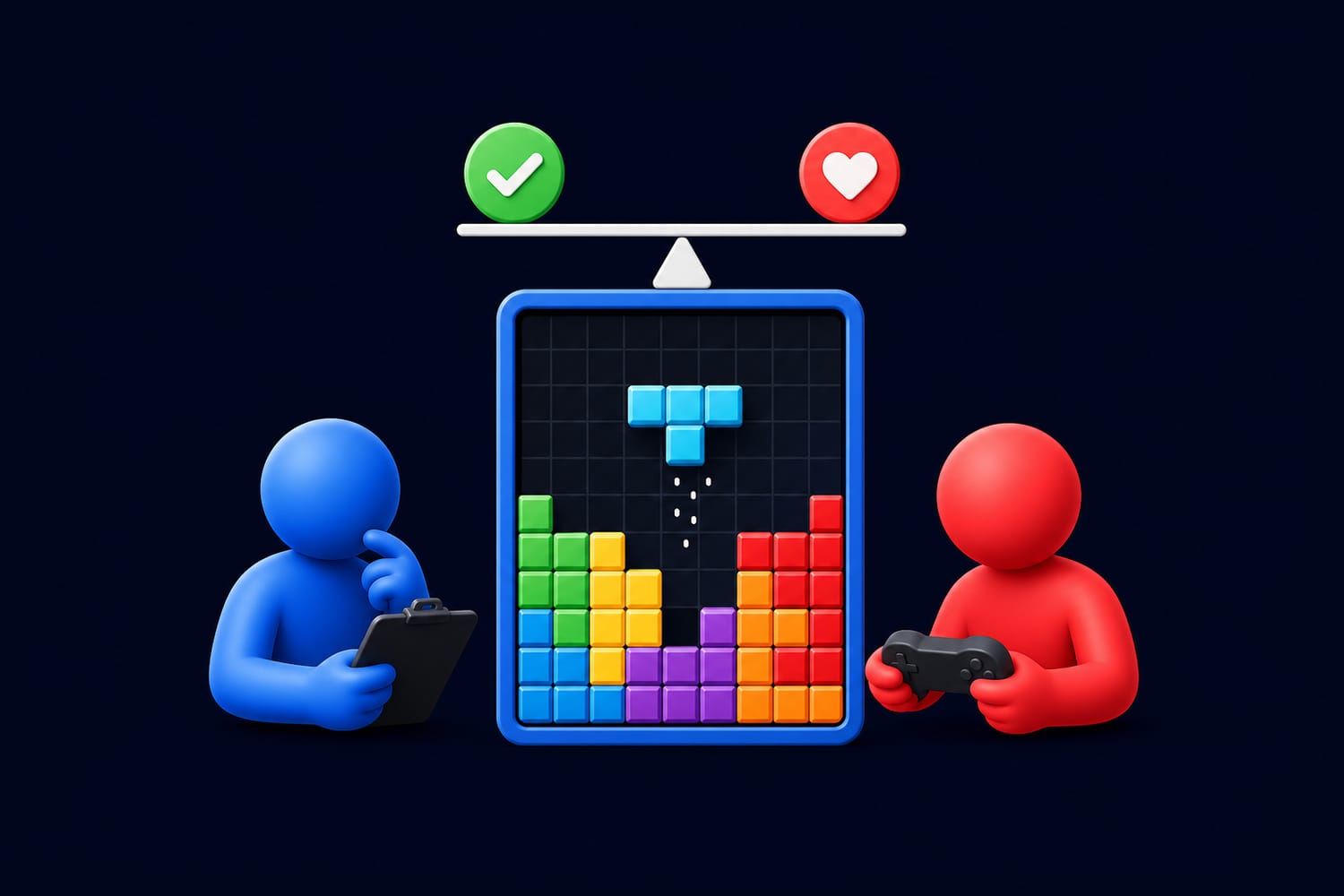
Inside a Puzzle Playtest: How Designers Make Games Feel Fair
Why “Fair” Matters More Than “Easy”
A fair puzzle game is not necessarily an easy puzzle game. In fact, many of the best puzzles are challenging, surprising, and a little bit stubborn. What makes them feel fair is that players believe the solution was possible to discover. When they finally solve it, they think, “Of course!” rather than, “How was I supposed to know that?”
That difference is the heart of puzzle design—and playtesting is one of the most important ways designers find it.
A playtest is a session where people try a game while the creators observe what happens. In puzzle games, playtests help designers understand whether the rules are clear, whether the difficulty rises smoothly, and whether players are getting stuck for interesting reasons or frustrating ones.
For example, imagine a puzzle where you must push blocks onto switches to open a door. If players fail because they didn’t notice one switch hidden behind a wall, that may feel unfair. But if they fail because they tried a plan, learned from it, and then spotted a smarter sequence, that can feel satisfying. The first problem is about unclear information. The second is about meaningful challenge.
Fairness in puzzle games usually comes down to a few key ideas:
- The player understands the goal.
- The player has access to the information they need.
- The game’s rules behave consistently.
- Mistakes teach something useful.
- The solution feels clever, not random.
Playtesting helps designers check whether those ideas are actually working for real players—not just in the designer’s imagination.
Watching Players Think Out Loud
A puzzle designer may know every answer in the game, every hidden rule, and every intended trick. That knowledge can make it hard to see the puzzle like a new player would. Playtesting gives designers fresh eyes.
During a puzzle playtest, a designer might sit quietly while someone plays. Sometimes the player is asked to “think aloud,” meaning they say what they are noticing, wondering, or trying. This can reveal a lot.
A player might say:
- “I think this button controls the bridge.”
- “I don’t understand why that laser turned off.”
- “Maybe I need to move this piece first.”
- “Oh! The red tiles are dangerous.”
These comments are valuable because they show the player’s mental model: what they believe the rules are and what they think the game is asking them to do.
If the player’s understanding matches the designer’s intention, great. If not, the designer has learned something important. Maybe the visual design suggests the wrong thing. Maybe a rule was introduced too quickly. Maybe the puzzle has two possible interpretations, and one leads to a dead end.
Good playtesters do not need to be experts. In fact, designers often test with different kinds of players: beginners, experienced puzzle fans, children, adults, speed-solvers, and people who rarely play games. A puzzle that only makes sense to the designer’s closest friends may need clearer teaching. A puzzle that delights both newcomers and experts may be on the right track.
The Difference Between Good Confusion and Bad Confusion
Puzzle games are built on confusion—but not all confusion is equal.
Good confusion sounds like curiosity. The player understands the basic rules but does not yet know how to combine them. They might say, “I can reach the key, but then I can’t get back,” or “If I rotate this piece, the beam goes there, but I still need to power the door.” This kind of confusion invites experimentation. It creates the enjoyable feeling of being close to an answer.
Bad confusion sounds like helplessness. The player does not know what the game wants, what tools they have, or why something happened. They might say, “What am I supposed to do?” or “I didn’t know that was allowed,” or “Why did I lose?” This kind of confusion often feels unfair because the player is not solving the puzzle—they are trying to understand the puzzle’s basic language.
Playtesting helps designers separate these two experiences.
A designer might notice that players are stuck for five minutes but still engaged. They test ideas, laugh at mistakes, and keep trying. That may be a healthy challenge. But if players stop moving, click randomly, or look away from the screen, the puzzle may need clearer clues, better pacing, or a simpler introduction.
This is why designers often care less about whether a player solves a puzzle quickly and more about how they behave while stuck. A tough puzzle can be fair if players always have something logical to try next.
Teaching Without a Lecture
One of the most powerful tools in puzzle design is teaching through play. Instead of showing a long instruction screen, designers often introduce rules in safe, simple situations.
For example, a game with mirrors and light beams might start with one mirror and one target. The player moves the mirror, sees the beam change direction, and learns the rule by doing. Later, the game adds more mirrors, blockers, colors, splitters, or timing elements.
This gradual teaching is sometimes called scaffolding. Like building supports around a structure, each puzzle helps the player climb toward more complex thinking. Once the player understands a concept, the support can be removed, and the game can ask them to use that concept in a new way.
Playtests show whether the scaffolding is strong enough. If many players fail to understand a rule, the designer may add an earlier teaching puzzle. If players solve several puzzles instantly, the designer may increase complexity sooner. If players forget a mechanic after a long gap, the game may need a reminder.
Good teaching puzzles often have these qualities:
- They focus on one idea at a time.
- They let players see cause and effect clearly.
- They avoid punishing early experiments too harshly.
- They give players a small success before asking for mastery.
A fair puzzle does not need to explain everything with words. But it should communicate enough that players feel responsible for their choices.
Visual and audio cues also matter. A switch might glow when activated. A locked door might shake when the player tries to open it. A correct move might play a satisfying sound. These details help players understand the game’s logic without breaking the flow.
Finding the Difficulty Curve
A single great puzzle is wonderful, but most puzzle games are made of many puzzles arranged in a sequence. That sequence creates the difficulty curve: the way challenge rises, falls, and changes over time.
A fair difficulty curve usually does not climb like a straight mountain. It has peaks and valleys. A hard puzzle may be followed by a lighter one that lets the player enjoy a new skill. A new mechanic may begin with simple examples before becoming part of complex combinations.
During playtesting, designers track where players get stuck, where they feel excited, and where they become tired. If three difficult puzzles appear in a row, players may feel overwhelmed. If the game stays too easy for too long, players may feel bored.
Designers may ask questions such as:
- Did players learn the mechanic before being tested on it?
- Did the puzzle require logic or guessing?
- Was there a sudden spike in difficulty?
- Did the solution depend on a tiny detail that was easy to miss?
- Did players feel proud after solving it?
Sometimes designers use data as well as observation. A game might record how long players spend on each level, how many times they reset, or where they quit. This information does not automatically say whether a puzzle is good or bad, but it can point designers toward places that need attention.
For example, if most players solve Level 12 in two minutes but spend twenty minutes on Level 13, Level 13 may be too big a jump. Or maybe Level 13 introduces a brilliant new idea but needs a better lead-in. Playtesting helps designers decide the difference.
The Hidden Problem of “Almost Fair”
Some puzzles are not obviously broken. They are almost fair, which can make them tricky to improve.
An almost fair puzzle might have a logical solution but hide an important clue in a place players rarely look. It might use a rule that technically appeared earlier, but only once and many levels ago. It might allow players to reach a situation where they think they are close to solving it, even though they already made an irreversible mistake.
These problems can be frustrating because they make players doubt themselves. A player may spend a long time trying reasonable ideas, not realizing that the puzzle has quietly stopped being solvable.
Many puzzle games solve this by including undo buttons, reset options, clear feedback, or level design that prevents impossible states. Not every puzzle needs a safety net, but players should usually understand when they have made a mistake and how to recover.
Fairness also depends on consistency. If a crate can be pushed on one level, players will expect similar crates to be pushable later. If blue doors require blue keys, a sudden exception needs to be clearly explained. Puzzle players build trust with a game’s rules. Breaking that trust can feel unfair unless the surprise is carefully designed and communicated.
This is one reason playtesting is humbling. Designers often discover that players are not “missing the obvious.” Instead, they are following clues the game unintentionally gave them.
How Designers Use Feedback
After a playtest, designers review what happened. They may look at notes, recordings, player comments, completion times, and moments of confusion. Then they decide what to change.
Importantly, designers do not always follow feedback literally. If a player says, “Make this puzzle easier,” the real issue might be unclear feedback, not difficulty. If a player says, “I hated the key mechanic,” they might actually mean the mechanic was introduced too late or used in a confusing layout.
Designers often look for patterns. One player getting stuck may simply be part of normal puzzle-solving. Ten players getting stuck in the same place is a stronger signal. If different players misunderstand the same symbol, the symbol probably needs redesigning. If players solve a puzzle but do not feel satisfied, the solution may need a stronger “aha!” moment.
Common changes after playtesting include:
- Reordering puzzles.
- Adding a simpler introduction.
- Removing unnecessary steps.
- Making clues more visible.
- Improving feedback for correct and incorrect actions.
- Reducing busy visual details.
- Adjusting level size or layout.
- Adding optional hints.
Hints are especially interesting in puzzle games. A good hint does not simply give away the answer. It nudges the player toward a useful observation. For example, instead of saying, “Put the box on the left switch,” a hint might say, “Notice which switch controls the door and which one controls the bridge.” That keeps the player involved in the solution.
The Joy of the “Aha!” Moment
The best puzzle playtests are not only about finding problems. They are also about discovering joy.
Designers watch for the moment when a player’s face changes: the pause, the smile, the sudden movement, the “Wait, I’ve got it!” That is the famous “aha!” moment. It happens when confusion turns into understanding.
A fair puzzle protects that moment. It gives players enough information to reach the answer, enough challenge to make the answer meaningful, and enough feedback to make the discovery feel real.
Playtesting helps designers shape that experience. It shows where players are curious, where they are misled, where they are proud, and where the game can communicate better. It turns puzzle design from guesswork into a conversation between creator and player.
Behind every smooth puzzle game is often a long trail of rough drafts, confused testers, revised levels, clearer clues, and better ideas. That process is not a sign that the first version failed. It is how good games are made.
Fairness does not mean removing challenge. It means building trust. When players trust a puzzle, they are willing to struggle, experiment, and think deeply—because they believe the answer is waiting, and they believe they can find it.

