
How to Solve Nonograms Without Guessing: The Overlap, Edge, and Cross-Out Methods
Nonograms Are Logic Puzzles, Not Guessing Games
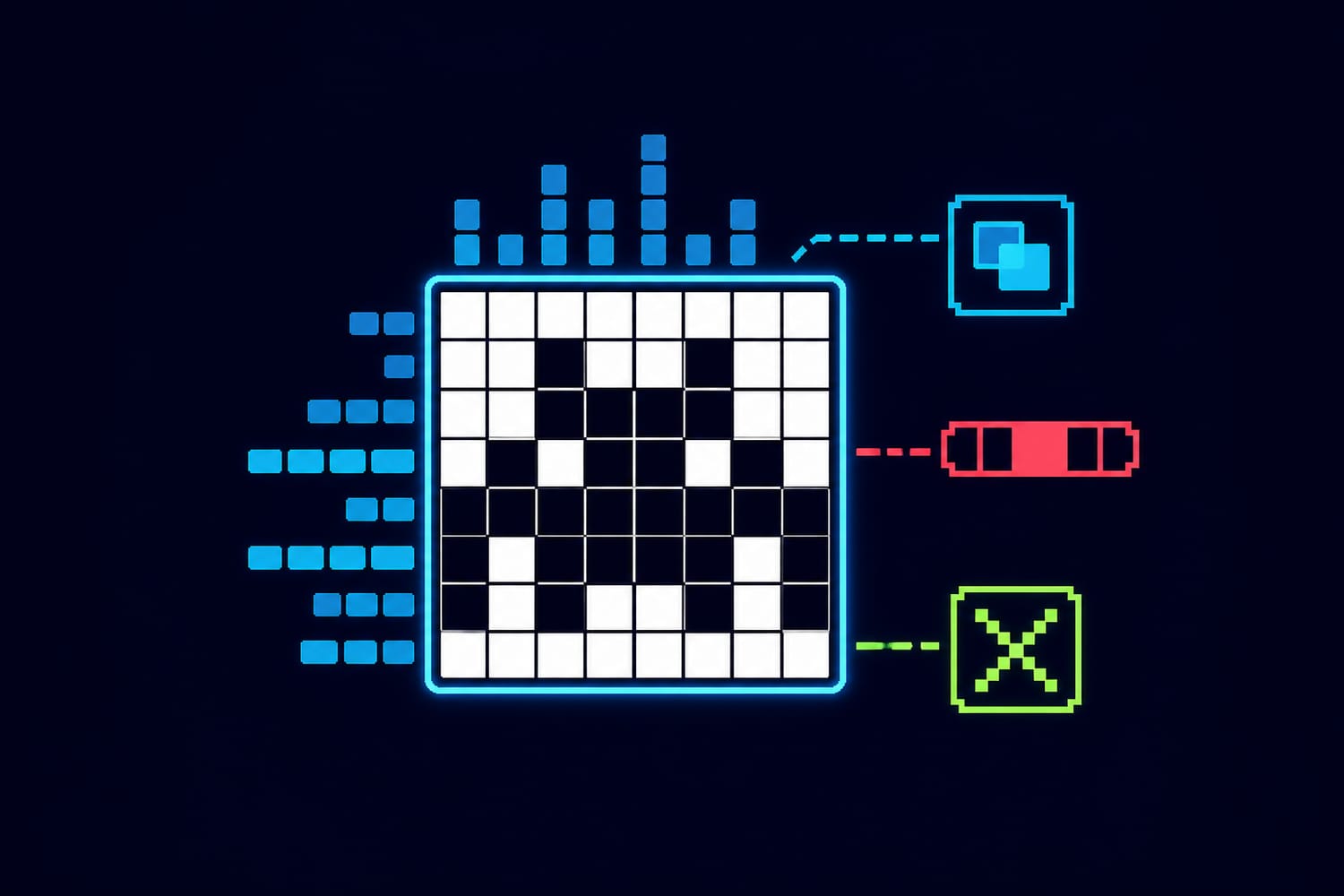
To solve a nonogram without guessing, look for cells that must have the same state in every legal arrangement. The overlap method reveals guaranteed filled cells, the edge method anchors groups near borders, and the cross-out method marks cells that cannot be filled. Repeating these deductions across rows and columns gradually unlocks the picture.
Nonograms—also called Picross, Griddlers, Hanjie, or picture crosswords—use numbered clues to describe groups of consecutive filled cells. A row clue of 4 2, for example, means the row contains a group of four filled cells followed later by a group of two. The groups must appear in that order and have at least one empty cell between them.
The picture is the reward, but it should not guide your decisions. A shape may look like an animal, letter, or object halfway through, yet appearances can be misleading. Trust the clues instead.
Read Every Clue as a Set of Rules
Before learning the three main methods, it helps to understand exactly what a line clue tells you.
Suppose a ten-cell row has the clue 3 2. You know that:
- Exactly three consecutive cells form the first group.
- At least one empty cell follows that group.
- Exactly two consecutive cells form the second group.
- The three-cell group must appear before the two-cell group.
- Every cell not belonging to those groups must be empty.
A clue is not an estimate. A 3 cannot become two or four cells, and two neighboring groups cannot touch. If they did, they would form one larger group.
Start each puzzle by finding completely determined lines:
- A blank clue or 0 means every cell is empty.
- A clue of 10 in a ten-cell line fills the entire line.
- Clues that occupy the exact line length after separators are added can be placed immediately.
For instance, 2 3 1 requires eight cells at minimum: two filled cells, one separator, three filled cells, another separator, and one final filled cell. In an eight-cell line, there is only one possible arrangement:
■■X■■■X■
These easy lines provide starting information for the crossing columns or rows.
The Overlap Method: Find Cells That Cannot Escape
Overlap is one of the most useful nonogram techniques because it finds definite fills before you know a group’s exact position.
Imagine a ten-cell row with the clue 7. The block can be pushed as far left as possible:
■■■■■■■???
It can also be pushed as far right as possible:
???■■■■■■■
Compare the two arrangements. Cells 4 through 7 are filled in both, so they must be filled in the actual solution:
???■■■■???
You have not guessed where the seven-cell group begins. You have simply found the cells it covers in every possible position.
For a single group of length N in an available line or segment of length L, the number of guaranteed overlap cells is:
(2 × N) − L
This only produces an overlap when the result is positive. A group of 7 in a ten-cell line gives 14 − 10 = 4 guaranteed cells. A group of 4 in that same line gives a negative result, so it creates no immediate overlap.
Overlap With Multiple Groups
The same principle works with several clues, but you must keep the groups in order and include the required separators.
Consider a ten-cell row with clues 3 4. Pack the groups as far left as possible:
■■■X■■■■??
Now pack them as far right as possible:
??■■■X■■■■
Compare the position of each corresponding group. The three-cell group overlaps at cell 3, while the four-cell group overlaps at cells 7 and 8. Those three cells are safe to fill.
Do not treat an overlap between different clue groups as a guaranteed fill. The first group’s earliest position must be compared with that same group’s latest position, not with the position of another group. The illustrated nonogram tutorial from Thonky offers additional examples of this important distinction.
The Edge Method: Use the Border as an Anchor
A group in the middle of a line may slide in several directions. A group touching the grid’s edge has fewer options, which makes border cells especially powerful.
Suppose an eight-cell row has the clue 4, and the first cell is already confirmed as filled:
■???????
Because the filled cell touches the left edge, the four-cell group must begin there:
■■■■X???
The first four cells are filled, and cell 5 is crossed out because the group must contain exactly four cells.
The same rule works from the opposite side. If the final cell is filled, the last clue group must finish at that edge.
Filled Cells Near an Edge
A confirmed cell does not always have to touch the border to produce information. Suppose a seven-cell row has a single clue of 4, and cell 2 is filled. A four-cell group containing cell 2 can start at cell 1 or cell 2:
■■■■???
?■■■■??
Cells 2, 3, and 4 are filled in both possibilities. You cannot yet decide whether cell 1 or cell 5 is filled, but the shared middle cells are certain.
This is overlap applied within an edge-limited area. The closer a known filled cell is to a border, the less freedom its group usually has.
Be careful not to overextend a group. If you know cell 2 belongs to a block of four, that does not automatically mean cells 1–4 are filled. Always compare every legal placement before making a mark.
This habit reflects a broader puzzle skill: separating proof from expectation. Puzzles Arcade’s guide to distinguishing facts from assumptions can help you avoid turning a likely placement into an unsupported move.
The Cross-Out Method: Empty Cells Are Valuable Clues
Many beginners concentrate almost entirely on filled cells. However, an X can be just as useful as a solid square because it removes possibilities and divides a long line into smaller sections.
You can safely cross out cells in several common situations.
Seal a Completed Group
If a clue of 3 has been fully identified, place an X immediately before and after it whenever those cells exist:
?X■■■X??
Those X marks prevent the group from accidentally growing beyond three cells.
Finish a Completed Line
Once every clue group in a row or column has been placed, cross out every remaining cell. Do not leave unknown cells behind when the line is already solved.
Eliminate Gaps That Are Too Small
Suppose the only remaining clue is 4, but an available gap contains just three cells. The block cannot fit there, so the entire gap must be empty.
This deduction becomes particularly powerful when X marks split a line into several separate spaces. Instead of analyzing one 15-cell row, you may only need to compare two small gaps.
Remove Cells Beyond a Group’s Reach
If a known filled cell belongs to a block of four, consider how far that block can extend in either direction. Any cell outside every possible position of that group cannot be part of it. If no other clue group can use the cell, mark it with an X.
The process is an excellent example of constraint mapping: every fill and X reduces the number of legal arrangements elsewhere on the board.
Cross-Reference Rows and Columns Constantly
The three methods are most effective when used together. A fill discovered through row overlap becomes evidence in its column. An X created by a completed column may shorten the usable space in a row, creating a new overlap.
Use a repeating solving cycle:
- Complete obvious lines, including full and empty ones.
- Apply overlap to promising rows.
- Apply overlap to promising columns.
- Check the edges for anchored or nearly anchored groups.
- Seal completed blocks with X marks.
- Cross out undersized gaps and unreachable cells.
- Rescan every changed row and column.
- Repeat until the picture is complete.
This is why one small mark can trigger a chain reaction. A single fill completes a column group; that creates two Xs; one X divides a row; the reduced row creates an overlap; and the new overlap solves another column.
If a large grid feels overwhelming, use the same orderly approach described in Puzzles Arcade’s 3-pass puzzle-solving method: collect obvious information first, analyze constrained areas next, and then revisit the whole board with fresh evidence.
What to Do When You Feel Stuck
Being stuck does not automatically mean you need to guess. It usually means a small deduction has been overlooked.
Run through this checklist:
- Is any line completely full or empty?
- Does a large clue create an overlap?
- Have all completed groups been sealed with Xs?
- Is any open gap too short for its remaining clue?
- Does a filled cell near an edge force part of a group?
- Can a known group reach every currently unmarked cell?
- Have you revisited both the row and column of your latest mark?
- Did you accidentally treat a possible placement as a certain one?
For well-constructed, logic-solvable nonograms, progress comes from identifying what must be true, not what merely looks promising. If several placements remain possible, leave them open and inspect another line. The information needed to resolve them may arrive from a crossing clue later.
A Calm, Reliable Route to the Final Picture
Solving nonograms without guessing is less about spotting the hidden image and more about managing certainty. Overlap finds cells shared by every valid placement. Edge logic reduces movement near the borders. Cross-outs eliminate impossible cells, seal groups, and divide complicated lines into manageable sections.
Work carefully, mark both filled and empty cells, and keep switching between rows and columns. Each logical mark makes the next one easier—and when the final image appears, you will know that every square was earned through deduction.

