
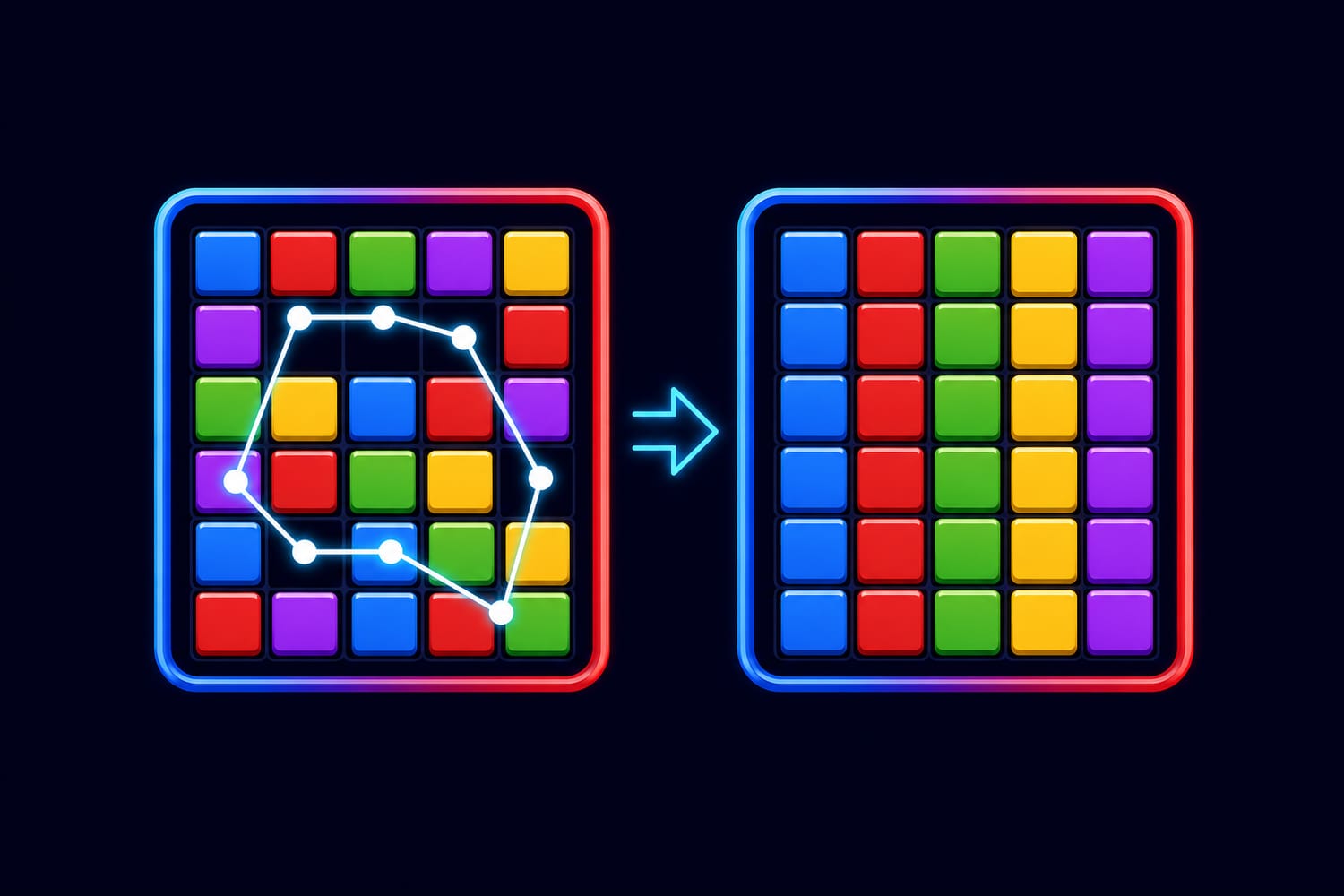
Constraint Mapping: The Universal Puzzle Strategy for Faster Solves
What Is Constraint Mapping?
Every puzzle has rules. A crossword clue points toward a word. A Sudoku row can only contain certain digits. A jigsaw piece must match by shape, color, and image. A logic grid gives you “if this, then that” relationships. Constraint mapping is the habit of turning those rules into a visible, organized map of what is possible, what is impossible, and what must be true.
In simple terms, a constraint is anything that limits your choices. If a puzzle asks for a five-letter animal beginning with “Z,” the length and first letter are constraints. If a maze has a wall, the wall is a constraint. If a number puzzle says two values must add to 10, that relationship is a constraint.
Constraint mapping means collecting these limits and using them strategically instead of guessing. It is not one single method for one single puzzle type. It is a universal thinking tool. Once you learn it, you can use it in Sudoku, crosswords, nonograms, escape rooms, riddles, word games, matchstick puzzles, chess problems, and many more.
The best part is that constraint mapping works for beginners and experts alike. Beginners use it to avoid feeling overwhelmed. Experts use it to solve faster, spot hidden patterns, and reduce mistakes.
Why Constraints Make Puzzles Easier
At first, constraints can feel like obstacles. A rule that says “you cannot place a 7 here” seems to remove freedom. But in puzzles, less freedom is often good news. Every eliminated option makes the solution space smaller.
Imagine you are trying to guess a secret number from 1 to 100. With no clues, you have 100 possibilities. If you learn the number is even, you now have 50. If you learn it is greater than 60, you have 20. If you learn its digits add to 9, you have only a few left. You have not solved the puzzle yet, but you have made it much easier.
That is the power of constraints: they convert a large, messy problem into a smaller, clearer one.
Good solvers rarely rely on sudden inspiration alone. They build progress from small deductions. Each deduction creates new constraints, and those constraints lead to more deductions. This chain reaction is why one tiny mark in a Sudoku grid, one confirmed letter in a crossword, or one placed piece in a jigsaw can unlock a whole section.
The Basic Constraint Mapping Process
Constraint mapping can be broken into four simple steps: list, mark, connect, and update.
First, list the known rules. These may be written in the instructions, shown in the puzzle layout, or discovered through observation. In Sudoku, the givens are known numbers. In a crossword, clue answers must fit the grid length and intersecting letters. In a path puzzle, barriers and start/end points are fixed facts.
Second, mark possibilities and impossibilities. This might mean pencil marks in a number grid, crossing off options in a logic puzzle, writing candidate letters beside a crossword clue, or sorting jigsaw pieces into edge, corner, color, and pattern groups.
Third, connect related information. Many puzzles are not solved by isolated facts but by relationships. If one square cannot be red, then another square might have to be red. If a word ending in “E” crosses a clue whose third letter is now fixed, that changes both clues. Constraint mapping is about noticing how one fact affects another.
Fourth, update constantly. A constraint map is not a static note sheet. It should evolve. When you confirm something, remove old possibilities. When you eliminate a choice, look for consequences. Many puzzle-solving errors happen because people make a good deduction but forget to apply it everywhere it matters.
Constraint Mapping in Sudoku
Sudoku is one of the clearest examples of constraint mapping. Each empty cell must contain a digit from 1 to 9, but it is constrained by its row, column, and 3×3 box. A beginner might scan for obvious missing numbers. A more systematic solver writes small candidate numbers in each empty cell.
Suppose a cell is in a row that already contains 1, 2, 4, 6, and 9. It is in a column that contains 3 and 8. It is in a box that contains 5. That leaves only 7, so the cell must be 7. This is a direct constraint.
But constraint mapping also helps with subtler deductions. If two cells in a row can only be 2 and 5, then those two digits are “reserved” for those cells. No other cell in the row can be 2 or 5. This is called a naked pair, and it is really just a relationship between constraints.
Sudoku teaches an important lesson: you do not need to see the whole solution. You only need to find the next safe step. A well-maintained constraint map keeps those safe steps visible.
Constraint Mapping in Crosswords and Word Puzzles
Crosswords use a different kind of constraint: language. A clue suggests meaning, the grid gives length, and crossing answers provide letters. At the start, a clue like “large bird” with five letters might be EAGLE, HERON, STORK, or another answer. But if the second letter is “A,” many options disappear. If the last letter is “E,” EAGLE becomes much more likely.
Word puzzles also include constraints such as spelling patterns, grammar, tense, plural forms, and common phrases. A clue asking for a past-tense verb probably will not end like a noun. A fill-in-the-blank clue may require a phrase that sounds natural when spoken aloud.
For games like Wordle-style puzzles, constraint mapping is essential. Green letters are fixed constraints, yellow letters are present but misplaced, and gray letters are usually eliminated unless duplicate-letter rules apply. The fastest players do not simply guess words they like. They use each guess to test and narrow the map of possibilities.
Constraint Mapping in Logic Puzzles
Classic logic puzzles often provide a set of people, places, objects, or events and ask you to match them correctly. For example: “Ava did not bring the blue bag. The person with the red bag arrived after Ben. Cara arrived before the person with the green bag.”
These puzzles are almost made for constraint mapping. A grid lets you mark “yes,” “no,” and “not yet known.” The goal is to turn every sentence into a visible mark. “Ava did not bring the blue bag” becomes an X in the Ava-blue square. If each person has exactly one bag, then confirming Ava has the red bag eliminates red from everyone else and eliminates all other bags from Ava.
The biggest advantage of a logic grid is that it prevents mental overload. Instead of remembering ten clues in your head, you store them in the map. This frees your mind to reason.
A strong habit is to reread each clue after every major discovery. A clue that seemed unhelpful at the beginning may become decisive once one or two possibilities are removed.
Constraint Mapping in Visual Puzzles
Not all constraints are numbers or words. Many are visual. In jigsaw puzzles, edge pieces are constrained by the border. Corner pieces have two straight sides. Pieces with sky-blue coloring probably belong near other sky pieces. Unique patterns, text, faces, and strong color changes act as anchors.
In nonograms, also known as picross puzzles, number clues tell you how blocks of filled squares must fit in each row and column. A clue of “8” in a row of 10 squares must overlap no matter where it is placed. Mapping that overlap can reveal guaranteed filled squares. Similarly, if a row is completed, it creates constraints for every column it crosses.
Mazes also use visual constraints. Walls block movement, one-way paths restrict direction, and dead ends can often be eliminated. Many maze solvers work backward from the finish because it reveals constraints from a different angle.
Visual puzzles remind us that constraint mapping does not always require writing. Sorting, grouping, highlighting, and tracing are all forms of mapping.
The Art of Choosing the Next Constraint
One reason experienced solvers seem fast is that they know where to look next. They do not examine every part of a puzzle equally. They search for areas with the most constraints.
In a crossword, that might be a short word with several crossing letters. In Sudoku, it might be a row with only two empty cells. In a jigsaw, it might be a distinctive object with clear colors and lines. In a logic puzzle, it might be the clue with the strongest wording, such as “exactly,” “immediately before,” or “only if.”
A good rule is to look for “pressure points.” These are places where many constraints overlap. Pressure points are valuable because a small discovery there can spread quickly through the rest of the puzzle.
This is also why random guessing is usually inefficient. A guess in a low-constraint area may not teach you much. A deduction in a high-constraint area can unlock several connected facts.
Common Mistakes to Avoid
The first common mistake is marking too much without organizing it. A page full of notes can become confusing if symbols are inconsistent. Use a simple system: circles for confirmed choices, X marks for eliminated choices, tiny candidates for possibilities, or colors for categories. The exact system matters less than using it consistently.
The second mistake is forgetting to update. If a number, word, or item is confirmed, the map must change around it. Old possibilities left behind can mislead you later.
The third mistake is making assumptions that are not actually supported by the rules. For example, a clue saying “the red house is next to the blue house” does not say which side it is on. A word containing “A” does not mean it contains only one A unless the puzzle’s feedback rules say so. Good constraint mapping separates facts from guesses.
The fourth mistake is pushing too hard in one area. If a section stops producing progress, move to another part of the puzzle. New constraints elsewhere may return you to the stuck area with fresh information.
Practice: A Simple Constraint Mapping Mindset
You can practice constraint mapping with almost any puzzle by asking four questions:
- What do I know for certain?
- What is impossible?
- What possibilities remain?
- What changes because of this?
These questions slow you down just enough to prevent careless guesses, but they also speed you up by guiding your attention. Over time, the process becomes automatic. You will begin to see puzzles not as mysterious challenges but as networks of linked restrictions.
For younger solvers, this is a great way to build patience and logical thinking. For experienced solvers, it is a way to sharpen efficiency. For casual players, it simply makes puzzles more fun because progress feels steady and earned.
Turning Constraints Into Confidence
Constraint mapping is powerful because it changes how you experience a puzzle. Instead of waiting for the answer to appear, you actively build a path toward it. Every crossed-out option is progress. Every confirmed fact is a foothold. Every relationship you notice brings the solution closer.
Whether you are filling a Sudoku grid, cracking a crossword, solving a logic mystery, assembling a jigsaw, or exploring a new puzzle game on Puzzles Arcade, the same strategy applies: find the limits, map the possibilities, and let the constraints guide you.
The next time you feel stuck, remember that puzzles are designed to be solved. The clues are already there. Constraint mapping simply helps you see them clearly.

