
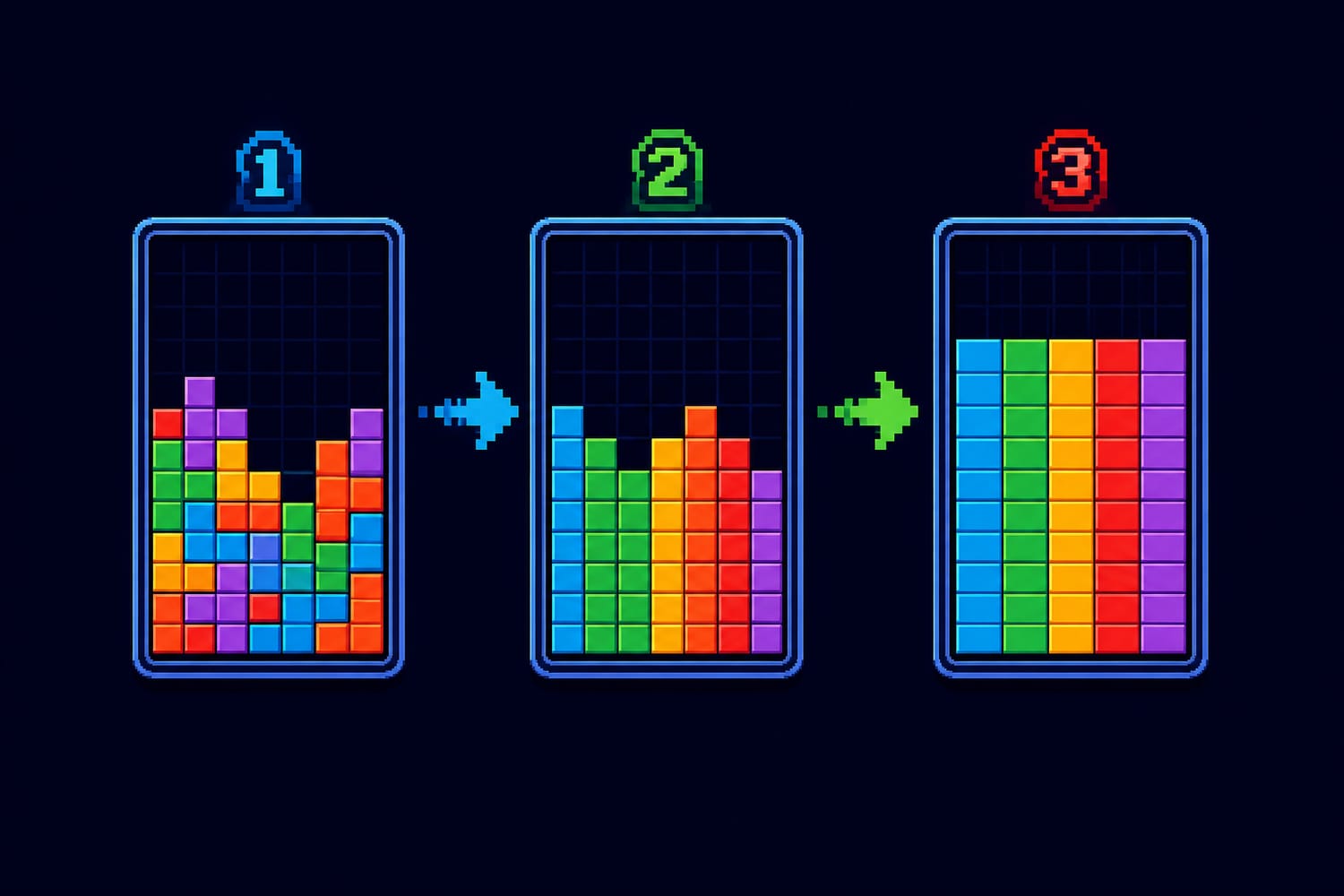
The 3-Pass Method for Solving Any Puzzle Faster
Why a “3-Pass Method” Works for Almost Any Puzzle
Most puzzles become easier when you stop trying to solve everything at once.
Whether you enjoy crosswords, sudoku, word searches, logic grids, jigsaw puzzles, escape-room riddles, number puzzles, or pattern games, the same challenge appears again and again: too much information, too many possibilities, and no obvious place to begin.
That is where the 3-Pass Method comes in.
The idea is simple: instead of forcing your way through a puzzle from start to finish, you move through it in three deliberate passes:
- Pass 1: Find the easy wins
- Pass 2: Use connections and constraints
- Pass 3: Focus deeply on what remains
This method works because puzzles are usually designed with layers. Some clues are meant to be solved quickly. Others depend on earlier answers. The hardest parts often become much easier once the simpler pieces are in place.
Think of it like cleaning a messy room. You would not start by organizing a tiny drawer while clothes, books, and boxes are scattered everywhere. First, you clear the obvious items. Then you group related things. Finally, you handle the tricky details. Puzzle-solving works the same way.
The 3-Pass Method helps you avoid frustration, save time, and make steady progress—even when a puzzle looks impossible at first glance.
Pass 1: Collect the Easy Wins
The first pass is all about speed and confidence.
Your goal is not to solve the whole puzzle. Your goal is to gather every answer, clue, piece, or pattern that seems obvious. Do not get stuck. Do not argue with one difficult clue for ten minutes. Move quickly.
In a crossword, this means filling in the clues you know immediately. In sudoku, it means placing numbers that have only one possible position. In a word search, it means scanning for short or familiar words first. In a jigsaw puzzle, it means finding corners, edges, and pieces with clear colors or patterns.
Pass 1 builds momentum. Every easy answer gives you new information. A crossword answer adds letters to crossing words. A sudoku number changes the possibilities in its row, column, and box. A jigsaw edge creates structure. A solved riddle may reveal how the puzzle designer thinks.
The key rule of Pass 1 is: skip without guilt.
Skipping is not failure. It is strategy. Many puzzle solvers waste time because they believe they should solve clues in order. But most puzzles do not require a straight-line approach. In fact, solving out of order is often faster.
During Pass 1, mark anything that seems promising but unfinished. Circle a clue, pencil in a possible answer, sort a puzzle piece into a “maybe” pile, or make a quick note. Then move on.
By the end of Pass 1, you should have a foundation. It may be small, but it gives you something to build on.
Pass 2: Look for Connections and Constraints
Pass 2 is where the puzzle begins to open up.
Now that you have some easy wins, you can use them to solve medium-difficulty parts. This pass is slower and more thoughtful than the first, but still not about getting stuck forever. You are looking for relationships.
Most puzzles are built on connections and constraints.
A connection is when one answer helps another. For example, in a crossword, the answer to “planet known as the Red Planet” gives you MARS, which may provide the first letter of a crossing answer. In a jigsaw puzzle, a blue piece might connect with several other blue sky pieces. In a logic puzzle, knowing that Anna does not own the red bike may help determine who does.
A constraint is a limit on what can be true. Sudoku is full of constraints: each number can appear only once in each row, column, and box. Word puzzles also use constraints: answer length, letter placement, theme, rhyme, category, or pattern. Even riddles use constraints, because every clue narrows the field of possible interpretations.
During Pass 2, ask questions like:
- What does this solved part reveal?
- What options are now impossible?
- Which unsolved area has the most information around it?
- Are there patterns in the puzzle’s design?
- Does one answer confirm or weaken another guess?
This is the best time to use light notes. In a number puzzle, write possible candidates. In a logic puzzle, use a grid. In a word game, jot down likely prefixes, suffixes, or letter combinations. In a jigsaw puzzle, sort pieces by color, texture, shape, or object.
The purpose of notes is not to make the puzzle more complicated. It is to reduce the load on your memory. Your brain is better at spotting patterns when it does not have to hold every detail at once.
Pass 3: Slow Down and Solve the Hardest Parts
By the time you reach Pass 3, you have already done the most important work. You have removed easy items, used connections, and reduced the number of possibilities.
Now it is time to focus on what remains.
Pass 3 is for the stubborn clues, the nearly identical puzzle pieces, the tricky logical deductions, and the answers that did not reveal themselves earlier. The good news is that these hard parts are usually less hard now. You have more context than you had at the beginning.
In Pass 3, slow down and examine details carefully.
For word puzzles, look at word structure. If you know a five-letter answer starts with S and ends with E, ask what kinds of words fit the clue and pattern. For sudoku, check rows, columns, and boxes with the fewest empty spaces. For jigsaws, compare piece shape as much as color. For riddles, revisit the wording: puzzle creators often hide meaning in small details.
This is also the pass where you can try controlled guessing—but carefully.
A controlled guess is not random. It is a test based on evidence. You choose the most likely option and see whether it creates progress or contradiction. In pencil-and-paper puzzles, use light marks. In digital puzzles, use undo features if available. In physical puzzles, place a piece without forcing it.
If a guess leads to contradictions, remove it and try another path. If it creates several new solutions, it was probably a good step.
Pass 3 requires patience, but it should not feel hopeless. If you are truly stuck, it may mean you need to return to Pass 2 and search for a missed connection.
How to Use the Method in Different Puzzle Types
The 3-Pass Method is flexible. Here is how it can work across popular puzzle categories.
For crosswords, Pass 1 means answering every clue you know instantly. Pass 2 means using crossing letters, theme clues, and answer lengths. Pass 3 means tackling wordplay, uncommon terms, and clues with double meanings.
For sudoku, Pass 1 means filling in obvious singles. Pass 2 means scanning for hidden singles, pairs, and interactions between boxes, rows, and columns. Pass 3 means using more advanced logic such as candidate elimination, but without guessing blindly.
For jigsaw puzzles, Pass 1 means finding corners, edges, and visually distinct pieces. Pass 2 means building clear sections such as faces, signs, buildings, or bright color areas. Pass 3 means fitting subtle textures like sky, grass, water, or shadows.
For word searches, Pass 1 means finding short, unusual, or easy-to-spot words. Pass 2 means scanning in organized directions: horizontal, vertical, diagonal, forward, and backward. Pass 3 means searching for hidden words in crowded areas or using remaining letters to guide you.
For logic puzzles, Pass 1 means recording direct facts. Pass 2 means combining clues to eliminate possibilities. Pass 3 means testing remaining options and checking for contradictions.
For escape-room style puzzles, Pass 1 means identifying visible locks, codes, symbols, objects, and instructions. Pass 2 means grouping clues that seem related. Pass 3 means testing combinations and interpreting more subtle hints.
The exact techniques differ, but the rhythm is the same: easy first, connected second, difficult last.
Why Skipping Is a Superpower
Many people think good puzzle solvers are good because they never get stuck. In reality, strong puzzle solvers get stuck all the time—they just do not stay stuck in the same place for too long.
Skipping gives your brain time to process information in the background. This is sometimes called incubation. You may leave a clue unanswered, solve five other parts of the puzzle, and then suddenly realize the answer when you return.
That “aha!” moment can feel magical, but it often happens because your brain has collected more context.
Skipping also protects your energy. Frustration narrows your thinking. When you spend too long on one problem, you may stop seeing simple alternatives. Moving on keeps your mind fresh.
This does not mean you should rush carelessly. It means you should spend your effort where it has the highest chance of paying off.
Common Mistakes the 3-Pass Method Helps You Avoid
One common mistake is trying to solve the puzzle in order. This can work for some puzzles, but many are not designed that way. A later clue might be much easier than an earlier one, and solving it may unlock the difficult section.
Another mistake is refusing to write things down. Memory is useful, but notes make patterns visible. Even simple marks can prevent repeated work.
A third mistake is overcommitting to an early guess. If you assume one answer is correct and build everything around it, you may create a chain of errors. The 3-Pass Method encourages you to treat uncertain answers as temporary until confirmed.
A fourth mistake is ignoring the puzzle’s structure. Most puzzles include hints through layout, symmetry, categories, repeated symbols, answer length, or visual grouping. Pass 2 is especially helpful because it trains you to look for these features.
Finally, many solvers quit too soon. A puzzle may look impossible at first, but after one clean pass, it often becomes much more manageable.
A Simple Practice Routine
To build the 3-Pass habit, try this routine the next time you play a puzzle:
- Set a calm starting pace. Look over the whole puzzle before diving in.
- Do Pass 1 quickly. Solve only what feels easy or obvious.
- Pause and review. Notice what new information you have created.
- Do Pass 2 carefully. Use connections, constraints, and patterns.
- Mark uncertain areas. Keep guesses separate from confirmed answers.
- Do Pass 3 patiently. Focus on the remaining hard parts.
- Check your work. Make sure every answer fits the puzzle’s rules.
This routine becomes natural with practice. At first, you may need to remind yourself not to get stuck. Eventually, you will start moving through puzzles more smoothly without thinking about the method.
The Faster Way Is the Calmer Way
The 3-Pass Method is not about rushing. It is about solving in the right order.
When you begin with easy wins, you build confidence. When you use connections, you turn scattered clues into useful information. When you save the hardest parts for last, you face them with the strongest possible position.
That is why this method works for beginners and experienced puzzlers alike. It respects how puzzles are built and how the mind solves problems best: step by step, with curiosity and patience.
So the next time you open a puzzle on Puzzles Arcade, try the 3-Pass Method. Start with what you know, connect what you find, and then take on the challenge that remains.
You may be surprised by how much faster “slow and steady” can be.

