
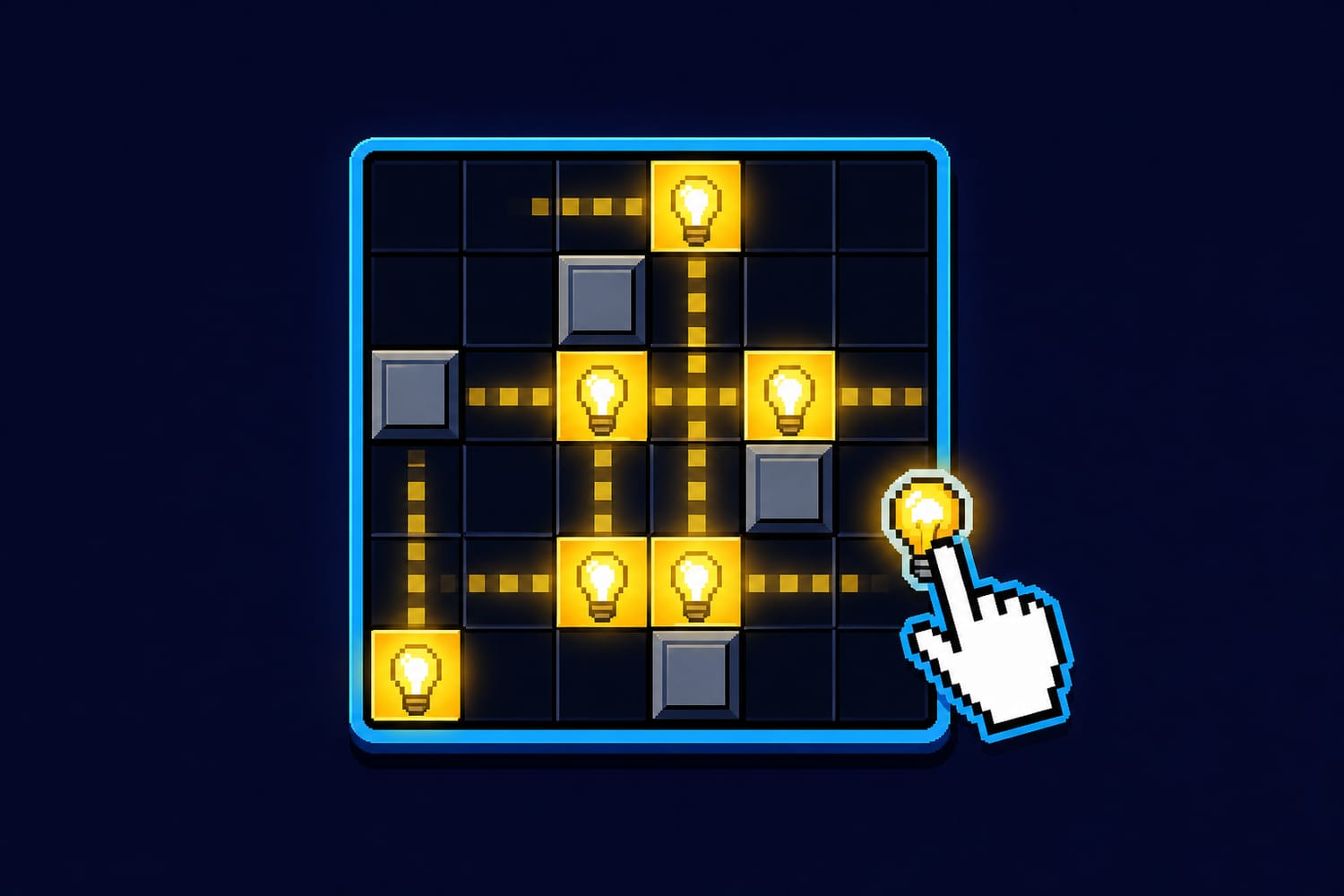
How to Solve Akari (Light Up) Without Guessing: Wall Clues, Forced Bulbs, and Shadow Checks
Akari Is a Logic Puzzle, Not a Guessing Game
To solve Akari without guessing, treat every bulb and no-bulb mark as a consequence of three questions: What do the wall clues require? Where can bulbs legally go? Which cells still need light? By repeatedly checking those constraints, forced placements appear and spread across the grid.
Akari—also known as Light Up—is a grid-based logic puzzle developed by Nikoli in 2001. Its rules are simple enough for beginners, but their interaction can produce wonderfully challenging deductions.
Your goal is to place bulbs in white cells so that:
- Every white cell is illuminated.
- A bulb shines horizontally and vertically until its light reaches a black wall or the grid’s edge.
- No bulb can shine directly onto another bulb.
- A number on a black wall gives the exact number of bulbs in the white cells immediately above, below, left, and right of it.
The numbers do not count diagonal bulbs, and they do not describe how many cells the wall illuminates. They are exact counts of orthogonally adjacent bulbs.
For the official foundation, see Nikoli’s Akari rules. Once those rules are clear, the puzzle becomes a map of possibilities and impossibilities rather than a search for lucky placements.
Use Two Marks: Bulb and No Bulb
Strong Akari solving depends on recording both positive and negative information. Place a bulb symbol in a confirmed bulb cell, and use a dot or X for a cell that cannot contain one.
A no-bulb mark does not mean that the cell must remain dark. It means the cell will eventually be illuminated by a bulb somewhere else.
Add a no-bulb mark whenever:
- A numbered wall has already received its required bulbs.
- A bulb can already see the cell.
- Placing a bulb there would exceed a nearby wall clue.
- The cell has been eliminated by another logical deduction.
This is a perfect example of constraint mapping: every marked impossibility reduces the puzzle’s remaining choices.
Start With the Strongest Wall Clues
Numbered walls are usually the best starting points because they create local, exact restrictions. Do not merely look at the printed number. Compare it with the number of confirmed bulbs and undecided neighboring cells.
Zero Walls Eliminate Bulbs
A wall marked 0 cannot touch any bulbs. Mark every adjacent white cell with an X or dot.
These marks often have effects far beyond the 0 itself. An eliminated cell may leave another clue with only enough spaces to hold its remaining bulbs, or it may become impossible to light a distant cell from one direction.
Clues With Exactly Enough Available Cells
Suppose a 2 wall has four neighboring positions, but two have already been ruled out. The two remaining cells must both contain bulbs.
The general rule is:
If a clue still needs N bulbs and has exactly N legal neighboring cells remaining, all those cells are bulbs.
This applies equally to edges and corners. For example, a 3 on the edge may have only three available neighboring white cells. If all three are legal, all three must contain bulbs.
Satisfied Clues Exclude the Rest
The reverse is just as important:
If a numbered wall already has its required number of bulbs, every other adjacent cell must be marked as no bulb.
If a 2 already touches two confirmed bulbs, placing a third bulb beside it would violate the clue. Mark all its remaining undecided neighbors immediately.
These two rules—fill when spaces equal demand and exclude when demand is satisfied—form the engine of most Akari solves.
Let Every Bulb Create New Information
A bulb is more than a source of light. It is also a long-range restriction.
When you place one, follow its row and column until each beam reaches a wall or the grid edge. Every visible cell becomes ineligible for another bulb because two bulbs may not illuminate each other.
This can solve numbered clues indirectly. Imagine that a 2 wall has three undecided neighboring cells. A newly placed bulb elsewhere shines through one of those cells, preventing that cell from holding a bulb. The remaining two neighbors are now forced bulbs.
Always complete this update cycle:
- Place the forced bulb.
- Mark every cell it illuminates as no bulb.
- Recount nearby numbered walls.
- Mark newly satisfied clues.
- Check whether another clue now has exactly enough spaces.
- Rescan the dark cells.
This repeating rhythm is similar to Puzzles Arcade’s 3-pass puzzle-solving method: collect obvious deductions, use their connections, and then study what remains.
Use Shadow Checks to Find Hidden Forced Bulbs
Wall clues are not your only source of certainty. Every white cell must eventually receive light, so an unlit cell creates its own constraint.
A shadow check means selecting a dark cell and asking:
Which legal bulb positions could still illuminate this cell?
Look along the cell’s row and column, stopping at every black wall. Include the dark cell itself, because a bulb lights the cell it occupies. Then remove any positions that:
- Are marked as no bulb.
- Can already see another bulb.
- Would violate a numbered wall.
- Are blocked from the target by a wall.
If only one legal source remains, that source must contain a bulb. This is sometimes called an isolated-dark-cell deduction and is one of the most useful Akari techniques.
For example, imagine a dark cell in a short corridor. A wall blocks light from the left, an existing bulb rules out the cells above, and a 0 clue forbids a bulb below. If only one position to the right could illuminate the cell, place a bulb there.
Check Cells Hidden Behind Walls
Walls create separate lighting regions. A bulb on one side of a black square cannot illuminate anything on the other side, even if the cells share a row or column.
This means that a white cell tucked between walls may need special attention. Short one-cell or two-cell corridors are particularly restrictive:
- A one-cell pocket must contain a bulb unless another aligned bulb can reach it.
- A dark endpoint in a corridor may have very few possible light sources.
- Two disconnected sections of the same row must be analyzed separately.
- A bulb near a wall may safely share a row or column with another bulb if the wall blocks their view.
Avoid mentally tracing light through a numbered clue. Numbered and unnumbered black cells both block illumination completely.
Compare Overlapping Wall Clues
Harder puzzles often require you to compare clues rather than solve them individually. Two nearby numbered walls may depend on some of the same possible bulb cells.
Suppose one clue needs one more bulb among two shared cells. A neighboring clue may need two bulbs among those same cells plus one extra cell. Because the first clue allows only one shared bulb, the second clue’s extra requirement may force a bulb into its non-shared cell.
You do not always need to know which shared cell contains the bulb. Sometimes knowing how many bulbs must occupy a group is enough to solve cells outside that group.
A useful way to approach overlapping clues is:
- Count the bulbs each clue still needs.
- Identify neighboring cells shared by both clues.
- Separate shared cells from cells belonging to only one clue.
- Ask what must happen in the non-shared cells for both totals to remain possible.
This is the Akari version of comparing candidate groups in Sudoku or logic grids.
Avoid the Most Common False Deductions
Akari is unforgiving when a possibility is mistaken for a certainty. Watch for these common errors:
Placing a Bulb Just Because a Cell Is Dark
A dark cell needs illumination, but the bulb does not necessarily belong in that cell. It could shine in from anywhere along the same unobstructed row or column.
Forgetting That Light Stops at Every Wall
A numbered wall is still a wall. Its clue affects adjacent bulb counts, but light cannot pass through it.
Counting Diagonal Bulbs
Wall numbers count only edge-sharing cells. Diagonal bulbs have no effect on the clue.
Assuming a Lit Cell Is Fully Solved
A lit cell cannot contain a bulb, but it may still matter as a possible neighbor of a numbered wall. Mark it clearly so you do not accidentally count it as undecided.
Stopping After One Consequence
Every confirmed bulb or X may affect several clues and lighting lines. Failing to update the whole area is one of the easiest ways to overlook the next forced move.
The habit of separating proof from possibility is explored further in Facts vs. Assumptions: The Simple Habit That Prevents Costly Puzzle Mistakes.
Follow a Reliable No-Guessing Checklist
Whenever progress slows, scan the grid in this order:
- Mark every cell beside a 0.
- Find clues whose remaining demand equals their remaining legal spaces.
- Find satisfied clues and exclude their unused neighbors.
- Trace the sightline of every bulb.
- Inspect every unlit cell for a unique possible light source.
- Check short corridors, corners, and spaces behind walls.
- Compare nearby clues with overlapping candidate cells.
- Revisit every area changed by your latest mark.
Do not remain fixed on one clue. Akari is interconnected: a no-bulb mark on one side of the board can force a bulb that illuminates several rows, satisfies another clue, and unlocks an entirely different region.
Finish With a Full Grid Audit
Before declaring victory, check every rule separately:
- Is every white cell lit or occupied by a bulb?
- Can any two bulbs see each other?
- Does every numbered wall touch exactly the printed number of bulbs?
- Have you accidentally allowed light to pass through a wall?
- Does every bulb serve a legal purpose without creating a conflict?
Solving Akari without guessing is not about seeing the entire solution at once. It is about finding one statement that must be true, updating the grid, and allowing that new information to reveal the next statement. Work patiently, mark impossibilities clearly, and let the light spread one deduction at a time.

