
Escape Room Strategy: The Search, Sort, and Solve System for Beating the Clock
A Simple System for Escaping the Chaos
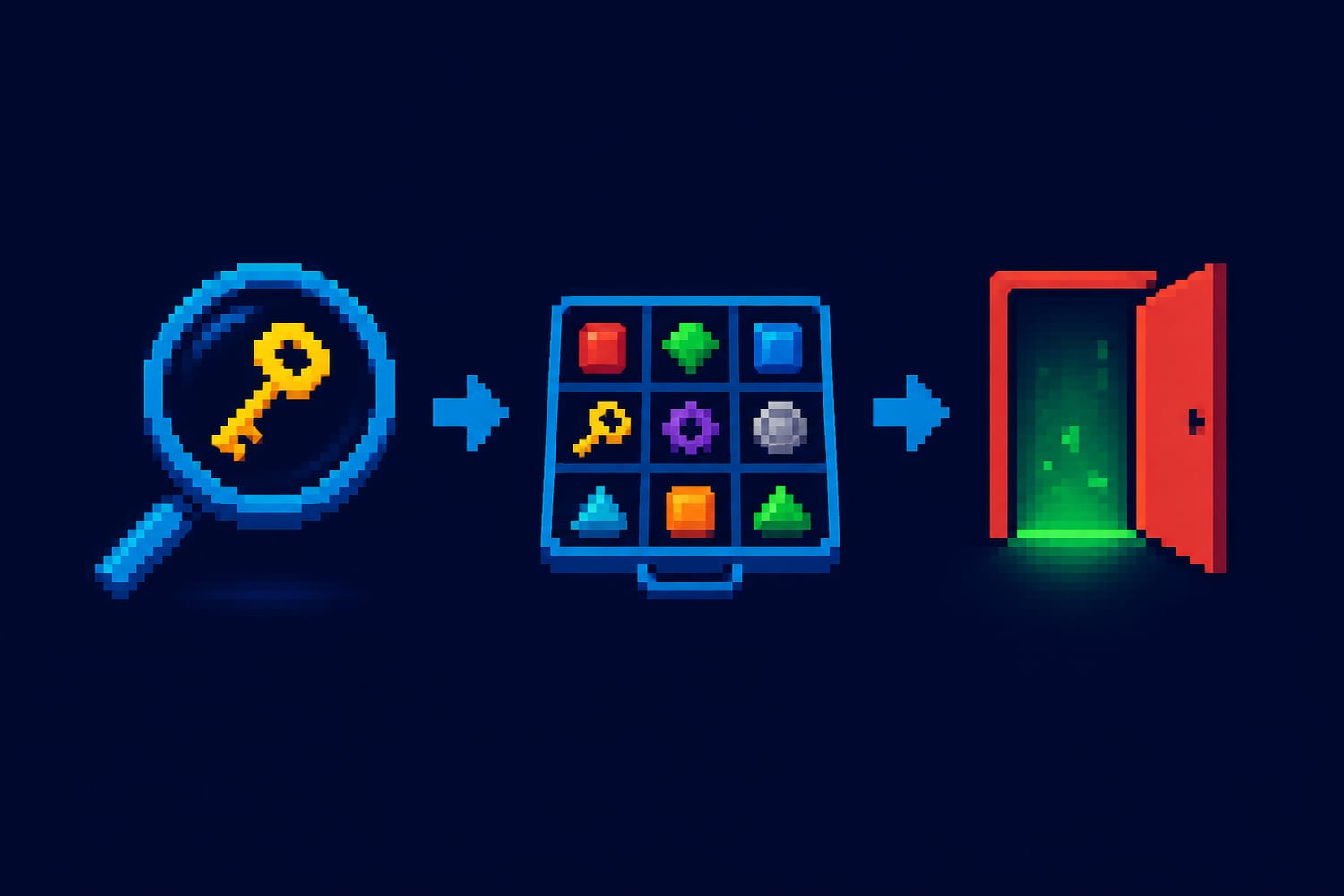
An effective escape room strategy can be summarized in three words: search, sort, and solve. First, inspect the room safely and announce what you discover. Next, organize clues according to their likely purpose and status. Finally, solve the most promising puzzles while sharing every result. Repeating this cycle keeps the entire team moving forward.
Escape rooms feel chaotic because they present many unfamiliar objects, locks, symbols, and possible paths at once. The clock adds pressure, encouraging players to grab the first clue they see and begin guessing.
The Search, Sort, and Solve system replaces that confusion with a repeatable process. It works for beginners, experienced players, families, friends, and team-building groups because it does not depend on knowing special tricks. It simply helps everyone manage information efficiently.
Before the Clock Starts
Pay close attention to the game master’s introduction. The briefing normally explains the objective, safety rules, hint system, prohibited areas, and markings used to identify objects that are not part of the game.
Never force a lock, dismantle furniture, climb on unstable objects, or ignore a “do not touch” marker. Well-designed escape room puzzles should respond to the correct solution without excessive strength. If something appears stuck, check your answer or ask the game master rather than pulling harder.
The story also deserves your attention. A name, date, mission, or unusual phrase from the introduction may become meaningful later. You do not need to memorize every detail, but everyone should understand the main objective.
Before entering, agree on three team rules:
- Announce every significant discovery.
- Place found items in a shared area when permitted.
- Ask for help or switch tasks before frustration takes over.
These rules create the foundation for the system.
Step One: Search the Room Systematically
When the clock starts, divide the room into zones so multiple players can search without repeatedly covering the same ground. One person might inspect a desk, another a bookshelf, and another the walls and decorations.
Search with both your eyes and your hands—but only within the venue’s rules. Look for:
- Keys, puzzle pieces, and loose objects
- Numbers, letters, colors, and symbols
- Visible locks and their input types
- Repeated images or unusual patterns
- Containers, drawers, books, and permitted movable props
- Instructions hidden within the room’s story
The objective is not to interpret everything immediately. During the first sweep, prioritize discovery and communication. If you find a brass key, say, “Small brass key found in the desk.” If you see a four-digit lock, announce that too.
This verbal inventory allows information to travel across the team. A player on the opposite side of the room may already be holding the matching object.
Search carefully rather than destructively. An object being slightly crooked does not automatically make it a clue, and ordinary set decoration may exist purely to support the theme. If a venue says certain objects are off-limits, believe it. Searching prohibited areas wastes time and can damage the room.
The Escape Game’s guide to escaping successfully similarly recommends splitting up, announcing discoveries, and keeping found materials organized.
Step Two: Sort Clues Into Useful Groups
Searching produces raw information. Sorting turns that information into a usable map.
Choose a visible, permitted surface as the team’s clue station. Keep the arrangement simple, because an elaborate filing system can consume more time than it saves.
Create three basic groups:
- Unused: Items and information that have not yet contributed to a solution
- In progress: Clues currently connected to an active puzzle
- Completed: Used keys, opened locks, and fully solved materials
This prevents teammates from repeatedly testing a used key or rebuilding a puzzle that has already produced an answer. If the venue explains that some objects may be reused, keep those items accessible and mark their status verbally instead of assuming they are finished.
Next, sort by likely relationship. Colors may correspond to colored buttons. A sequence of arrows may fit a directional lock. Four animal pictures may connect to four animal statues elsewhere in the room.
Useful matching questions include:
- Does the number of clue elements match the number of lock positions?
- Do the colors, shapes, or symbols appear somewhere else?
- Is there a clear reading order?
- Does an object physically fit another object?
- Is the clue complete, or are pieces still missing?
- Has this information already been used?
This stage is similar to the Puzzles Arcade 3-Pass Method for solving puzzles faster: identify the obvious elements first, connect related information next, and reserve deeper focus for the difficult remainder.
Step Three: Solve the Best-Supported Puzzle
Once clues are organized, choose puzzles with enough information to produce a reasonable answer. Do not begin with whichever lock looks most exciting. Begin with the strongest clue-to-puzzle connection.
Suppose the team finds four portraits, each associated with a number, and a nearby box has a four-digit lock. That is a promising match—but the order still matters. Look for an instruction, timeline, left-to-right arrangement, age order, or another feature that determines the sequence.
A good solve follows this pattern:
- Identify the puzzle’s likely output, such as a word or four-digit number.
- Explain the proposed method briefly.
- Confirm that every part of the clue has a purpose.
- Enter the answer carefully.
- Announce the result and distribute any newly revealed items.
Avoid rapid random guessing. Besides wasting time, repeated guesses can distract the team from finding the intended logic. Some electronic puzzles may also reset after incorrect input.
If a solution appears convincing but does not work, have a different teammate check it. They may notice a reversed order, transcription error, overlooked instruction, or incorrectly entered symbol.
Repeat the Cycle After Every Breakthrough
Search, Sort, and Solve is not a one-time opening routine. It is a loop:
Search → Sort → Solve → Search again
Opening a box, door, drawer, or hidden compartment changes the room. Pause briefly after each breakthrough and announce what has become available. Move completed materials aside, add new clues to the shared area, and decide what now has the clearest path forward.
This rhythm is especially valuable in multi-room games. A newly opened area can create excitement, but sending the whole team rushing into it may leave unfinished clues behind. Assign some players to search the new space while another person checks whether the earlier area still contains unresolved puzzles.
Communicate Without Creating More Noise
Strong communication is not constant shouting. It is clear, short, useful information.
Instead of saying, “I found something weird,” say, “I found a five-letter word clue beside the green lock.” Instead of quietly trying the same code on every lock, announce what the code is, where it came from, and which locks have already rejected it.
Teams should also avoid crowding. If several people are staring at one puzzle while unused clues remain elsewhere, politely redistribute:
- One or two people solve the active puzzle.
- One person maintains the clue area.
- Other players search, review unused objects, or work on separate paths.
Roles should remain flexible. A strong searcher may become the perfect pattern solver later, while a quiet player may suddenly recognize the key connection. Effective escape room teamwork makes space for every voice.
Game masters writing for Escape Experience also emphasize that communication and organization help teams avoid duplicated effort and overlooked information.
Know When to Switch, Reset, or Request a Hint
Tunnel vision is one of the clock’s greatest allies. A player becomes convinced that a painting contains a code, spends ten minutes counting tiny details, and misses the clear clue sitting nearby.
Set a practical stuck rule. If a puzzle has produced no new information after a few focused minutes, do one of the following:
- Hand it to someone with fresh eyes.
- Return it to the unused group.
- Search for a missing component.
- Review the room’s story or instructions.
- Ask the game master for a hint.
Hints are part of the experience, not a sign of failure. A timely nudge can preserve momentum and allow the team to enjoy more of the room. The Puzzles Arcade guide to using a hint ladder without spoiling the solution offers a useful principle: ask first for direction rather than the complete answer.
Use the Clock as a Guide, Not a Threat
Assign one player to check the remaining time occasionally. Watching the timer constantly increases stress, but ignoring it completely can leave the team surprised by the final minutes.
Use time checks to trigger strategic decisions. If progress has stopped, regroup. If several puzzles remain near the end, split into smaller teams. If everyone is stuck on the same bottleneck, request a hint instead of protecting a hint-free record.
For more ideas about maintaining speed without sacrificing accuracy, see Puzzles Arcade’s guide to beating the clock in timed puzzle games.
Your Final Escape Room Checklist
Before the game:
- Listen to the rules and story.
- Learn how hints work.
- Agree to announce discoveries.
During the game:
- Divide the room into search zones.
- Build a shared clue station.
- Separate unused, active, and completed materials.
- Match clue formats to puzzle inputs.
- Explain solutions before entering them.
- Switch solvers when progress stops.
- Repeat the cycle whenever something opens.
Most importantly, stay curious and supportive. An escape room is not a test of which teammate is smartest. It is a shared challenge built around observation, communication, and the pleasure of discovering how scattered details fit together.
Search thoroughly. Sort clearly. Solve logically. Then repeat until the final lock clicks—or the clock runs out with everyone already planning the next adventure.

