
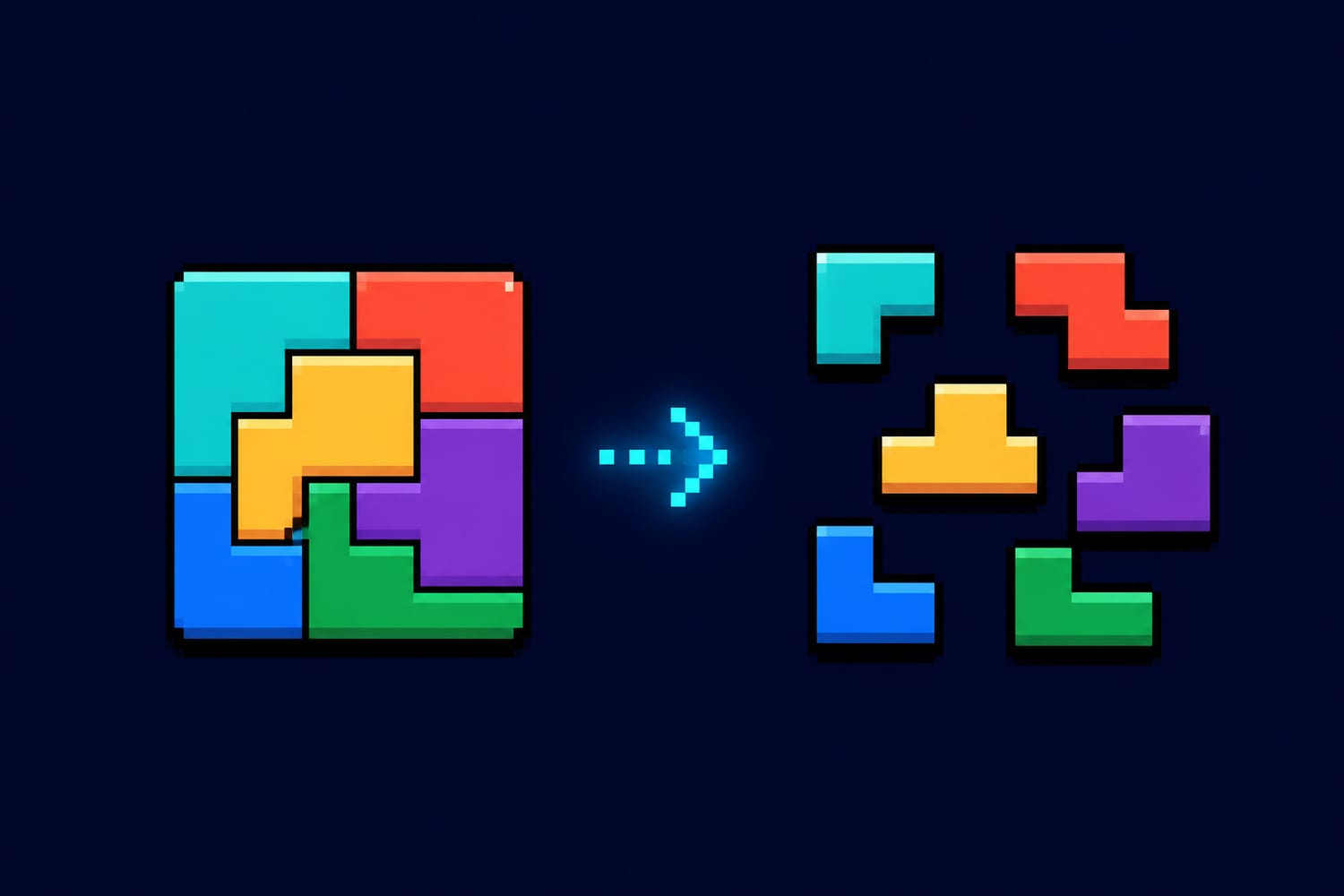
Divide and Conquer: How to Break Overwhelming Puzzles Into Solvable Pieces
Why Big Puzzles Feel Overwhelming
When a puzzle looks impossibly complicated, do not try to solve the whole thing at once. Divide it into smaller sections, identify the easiest useful task, solve one piece at a time, and connect the results. This “divide and conquer” approach turns a wall of information into a series of manageable decisions.
A difficult puzzle may ask you to track numerous clues, rules, symbols, possibilities, and relationships at the same time. That creates mental clutter. Working memory—the system used to hold and manipulate information while thinking—has a limited capacity. Organizing information into meaningful chunks can reduce that burden and make complex material easier to handle, as explained in Stanford University’s guide to strategies for improving working memory.
Dividing a puzzle is not a shortcut or a sign that you lack skill. It is a structured problem-solving method. George Pólya’s well-known framework recommends understanding the problem, creating a plan, carrying it out, and checking the result. It also encourages solvers to concentrate on one part at a time.
Step 1: Understand the Whole Before Dividing It
Divide and conquer begins with a brief look at the entire puzzle. If you split it too quickly, you may create sections that ignore important connections.
Start by identifying three things:
- The goal: What must be completed, found, arranged, or proven?
- The rules: Which moves, placements, or answers are permitted?
- The available information: What has already been confirmed?
For example, the goal of a jigsaw is to reproduce the complete image, while the rules require every piece to connect correctly by shape and picture. In Sudoku, the goal is to complete the grid while obeying the row, column, and box restrictions. In a crossword, each answer must satisfy both its clue and the letters provided by crossing answers.
A quick scan can also reveal obvious entry points. Look for distinctive colors in a jigsaw, heavily filled boxes in Sudoku, short or straightforward crossword clues, and strongly restrictive statements in a logic puzzle. The guide to sizing up a puzzle in the first 60 seconds offers a useful routine for completing this initial survey.
Step 2: Choose Meaningful Pieces
Breaking a puzzle into pieces does not mean dividing it randomly. Each part should have a clear purpose and be small enough to examine without losing sight of the larger goal.
You can divide puzzles in several ways:
Divide by Location
This works especially well for visual and grid-based puzzles. You might focus on one jigsaw corner, one Sudoku box, one region of a maze, or one section of a hidden-object scene.
Location-based divisions create visible boundaries. However, remember that neighboring sections may interact. A number placed in one Sudoku box also affects its row and column, just as a jigsaw section must eventually connect to the surrounding image.
Divide by Category
Sort information by type rather than position. In a jigsaw, create groups for edge pieces, sky, buildings, faces, and patterned objects. In a word puzzle, separate known letters, possible letters, word meanings, and grammatical clues.
Categories reduce a mixed collection into recognizable groups. Once grouped, pieces become easier to compare because they share a common feature.
Divide by Rule or Constraint
Some puzzles are best separated according to the rules affecting them. In a logic-grid puzzle, you might create one mini-problem for people, another for times, and another for objects. Then examine how the clues connect those categories.
This approach is closely related to constraint mapping, which organizes what can and cannot be true before the solver commits to an answer.
Divide by Certainty
Separate the puzzle into:
- Facts you have confirmed
- Possibilities that remain open
- Options you have eliminated
- Questions you still need to answer
This is particularly helpful when a puzzle contains assumptions, branching paths, or incomplete information. It prevents a promising guess from quietly turning into a supposed fact.
Step 3: Find the Best First Piece
After dividing the puzzle, do not automatically begin with the first section you noticed. Choose the section that offers the best combination of simplicity and usefulness.
A good starting piece usually has one or more of these qualities:
- It has relatively few possibilities.
- It contains clear or distinctive information.
- It can be solved without depending on many other sections.
- Its solution will affect several neighboring areas.
- It provides a safe opportunity to test your understanding of the rules.
Imagine a logic puzzle with five people, five pets, and five appointment times. A clue stating that “Mina arrived before the bird owner” is useful but not immediately decisive. A clue stating that “Leo owns the turtle” gives a direct match. Record the direct match first because it may eliminate the turtle from four other people and help activate additional clues.
Likewise, completing a brightly colored sign in a jigsaw may help you position several nearby pieces. Solving an easy crossword entry can supply crossing letters for three difficult answers. The best first piece is not merely easy—it creates momentum.
Step 4: Give Every Mini-Problem a Clear Goal
“Work on the left side” is vague. “Find all edge pieces with blue markings” is specific. Clear subgoals help you recognize progress and know when to switch tasks.
Useful mini-goals might include:
- Fill every certain number in the upper-left Sudoku box.
- Solve all three-letter crossword entries.
- Connect the jigsaw’s red roof to the outer edge.
- Determine which maze routes lead to dead ends.
- List every location where the triangle tile could legally fit.
- Identify the clue that connects a person to a time.
If a mini-problem remains confusing, divide it again. “Solve this crossword clue” could become:
- Identify the likely meaning of the clue.
- Determine the required answer length.
- Note the known crossing letters.
- List words matching both the meaning and pattern.
- Test each candidate against the clue’s wording.
Continue dividing until you reach an action you can actually perform.
How Divide and Conquer Works Across Puzzle Types
The basic method stays the same, but the pieces look different in different games.
Jigsaw Puzzles
Separate edges from interior pieces, then sort by color, texture, and recognizable objects. Build small clusters before joining them to the frame. A face, window, flower, or printed word is often easier to assemble than a large area of plain sky.
Sudoku and Number Puzzles
Treat each row, column, or box as a temporary mini-puzzle. Find the missing numbers, eliminate illegal candidates, and record definite placements. Then return to the whole grid because each new answer may have changed several sections.
Crosswords and Word Puzzles
Divide clues by answer length, difficulty, or clue style. Solve the most accessible group first and use the resulting letters to reduce the possibilities elsewhere. A difficult clue with no letters may become simple once four crossing letters are known.
Logic Puzzles
Convert long clues into small statements. For example, “The drummer arrived later than Ava but did not order tea” becomes:
- Drummer arrived after Ava.
- Drummer did not order tea.
Record each statement separately, apply it to the relevant category, and combine it with other facts only when needed.
Mazes and Movement Puzzles
Break the route into landmarks or decision points. Instead of searching for one complete path, find a route to the bridge, gate, switch, or central room. Working backward from the destination can also expose routes that are difficult to see from the starting point.
Keep a Record of Your Progress
Dividing a puzzle helps only if you can remember what happened in each section. Use pencil marks, symbols, lists, screenshots, colored groups, or a simple table to track your work.
A useful notation system might include:
- ✓ for confirmed information
- X for an eliminated option
- ? for an unresolved possibility
- → for a consequence or connection
The puzzle solver’s scratchpad method provides practical ways to separate facts, candidates, questions, and failed attempts.
Recombine the Pieces Carefully
Solving the smaller sections is not the final step. You must reconnect them and check that they form one valid solution.
Ask:
- Does each completed section obey the original rules?
- Do neighboring sections fit together?
- Have two mini-solutions created a contradiction?
- Did I overlook a clue that applies across multiple sections?
- Is the final answer complete, or have I solved only part of the goal?
This checking stage is essential because a locally reasonable answer may fail when placed into the wider puzzle. A jigsaw cluster may look convincing but belong elsewhere. A crossword answer may fit its clue but conflict with crossing letters. A path through part of a maze may lead into a sealed region.
What to Do When One Piece Will Not Cooperate
Do not let one stubborn section stop the entire solve. Mark it, move to another piece, and gather more information. The unsolved section may depend on progress elsewhere.
You can also change the way you divided the puzzle. If sorting a jigsaw by color is not helping, sort by texture or piece shape. If examining a Sudoku box has stalled, switch to its intersecting rows and columns. If a word clue resists a definition-based approach, consider wordplay, grammar, or crossings.
Divide and conquer is flexible. The purpose is not to follow one rigid procedure but to keep transforming confusion into manageable tasks.
Turn Overwhelm Into Momentum
An intimidating puzzle is rarely one enormous problem. It is usually a collection of smaller questions hidden inside a busy presentation. Scan the whole challenge, choose meaningful divisions, set clear subgoals, record what you learn, and reconnect the results.
With practice, this process becomes almost automatic. Instead of seeing a wall of difficulty, you begin to see edges, categories, constraints, patterns, and promising starting points. Solve one useful piece, let it illuminate the next, and continue until the overwhelming puzzle has nowhere left to hide.

