
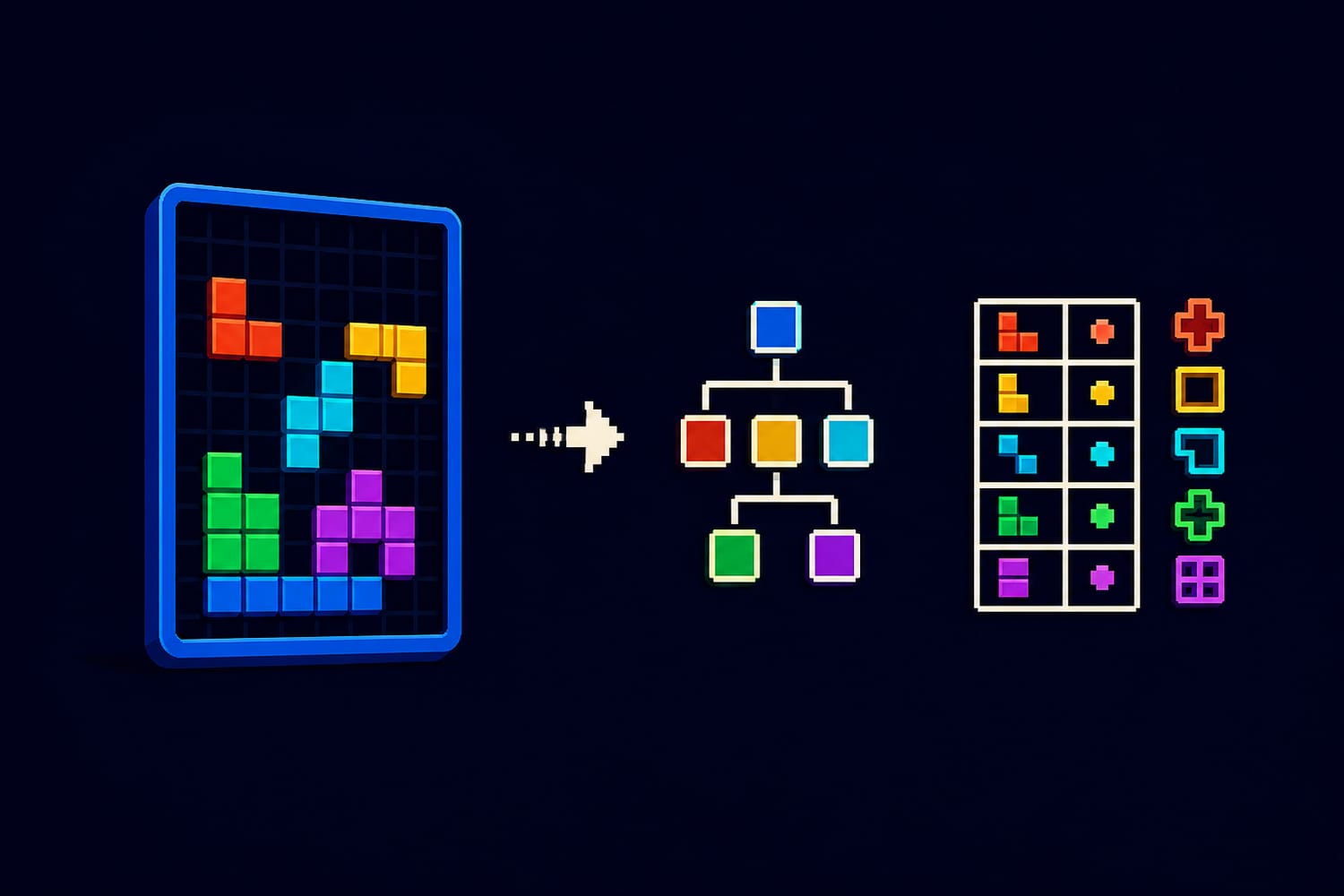
Change the Representation: How to Make Hard Puzzles Easier with Diagrams, Tables, and Symbols
When a Hard Puzzle Is Really a Hard Format
A difficult puzzle does not always contain difficult logic. Sometimes, the real problem is the way its information is presented. A dense paragraph can become a simple diagram, a confusing list can become an orderly table, and a long clue can shrink into a few useful symbols. Change the representation, and hidden relationships often become visible.
This strategy works because you no longer have to hold every clue in your head at once. Instead, you give the information a structure that can be scanned, compared, and updated. Research into thinking with external representations suggests that diagrams and other visible tools do more than support memory: they can also make relationships easier to examine and ideas easier to reorganize.
In other words, drawing a table is not avoiding the puzzle. Building the right representation is part of solving it.
Why Representation Matters
Every puzzle has two layers:
- The underlying problem: the rules, relationships, and constraints.
- The visible presentation: the words, pictures, numbers, or objects used to communicate them.
The underlying problem may be simple even when the presentation feels overwhelming. Consider this clue:
Noah arrived after Priya but before Elena, and Marcus did not arrive first.
That sentence contains several relationships. Written as symbols, it becomes:
Priya < Noah < Elena
Marcus ≠ first
The meaning has not changed, but the structure is now easier to see. You can immediately identify a three-person sequence and one excluded position.
External representations can also free working memory for reasoning. A National Academies discussion of learning and problem solving explains that storing information in diagrams can reduce how much information must be mentally maintained at one time. However, representations are most useful when the solver understands their conventions.
Use Diagrams for Space, Movement, and Connections
A diagram is usually the best choice when a puzzle involves locations, routes, shapes, physical relationships, or connected objects. It does not need to be artistic. A rough sketch with correctly placed labels is far more useful than a beautiful but inaccurate drawing.
Map Spatial Language
Suppose a puzzle says:
- The library is east of the fountain.
- The café is north of the library.
- The statue is west of the café.
- The fountain is south of the statue.
Instead of repeatedly interpreting “north,” “south,” “east,” and “west,” sketch the arrangement:
Statue ---- Café
   |          |
Fountain -- Library
The paragraph has become a visible square. You may now notice connections or possible routes that were difficult to detect in sentence form.
Draw a Network
Use circles or boxes connected by lines when the puzzle concerns relationships rather than exact positions:
Key A → Red Door → Clock Room
Key B → Garden Gate → Fountain
                  ↘ Hidden Lever
A network can clarify adventure puzzles, family-tree riddles, switch-and-door challenges, transport problems, and any mystery involving “this affects that.”
Mark What Is Blocked
A useful diagram should show impossibilities as well as possibilities:
- Solid line: confirmed connection
- Dotted line: possible connection
- Crossed line: impossible connection
- Arrow: direction or consequence
- Box: fixed object or location
Drawing is especially valuable when you construct the diagram yourself. Studies of problem-appropriate diagram instruction have found that the right kind of representation can improve performance and reduce the effort solvers feel a problem requires—but the representation must match the problem.
Use Tables for Matching and Comparison
Tables are ideal when a puzzle asks you to match members of different categories. Common examples include matching people to pets, suspects to locations, books to authors, racers to finishing positions, or events to times.
Imagine three friends—Ava, Ben, and Chloe—who each chose a different snack:
| Person | Apple | Cookie | Popcorn | |---|---:|---:|---:| | Ava | ? | ? | ? | | Ben | ? | ? | ? | | Chloe | ? | ? | ? |
Now apply two clues:
- Ben did not choose the cookie.
- Chloe chose the popcorn.
| Person | Apple | Cookie | Popcorn | |---|---:|---:|---:| | Ava | ? | ? | X | | Ben | ? | X | X | | Chloe | X | X | ✓ |
Once Chloe is confirmed for popcorn, popcorn can be eliminated from Ava and Ben. Ben cannot have the cookie, so he must have the apple. That leaves the cookie for Ava.
The table does not perform the deduction for you. It makes the consequences of each clue easy to see.
For more detailed grid methods, see Puzzles Arcade’s guide to reading clues and marking logic grids.
Use Symbols to Compress Repeated Ideas
Symbols are most helpful when a puzzle repeats the same kinds of facts. They shorten your notes and make important differences visible at a glance.
A simple symbol key might include:
✓= confirmedXor≠= impossible?= possible but unproven→= leads to or causes<= earlier, smaller, or before>= later, larger, or after== matches*= especially importantA/B= either A or B
Suppose a mystery puzzle gives these clues:
- Lina was not in the kitchen.
- Omar entered after Lina.
- The person in the study had the silver key.
- Lina was either in the garden or the study.
Your notes could become:
Lina ≠ kitchen
Lina < Omar
study = silver key
Lina = garden/study
This compact version is easier to scan when a later clue mentions the silver key or establishes Omar’s exact position.
Consistency matters more than sophistication. If X means “impossible” in one section, do not use it to mean “completed” somewhere else. If necessary, write a tiny legend at the top of the page.
You can find more ways to organize shorthand, candidates, and dead ends in The Puzzle Solver’s Scratchpad.
Match the Representation to the Puzzle
No single format is best for every challenge. Before drawing anything elaborate, ask what kind of information the puzzle contains.
| Puzzle feature | Useful representation | |---|---| | Positions, directions, or routes | Map or spatial diagram | | People matched with objects | Grid or table | | Earlier, later, taller, or smaller | Ordered list or number line | | Causes and consequences | Arrow diagram | | Several possible values | Candidate list | | Repeated logical statements | Symbols and shorthand | | Branching choices | Decision tree | | Overlapping groups | Circles or grouped lists | | Multi-step calculations | Equation chain or calculation table |
Some puzzles benefit from more than one representation. A scheduling puzzle might use a table for people and tasks, plus a timeline for arrival order. A maze could use a map and a short list of tested routes.
The goal is not to represent every detail. It is to represent the details that affect the solution.
A Five-Step Method for Changing the Representation
When you are stuck, use this repeatable process.
1. Identify the Information Types
Separate the puzzle into categories:
- Fixed facts
- Possibilities
- Impossibilities
- Sequences
- Quantities
- Locations
- Relationships
This prevents a confirmed fact from being mixed with a guess.
2. Choose the Simplest Suitable Format
Do not build a giant grid for three clues if a short list will work. Start small. You can always expand your notes later.
3. Create a Clear Key
Decide what your marks mean before using them. A basic ✓, X, and ? system is enough for many puzzles.
4. Transfer Every Important Clue
Translate clues one at a time. After transferring each clue, check that your diagram, table, or symbol statement means exactly the same thing as the original wording.
5. Look for New Consequences
Do not stop after recording information. Ask:
- Did a row or column fall to one remaining option?
- Does a sequence now have a fixed beginning or end?
- Did two separate clues connect?
- Has a candidate become impossible?
- Is there a contradiction?
This final step turns note-taking into deduction. It is closely related to constraint mapping: making the puzzle’s limits visible and updating them as you learn more.
Avoid Common Representation Mistakes
A representation should simplify the puzzle, not create a second puzzle. Watch for these common problems:
- Adding assumptions: If a clue says Mia arrived before Leo, do not place Mia first unless another clue proves it.
- Making the diagram too literal: Objects described as “close” do not necessarily need to touch.
- Using too many colors: Color can help, but every meaning should also have a symbol or label.
- Failing to update: Remove old candidates as soon as they become impossible.
- Overloading one page: If the representation becomes crowded, redraw a clean version containing only confirmed facts and active possibilities.
- Forgetting the original rules: A neat table is useless if it misrepresents the clue.
Accuracy always comes before neatness. A rough, truthful diagram is better than a polished, misleading one.
Make the Puzzle Easier to See
When a puzzle feels impossibly complicated, do not immediately search for a more brilliant answer. Search for a clearer way to display the information.
Turn space into a diagram, relationships into a table, sequences into a line, and repeated ideas into symbols. The puzzle may not change, but your view of it will—and that change can reveal the next safe step.
Great puzzle solving is not only about thinking harder. Often, it is about giving your thoughts a better shape.

