
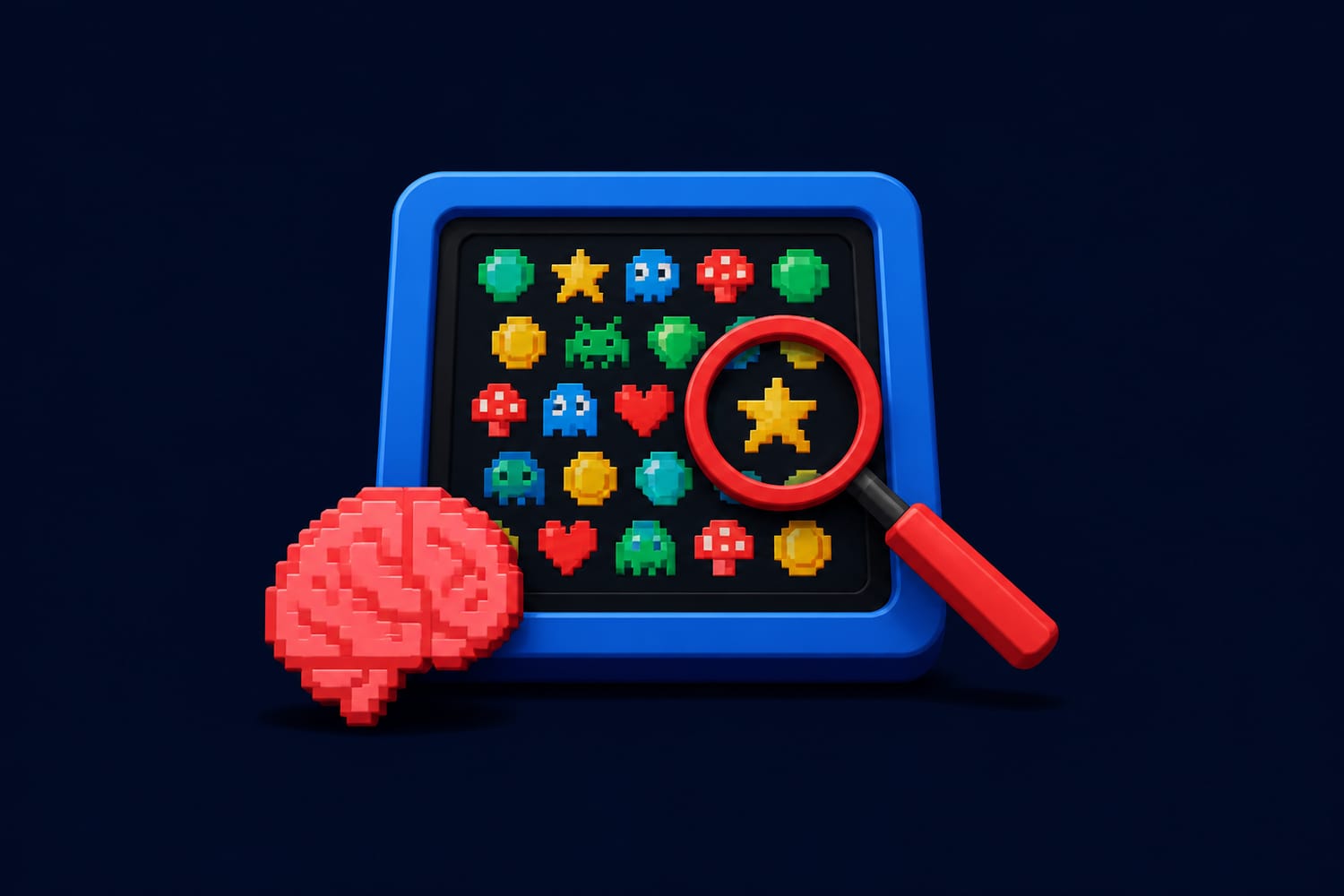
Hidden-Object Games and Visual Attention: How Search Puzzles Train Your Eyes and Brain
Why Hidden-Object Games Are More Than a Search for Tiny Clues
Hidden-object games exercise visual search: the everyday ability to locate something important among distracting information. By repeatedly comparing targets with busy scenes, players practice selective attention, eye-movement control, pattern recognition, and short-term memory. These games can sharpen puzzle-specific skills, although they do not improve eyesight or guarantee broad cognitive gains.
Whether you are hunting for a silver key in a crowded castle or spotting a toy hidden in a colorful bedroom, the basic challenge is the same: identify what matters while ignoring everything else. That process may feel effortless, but it involves close cooperation between your eyes and brain.
What Happens in Your Brain During a Visual Search?
Visual search is the act of looking for a target among other objects, often called distractors. Scientists use visual-search tasks to study how attention selects useful information from the enormous amount of detail around us.
In a hidden-object puzzle, your brain usually starts by creating a search template—a mental description of the target. If you need to find a blue teacup, for example, you may hold its color, shape, size, and possible orientation in mind.
Your attention is then guided by several kinds of information:
- Target features: You look for the correct color, outline, texture, or size.
- Visual salience: Bright, unusual, or high-contrast objects attract attention automatically.
- Scene meaning: You expect a teacup near a table or cupboard rather than floating in the sky.
- Search history: Recently examined objects and locations influence where you look next.
- Experience: Familiarity with puzzle design can help you predict common hiding tricks.
Research describes visual search as a guided process rather than a completely random scan. The brain combines your goal with noticeable features, previous searches, and knowledge about the scene to prioritize promising locations.
How Search Puzzles Exercise Visual Attention
Selective Attention Filters the Scene
Selective attention allows you to concentrate on relevant information while reducing the influence of distractions. A hidden-object picture may contain hundreds of shapes, colors, shadows, and decorative details, but only a few match your current target.
Imagine searching for a green feather in a garden scene. Leaves, grass, and vines share the target’s color, so “green” alone is not enough. You must combine color with shape, size, texture, and context. The closer the distractors resemble the target, the more carefully you must inspect the scene.
That is why crowded searches usually feel harder than finding a red circle among blue squares. A target that differs in one obvious way may seem to “pop out.” A target sharing several characteristics with nearby objects generally requires slower, more focused examination.
Sustained Attention Keeps You on Task
Some hidden objects appear immediately. Others remain invisible even though you have looked directly at their location several times. Continuing without clicking randomly requires sustained attention—the ability to stay engaged over time.
Search puzzles support this kind of practice by giving attention a clear purpose. Each discovery provides feedback and reduces the number of remaining possibilities. Readers interested in the wider role of puzzles may also explore how puzzle games strengthen attention in a distracted world.
Attention Shifting Helps You Escape Mental Ruts
Effective players alternate between broad scanning and close inspection. If one region produces no results, they shift to another area or reconsider the target’s appearance.
This flexibility matters because attention can become “stuck.” Once you expect an object to look or appear in a particular way, you may repeatedly check the same unhelpful locations. Learning how to avoid tunnel vision in puzzle solving can make searches both faster and less frustrating.
Your Eyes Are Moving More Than You Realize
Although the brain directs the search, your eyes gather the detailed information it needs. They generally alternate between two important actions:
- Saccades are rapid jumps from one location to another.
- Fixations are brief pauses during which visual information is examined more closely.
You do not normally experience the scene as a series of jumps and stops. Instead, the movements feel like one smooth search. During a difficult puzzle, however, inefficient eye movements may send you repeatedly across the same objects while leaving other areas underexplored.
A systematic scanning method can reduce this problem. Try moving from left to right in horizontal bands, dividing the picture into quarters, or examining the foreground, middle ground, and background separately. Structure is especially useful in scenes filled with repeated textures.
Other Skills Hidden-Object Games May Practice
Visual Working Memory
Working memory temporarily holds information that you are actively using. In a search puzzle, it helps you remember the target, track recently checked areas, and compare possible matches without constantly returning to the list.
A complex target places greater demands on working memory. “Find a star” is simple. “Find a small, five-pointed, gold star with a red center” requires several features to remain active at once.
Pattern and Shape Recognition
Hidden objects are often rotated, partly covered, resized, recolored, or blended into larger patterns. Recognizing them requires more than matching an exact picture. You must identify the object despite changes in its appearance.
This overlaps with visual-spatial reasoning, which helps people understand where objects are located and how shapes relate to one another. Similar processes appear when solving jigsaws, interpreting diagrams, packing a suitcase, or navigating a room. Learn more about how jigsaw puzzles support visual-spatial reasoning.
Inhibitory Control
A convincing distractor creates an impulse to click. Resisting that impulse and checking the details first involves inhibitory control—the ability to pause an automatic response.
Timed games make this particularly challenging. A fast player must balance speed with accuracy instead of treating every vaguely similar shape as the answer. Penalties for incorrect clicks encourage a useful pattern: notice, compare, verify, and then act.
Does Practice Transfer to Everyday Life?
Hidden-object games can clearly improve familiarity with hidden-object games. With practice, players may develop better scanning strategies, learn common concealment techniques, and become faster at identifying target features.
The more difficult question is whether those gains transfer broadly to unrelated activities. Research on attention training has produced mixed findings. People often improve most on the exercises they practice or on closely related tasks, while evidence for large improvements in general intelligence, school performance, or everyday attention is less consistent.
That does not make puzzle play pointless. It simply means claims should remain realistic. Hidden-object games provide enjoyable practice in observation, concentration, patience, and organized searching, but they are not medical treatment or a guaranteed shortcut to a “better brain.”
The healthiest reason to play is that the activity is fun, mentally engaging, and challenging enough to encourage effort.
A Better Strategy for Finding Difficult Objects
When a target seems impossible, use this step-by-step method:
- Build a clear target template. Identify the object’s defining features rather than relying only on its name.
- Scan the whole image quickly. Look for an obvious match before concentrating on details.
- Divide the scene into sections. Search each area systematically to avoid gaps and repetition.
- Check likely locations. Use the scene’s meaning, but remember that puzzle designers often break real-world expectations.
- Change your search feature. If color is unhelpful, search by outline, texture, or orientation.
- Look near visual boundaries. Objects are often concealed along furniture edges, shadows, curtains, branches, or picture frames.
- Take a short break. A fresh look can weaken an unhelpful expectation and reveal something you repeatedly overlooked.
This approach resembles the broader 3-pass method for solving puzzles efficiently: collect easy discoveries, use what you have learned, and then concentrate on the most difficult targets.
Keep Digital Search Sessions Comfortable
Digital hidden-object games do not damage eyesight simply because they make you look carefully. However, long periods of close screen use may contribute to temporary discomfort such as tired or dry eyes, headaches, or blurred vision.
The American Optometric Association recommends the 20-20-20 rule: after every 20 minutes of screen use, look at something about 20 feet away for at least 20 seconds. Its guidance on computer vision syndrome and digital eye strain also emphasizes appropriate viewing distance, screen position, lighting, and regular eye care.
Persistent pain, double vision, frequent headaches, or continuing blurred vision should not be treated as a gaming problem to “push through.” An optometrist or other qualified eye-care professional can check for uncorrected vision or eye-coordination issues.
Small Searches Can Create Meaningful Practice
Hidden-object games turn an ordinary human ability into a playful challenge. Every scene asks the eyes to explore and the brain to choose: What is important? What can be ignored? Where should attention move next?
Their benefits are best understood as practice rather than transformation. Search puzzles can exercise visual attention, working memory, pattern recognition, patience, and efficient scanning, especially when players use deliberate strategies instead of random clicking.
Most importantly, they make careful observation enjoyable. A hidden key, disguised feather, or perfectly camouflaged button offers a small reminder that looking and truly noticing are not always the same thing.

