
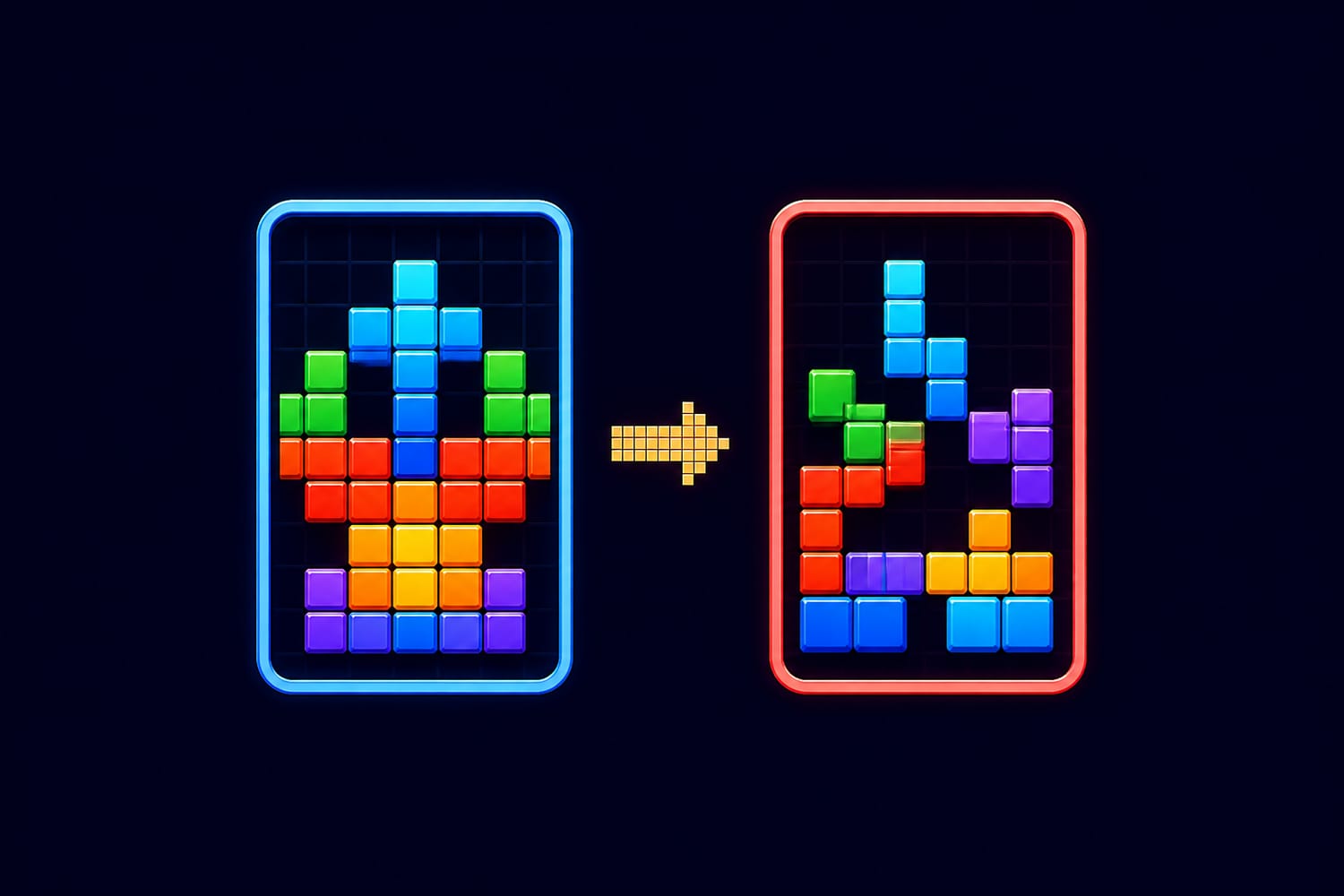
Why Symmetry Makes Puzzles Feel Right—and Why Designers Sometimes Break It
The Short Answer: Order Creates Trust, and Exceptions Create Interest
Symmetry makes puzzles feel “right” because the human visual system is remarkably good at finding order, balance, and repeated structure. A symmetrical design is easier to scan and understand, while a carefully placed break in that symmetry attracts attention, creates uncertainty, and often provides the clue or challenge that makes a puzzle memorable.
Puzzle designers use this contrast constantly. Symmetry establishes the rules of a visual world; asymmetry gives players something to investigate. The result is a satisfying conversation between expectation and surprise.
What Symmetry Actually Means
In everyday language, symmetry usually means that two sides match. In mathematics, the idea is broader: a design is symmetrical if it remains unchanged after a particular transformation.
The most common forms found in puzzles are:
- Reflectional symmetry: One side mirrors the other across a line.
- Rotational symmetry: The design matches itself after being turned around a central point.
- Translational symmetry: A pattern repeats after being shifted in a particular direction.
- Point symmetry: Each part has a matching part on the opposite side of a central point, equivalent to a 180-degree rotation.
A checkerboard contains repeating translation. A butterfly-shaped tile may have reflectional symmetry. A pinwheel can have rotational symmetry. A typical American crossword grid often uses 180-degree rotational symmetry in its pattern of black squares.
For an accessible visual introduction, this guide to reflectional, rotational, and point symmetry shows how each transformation works.
Why Our Eyes Like Balanced Patterns
Symmetrical objects are usually quick to organize mentally. Once you recognize that the left side mirrors the right, you no longer need to process every part as completely separate information. One region helps you predict another.
This fits with ideas studied in Gestalt psychology, which examines how people naturally group visual elements into meaningful wholes. Symmetry is one of several cues—alongside similarity, proximity, continuity, and closure—that can help a shape stand out as a complete figure rather than a collection of unrelated marks. A detailed review of Gestalt principles in visual perception discusses symmetry as one factor involved in perceptual grouping and figure-ground organization.
In practical puzzle terms, symmetry can provide:
- Clarity: The board looks organized rather than accidental.
- Predictability: Players can anticipate how pieces or clues may correspond.
- Visual hierarchy: The center, axes, and repeated regions become easier to identify.
- A sense of completion: Restoring a balanced form creates a clear visual finish.
- Reduced mental clutter: Repeated structures can be understood as a system instead of isolated details.
This does not mean everyone always prefers perfect symmetry, or that symmetry automatically produces a good puzzle. Color, contrast, complexity, meaning, and personal taste also influence what people notice and enjoy. Symmetry is powerful, but it is one tool among many.
Symmetry Is More Than Decoration
In a well-designed puzzle, symmetry often affects how the puzzle works—not merely how it looks.
Imagine a grid divided by a vertical line. If every marked square on the left must have a partner the same distance to the right, the player receives a logical rule. A single placed tile tells them something about two positions at once.
That makes symmetry a kind of information shortcut. The designer can give players fewer clues because the pattern itself supplies additional relationships.
This principle appears in many puzzle forms:
Crosswords
Many American-style crossword grids use 180-degree rotational symmetry in their black-square layouts. If a black square appears near the upper-left corner, a matching one appears near the lower-right corner.
The answers themselves do not become identical after rotation. It is the structural pattern of blocked and open cells that matches. This tradition gives the grid a deliberate appearance while also placing an extra constraint on the constructor.
However, symmetry is a convention rather than a universal law. Constructors sometimes abandon it when an unusual theme or layout needs a different shape, as explored in this discussion of why crossword setters sometimes reject symmetry.
Sudoku and Other Number Grids
Sudoku’s logical rules do not require the starting clues to be symmetrical. Still, many published puzzles arrange their given numbers in a rotationally or reflectionally balanced pattern because it makes the opening grid look polished.
The symmetry belongs to the presentation, not necessarily to the solution. Designers must still make sure the clues produce the intended solving experience, whether the starting arrangement is symmetrical or not.
Tile and Spatial Puzzles
In matching, folding, mosaic, and shape-placement puzzles, symmetry may become the main mechanic. Players might complete a mirror image, rotate pieces into equivalent positions, or restore a broken pattern.
These challenges draw directly on geometry. As explained in Puzzles Arcade’s guide to the hidden math behind puzzle games, shapes and transformations often influence both the rules and the strategies available to players.
How Symmetry Quietly Teaches the Player
Symmetry is also a teaching tool. A repeated layout suggests that repeated actions may have repeated effects.
Suppose an early level contains two matching rooms, each with one switch and one door. Even without written instructions, the design encourages the player to compare the rooms. If pressing the switch opens the nearby door, the matching layout helps communicate that relationship.
This is part of what makes an invisible tutorial effective. Designers arrange objects so players discover rules through observation and experimentation rather than lengthy explanations.
Symmetry can signal:
- These objects belong to the same system.
- These positions have comparable roles.
- An action performed here may have a related effect there.
- A missing element may need to match an existing one.
- The center or axis may be especially important.
Because the structure feels orderly, beginners can form useful guesses without already knowing formal geometry.
Why Designers Deliberately Break Symmetry
If symmetry is so useful, why disturb it? Because perfect repetition can become predictable. Once players understand the mirror rule, they may be able to complete the rest of a challenge without making any new deductions.
A break in symmetry restores uncertainty. It creates a visual question: Why is this part different?
Designers commonly use asymmetry for several reasons.
To Direct Attention
A single red tile in an otherwise balanced blue pattern is difficult to ignore. The unusual element becomes a focal point and may indicate a mistake, destination, switch, hazard, or clue.
To Create a Unique Solution
Perfectly symmetrical starting conditions can sometimes produce equivalent choices. If moving left works exactly like moving right, the puzzle may have two mirrored solutions.
A designer can remove that ambiguity by shifting one wall, changing one clue, or placing one obstacle off-center. The difference may be tiny, but it forces the player to distinguish between options.
To Increase Difficulty
When most of a board follows a pattern, players naturally begin relying on that pattern. Breaking it later tests whether they are still examining the evidence or merely repeating a familiar strategy.
This is usually fairest after the regular rule has been clearly established. The player should first learn what “normal” looks like. Only then does the exception become meaningful.
To Support Theme and Story
Asymmetry can communicate damage, movement, conflict, or change. A perfectly balanced temple may suggest stability; one fallen pillar immediately suggests age or disruption. A mechanical puzzle with one mismatched gear can make the problem visible before the player understands how to fix it.
To Give the Design Character
Absolute symmetry can feel calm and formal, but it can also feel static. Small irregularities add energy and personality. The goal is often not to choose between order and disorder, but to find the right balance between them.
The Exception Must Feel Fair
A broken pattern is satisfying only when players can understand its purpose. If an exception exists merely to hide information, it may feel arbitrary. If it is visible, logically connected to the rules, and useful to the solution, it can produce a powerful discovery.
That discovery often becomes the puzzle’s central “Aha!” moment: the instant when a strange detail stops looking like an error and starts looking like the answer.
Good symmetry breaking generally follows three principles:
- Establish the pattern clearly.
- Make the exception noticeable or discoverable.
- Give the exception a logical consequence.
For example, imagine ten symbols arranged in five matching pairs. One pair is reversed. If that reversal tells the player which button to press, the asymmetry is meaningful. If it has no connection to anything else, it is simply visual noise.
A Simple Way to Read Symmetry in Any Puzzle
The next time you face a visual or spatial puzzle, try this quick inspection:
- Find the boundaries. Is the puzzle square, circular, rectangular, or irregular?
- Look for an axis or center. Could the design be mirrored or rotated?
- Identify repetitions. Which shapes, colors, numbers, or spaces appear more than once?
- Compare matching regions. Do corresponding areas behave in the same way?
- Mark the exceptions. What fails to match, and could that difference be intentional?
- Test the rule. Use one repeated relationship to predict another part of the puzzle.
This method will not solve every challenge automatically, but it separates structure from decoration. That is often the first step toward understanding what a designer wants you to notice.
The Satisfying Dance Between Order and Surprise
Symmetry makes puzzles readable, elegant, and trustworthy. It gives players patterns to recognize and rules to test. Breaking symmetry adds tension, directs attention, and prevents those patterns from becoming automatic.
The most memorable designs often use both. They present enough order for the player to feel grounded, then introduce one carefully chosen difference that invites a closer look.
That is why a great puzzle can feel balanced without being boring and surprising without being chaotic. Symmetry tells us how the world of the puzzle is supposed to work. Asymmetry asks us to discover what happened—and what to do next.

