
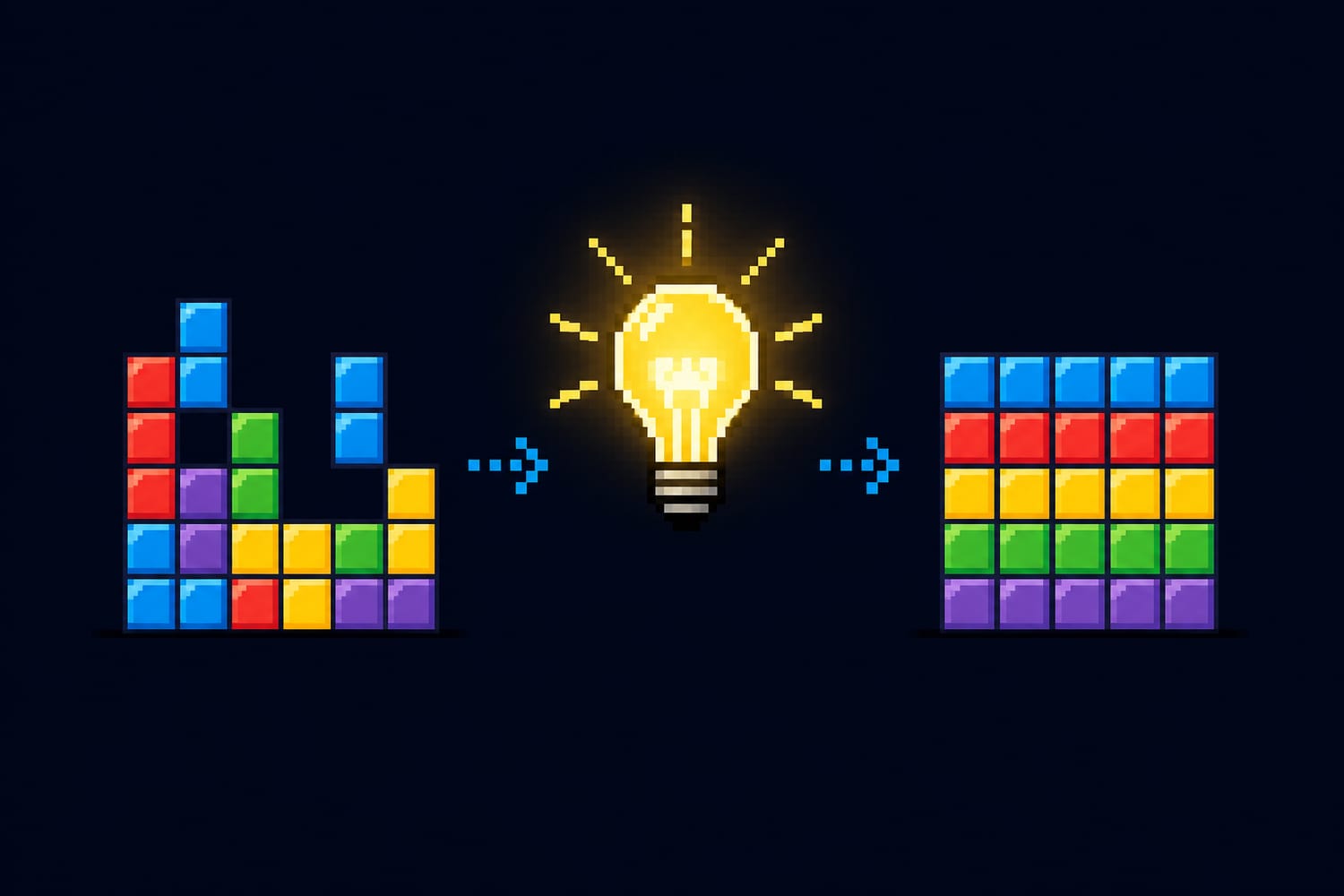
The Aha! Moment: How Puzzle Designers Create That Sudden Flash of Insight
The Tiny Lightning Bolt in Your Brain
Every puzzle fan knows the feeling. You stare at a grid, a riddle, a locked-door clue, or a strange pattern. Nothing seems to work. You try the obvious answers. You try the silly answers. You consider giving up. Then, suddenly, something clicks.
Of course! The number was a date. The empty spaces mattered. The “wrong” object was actually a hint. The rule was hiding in plain sight.
That sudden flash of understanding is often called the “Aha!” moment. Psychologists sometimes describe it as an insight experience: a shift in how you see a problem that makes the solution feel clear, surprising, and satisfying. In puzzle games, the Aha! moment is one of the most powerful rewards a designer can create. It is not just about finishing a level. It is about feeling your mind reorganize the pieces and discover something new.
Puzzle designers do not create insight by accident. Behind a great “Aha!” is careful structure, fair clueing, player psychology, testing, and a deep respect for curiosity. Whether the puzzle is a crossword clue, a sokoban-style box-pushing level, an escape room, a hidden object challenge, or a logic grid, the designer’s goal is often the same: guide the player toward discovery without simply handing them the answer.
What Makes an Aha! Moment Feel So Good?
An Aha! moment is enjoyable because it combines surprise with certainty. Before the insight, the puzzle feels confusing or incomplete. After the insight, the answer feels obvious—almost as if it had been there all along.
That “it was obvious in hindsight” feeling is important. A fair puzzle solution should not feel random. When players solve it, they should be able to look back and say, “Yes, the clues were there.” The twist may be unexpected, but it should still be logical.
Several ingredients help create this feeling:
- A clear goal: The player knows what they are trying to accomplish.
- A gap in understanding: Something does not quite make sense yet.
- Useful clues: Information in the puzzle points toward the solution.
- A shift in perspective: The player realizes they were looking at the problem the wrong way.
- Confirmation: The solution works, proving the insight was correct.
This combination turns confusion into delight. The player does not merely receive an answer; they earn it.
The Art of Fair Misdirection
Puzzle designers often use misdirection, but good misdirection is not the same as trickery. A trick makes the player feel cheated. Fair misdirection makes the player feel impressed.
For example, imagine a puzzle where four statues point in different directions. A player may first assume the statues indicate compass directions. But perhaps the important detail is not where the statues point—it is what each statue is holding. If the puzzle provides subtle clues that objects matter, the final realization can feel exciting rather than unfair.
Fair misdirection works because it encourages a natural assumption, then gives the player enough information to question that assumption. The designer is not hiding the truth in a completely invisible place. Instead, they are placing the truth slightly outside the player’s first interpretation.
This is why many memorable puzzles involve changing the meaning of familiar things:
- Letters may be treated as shapes.
- Numbers may represent positions, dates, colors, or sounds.
- Empty spaces may be more important than filled spaces.
- A map may be read upside down.
- A repeated phrase may be a rhythm instead of a sentence.
- A visual clue may need to be interpreted as a word.
The trick is to make the “wrong” interpretation understandable and the correct interpretation discoverable. If players never had a reasonable path to the answer, the Aha! moment collapses into frustration.
Clues, Hints, and the Invisible Hand of Design
Great puzzle design often feels invisible. Players may think they solved a puzzle entirely on their own—and in an important sense, they did. But the designer has usually built a path of clues that gently leads them there.
A clue does not always need to be obvious. Sometimes it is a repeated color, a strange word choice, an oddly placed object, or a pattern that appears in multiple places. Designers use these details to create a trail of meaning.
There are usually different types of clues in a puzzle:
- Direct clues: Information that clearly points to an action or answer.
- Indirect clues: Details that become useful only after the player understands the puzzle’s logic.
- Confirming clues: Evidence that tells the player they are on the right track.
- Red herrings: Distracting details, which should be used carefully and sparingly.
Good puzzle designers often avoid relying too heavily on red herrings. Too many false leads can make a puzzle feel noisy and unfair. Instead, they prefer meaningful ambiguity: details that can be interpreted in more than one way until the key insight resolves them.
This is especially important in digital puzzle games, where players may interact with dozens of objects. If everything looks equally important, nothing feels important. Strong visual design, sound cues, level layout, and repeated symbols can all help guide attention without spoiling the answer.
The Balance Between Challenge and Frustration
A puzzle that is too easy may be pleasant, but it may not create a strong Aha! moment. A puzzle that is too hard may become discouraging. Designers aim for the sweet spot between the two.
This balance depends on the audience. A children’s puzzle, a daily word game, a hardcore logic challenge, and an expert-level escape room should not demand the same skills. But all good puzzles share a respect for the player’s time and effort.
One useful idea is the “challenge ladder.” Designers often teach players a concept in a simple form, then gradually build on it. A game may introduce a mechanic in a safe, obvious situation, then combine it with other mechanics later. By the time the player faces the hardest version, they have learned the language of the puzzle.
For example, a block-pushing puzzle might begin with moving one crate onto one button. Later, it may introduce multiple crates, traps, one-way paths, or timing. The best levels make players feel clever because they use skills the game has quietly taught them.
Why “Thinking Differently” Is Often the Key
Many insight puzzles require what psychologists call restructuring: changing the way a problem is mentally represented. In simpler terms, you stop seeing the puzzle in one way and start seeing it in another.
Consider a classic riddle-style situation: you are trying to connect clues by their literal meanings, but the solution depends on their first letters. Or you are counting visible objects, but the answer depends on what is missing. The difficulty comes from being locked into the first approach.
Designers create these moments by encouraging one mental model, then rewarding players who notice its limits. This is why fresh eyes can help so much. When you take a break, your brain may stop repeating the same failed strategy and become more open to a different one.
Aha! moments often emerge from questions like:
- What if I read this backward?
- What if the colors are more important than the shapes?
- What if the order matters?
- What if the title is a clue?
- What if I am supposed to ignore the obvious object?
- What if the pattern is based on sound, not appearance?
These questions do not guarantee a solution, but they widen the search space. Designers know this, and many puzzles are built to reward players who examine assumptions.
The Role of Theme and Story
A puzzle does not exist only as a mechanical problem. Theme and story can make insight more memorable.
In an ancient temple puzzle, arranging symbols may feel like uncovering a lost ritual. In a detective game, matching timelines may feel like catching a suspect in a lie. In a science-fiction puzzle, redirecting lasers may feel like repairing a spaceship. The underlying logic matters, but the theme gives the solution emotional flavor.
Good puzzle themes also help players understand what kinds of actions make sense. If a room is designed like a music studio, players may naturally pay attention to sound, rhythm, instruments, and recording equipment. If a puzzle is set in a greenhouse, they may think about growth, sunlight, water, and seasons.
The best themes do not merely decorate a puzzle; they support its logic. A clock-themed puzzle about time, sequence, and rotation feels more satisfying than a clock-themed puzzle whose answer is an unrelated random number. When theme and mechanism work together, the Aha! moment feels natural within the world of the game.
Testing: Where Good Puzzles Become Great
Puzzle designers may have a clear solution in mind, but players are wonderfully unpredictable. They click unexpected objects, interpret clues differently, miss details the designer thought were obvious, and find alternate solutions that were never intended.
That is why playtesting is essential.
During testing, designers watch real players attempt the puzzle. They look for important signals:
- Do players understand the goal?
- Do they notice the necessary clues?
- Are they stuck for the right reason?
- Are they making reasonable but incorrect assumptions?
- Does the solution feel satisfying once found?
- Are there unintended shortcuts or ambiguous answers?
A player getting stuck is not always a problem. Some struggle is part of puzzle-solving. But if many players are stuck in the same unproductive way, the puzzle may need clearer clueing. If players solve it without understanding why, the puzzle may need stronger confirmation. If the answer feels arbitrary, the logic may need to be revised.
Testing helps designers tune the distance between confusion and clarity. The Aha! moment should feel like a leap—but not a leap across a canyon with no bridge.
The Different Flavors of Aha!
Not all Aha! moments are the same. Different puzzle genres create insight in different ways.
In word puzzles, the Aha! may come from a pun, double meaning, hidden phrase, or clever definition. A crossword clue can mislead with grammar, making a word seem like a noun when it is actually a verb.
In logic puzzles, the insight may come from realizing one condition eliminates several possibilities at once. The pleasure comes from deduction clicking into place.
In spatial puzzles, such as maze or block puzzles, the Aha! may be seeing a route, arrangement, or sequence of moves that was not obvious before.
In pattern puzzles, the key may be discovering the rule behind a sequence of numbers, shapes, colors, or sounds.
In escape-room-style puzzles, the Aha! often comes from connecting separate clues found in different places. A symbol on a painting, a number on a receipt, and a lock on a box may suddenly become one complete idea.
Despite their differences, these puzzle types share one principle: the player must have enough information to form the insight themselves.
How to Become Better at Finding the Flash
Although Aha! moments can feel magical, puzzle-solving is a skill that improves with practice. Experienced solvers build a mental toolbox of strategies. They learn to check assumptions, look for patterns, identify clue types, and recognize common puzzle structures.
Here are a few helpful habits:
- Take inventory: List what you know, what you have, and what still seems unused.
- Look for repetition: Repeated colors, numbers, words, or symbols are rarely accidental.
- Change perspective: Rotate, reverse, reorder, or group information differently.
- Use the title: Puzzle titles often contain subtle hints.
- Separate data from interpretation: Ask, “What is actually shown?” before deciding what it means.
- Take breaks: A short pause can reset your thinking.
- Explain your reasoning: Teaching the puzzle to someone else may reveal gaps or new connections.
Most importantly, stay playful. Puzzles are invitations to explore. Even wrong guesses can teach you something about the puzzle’s boundaries.
The Joy of Being Guided Without Being Told
The greatest Aha! moments feel personal. A designer may have built the path, placed the clues, removed distractions, tested the difficulty, and polished the presentation—but the final step belongs to the player.
That is the special magic of puzzle design. Unlike a movie twist, which is revealed to you, a puzzle twist is discovered by you. The designer and player are partners in a quiet conversation. The designer asks, “What if you looked at it this way?” The player answers, “Wait… I see it now.”
At Puzzles Arcade, behind every clever challenge is this beautiful goal: to create a moment where confusion turns into understanding and effort turns into delight. The Aha! moment is more than a solution. It is a reminder that your brain is capable of surprise, creativity, and discovery.
And that is why, after every satisfying flash of insight, we keep coming back for the next puzzle.

