
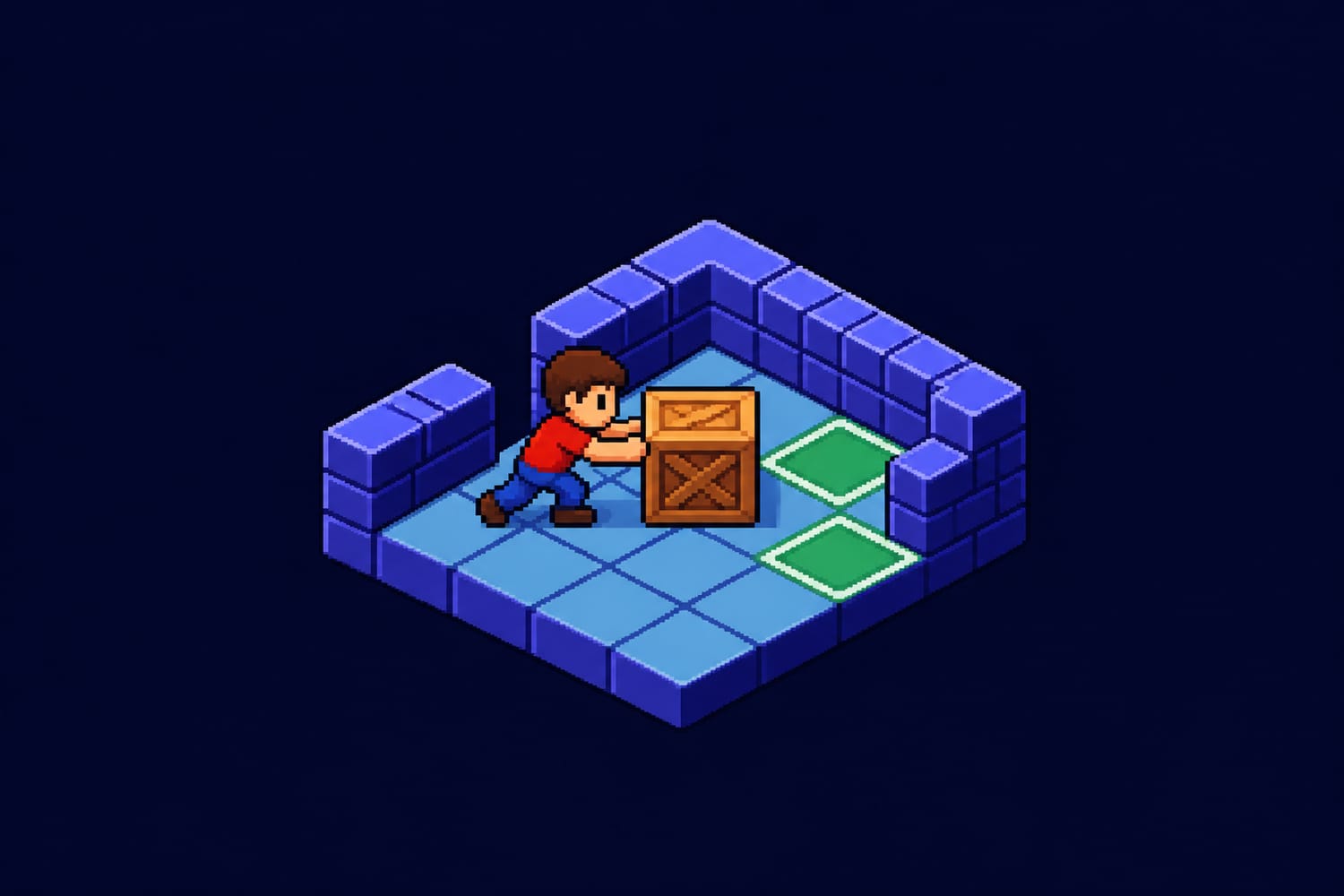
Why Pushing Boxes Is Harder Than It Looks: The Puzzle Design of Sokoban
Why Pushing Boxes Is Harder Than It Looks
Sokoban is difficult because moving a box changes more than its position: it changes which routes remain open and which pushes are still possible. You can push boxes but cannot pull them, so an innocent-looking move can make the entire puzzle impossible to finish. Success depends on planning access, space, and order.
At first glance, it looks like tidying up. A warehouse keeper, a few boxes, some marked destinations—how complicated could that be?
The surprise is that Sokoban turns this modest arrangement into a lesson in consequences. Its most interesting question is not “Can I move this box?” but “What will moving this box prevent me from doing later?”
A Tiny Rulebook With Enormous Consequences
The basic rules of Sokoban are easy to understand:
- Move the keeper up, down, left, or right through unoccupied floor squares.
- Push one box at a time into an empty square.
- Never pull a box or push a chain of boxes.
- Finish by placing every box on a marked goal.
That short list establishes the game’s central tension: the keeper can walk back along an open path, but a box cannot necessarily return the way it came.
Imagine pushing a box north. Reversing that push requires reaching the square north of the box and pushing it south. If a wall occupies that square, the apparent “one-step mistake” has no ordinary reversal.
From a design perspective, this makes pushing a commitment rather than simple movement. Walking gets you into position; pushing changes the problem.
The Real Puzzle Is Where You Can Stand
A box needs more than a clear route to its destination. For every push, the keeper must reach the square directly behind it. That requirement makes the keeper’s accessible space just as important as the boxes’ positions.
Suppose a box needs to move right, then upward. The first push requires standing to its left. The upward push requires standing below its new position. A route that looks perfectly clear for the box may still fail because you cannot reach that second pushing position.
This is why thinking of Sokoban as a delivery puzzle is incomplete. You are planning two connected journeys: the box’s route and your own route around it.
Deadlocks: When Legal Moves Lose the Puzzle
A deadlock is a position from which the level can no longer be solved. Crucially, the move that creates it may be completely legal. The game allows the push; the geometry makes its consequences disastrous.
The JSoko guide to deadlocks illustrates several ways this happens:
- A non-goal corner: A box pushed into an ordinary floor corner cannot be pushed out.
- An unrecoverable wall position: A box may still slide along a wall yet have no possible route to a goal.
- A frozen group: Boxes and walls can combine to immobilize a box that still needs moving.
- Lost access: A box can cut the keeper off from a region needed to finish the level.
The subtle lesson is that “still movable” does not mean “still useful.” A box might have several legal pushes remaining, none of which lead toward a complete solution.
Even a box sitting correctly on a goal can obstruct another box’s journey. A successful-looking placement is not necessarily safe to leave alone.
Why Getting Closer Can Mean Getting Further Away
Consider an imaginary warehouse with two goals in a narrow, single-entrance storage lane. One goal lies near the entrance; the other lies deeper inside.
The tempting move is to fill the nearer goal immediately. But if that box blocks the lane, the second box cannot reach the deeper goal. The sensible plan is to fill the far goal first.
Nothing about the rules has changed. What changes is your understanding of order.
Now imagine that the first box must temporarily move away from both goals so the keeper can pass behind the second box. The winning move looks like lost progress.
These examples expose a poor measure of success: the number of boxes currently touching goals. A more useful question is, “Does this arrangement preserve the moves I still need?”
How Designers Turn Empty Floor Into a Challenge
In Sokoban, empty floor is working space. It gives the keeper somewhere to stand, allows routes around boxes, and provides temporary parking. Removing a single useful square can eliminate one of those possibilities.
Consider a room with a side alcove large enough to hold a box. If the box can later be recovered, that alcove becomes a valuable parking space. Make the alcove a non-goal corner, however, and the apparent convenience becomes a trap.
This is the design power explored in Puzzles Arcade’s article on why small puzzle boards create big decisions: limited space makes pieces compete for positions and routes.
For a designer, the useful question is not simply “How many boxes should I add?” It is “Which actions should depend on other actions?”
A compact level might revolve around one relationship: move box A aside so box B can pass, then recover A without sealing the exit. That dependency can produce a satisfying challenge without a sprawling warehouse.
Building an “Aha!” Moment
One way to design a Sokoban puzzle is to begin with a specific discovery the player should make.
For example: the obvious destination must stay empty until the end.
A designer can build around that idea:
- Put a goal on a route needed by another box.
- Make filling that goal look immediately attractive.
- Provide somewhere safe to park the first box instead.
- Ensure the remaining boxes can pass.
- Check that the parked box can still reach its goal afterward.
This is a design exercise, not a guarantee of an enjoyable level. The arrangement still needs testing for accidental shortcuts, unnecessary chores, and unintended deadlocks.
Most importantly, the designer must establish that the starting position actually has a solution. Puzzles Arcade’s guide to how designers prove a level is solvable explains why that verification is separate from deciding whether a puzzle is fun.
For an approachable learning sequence, introduce the parking-space idea clearly before combining it with several competing routes. That gives players a concept to recognize rather than a pile of complications to guess through—a principle explored further in how puzzle difficulty can rise without feeling unfair.
Why Computers Have to Think Carefully, Too
Sokoban has also served as a research problem in artificial intelligence. A computer can explore possible actions, but exploring an undetected deadlock wastes effort on a position with no solution. Researchers have therefore developed methods that recognize deadlocks and plan at a higher level.
In University of Alberta research on planning in Sokoban, a warehouse is broken into rooms and connecting tunnels. Instead of treating every step as an equally important decision, the system reasons about moving boxes between those larger regions.
There is a useful human analogy here. “Move this box into the next room while keeping the doorway usable” is a more manageable plan than trying to memorize a long string of directional moves.
A Better Way to Approach Your Next Warehouse
Before making your first push, give the board a short inspection:
- Spot obvious traps. Which non-goal corners must never receive a box?
- Inspect the goals. Could filling one block access to another?
- Find working space. Where could a box wait and still be recovered?
- Check pushing positions. Can you reach the required side of each box?
- Choose a small objective. Try opening a route rather than solving everything at once.
Sokoban’s elegance lies in how much meaning it gives a single push. The rules stay simple, but your interpretation deepens: a corridor becomes a scheduling problem, an empty square becomes valuable workspace, and a box on a goal may still be unfinished business.
The boxes are not the only things you are arranging. You are arranging the possibilities that remain.

