
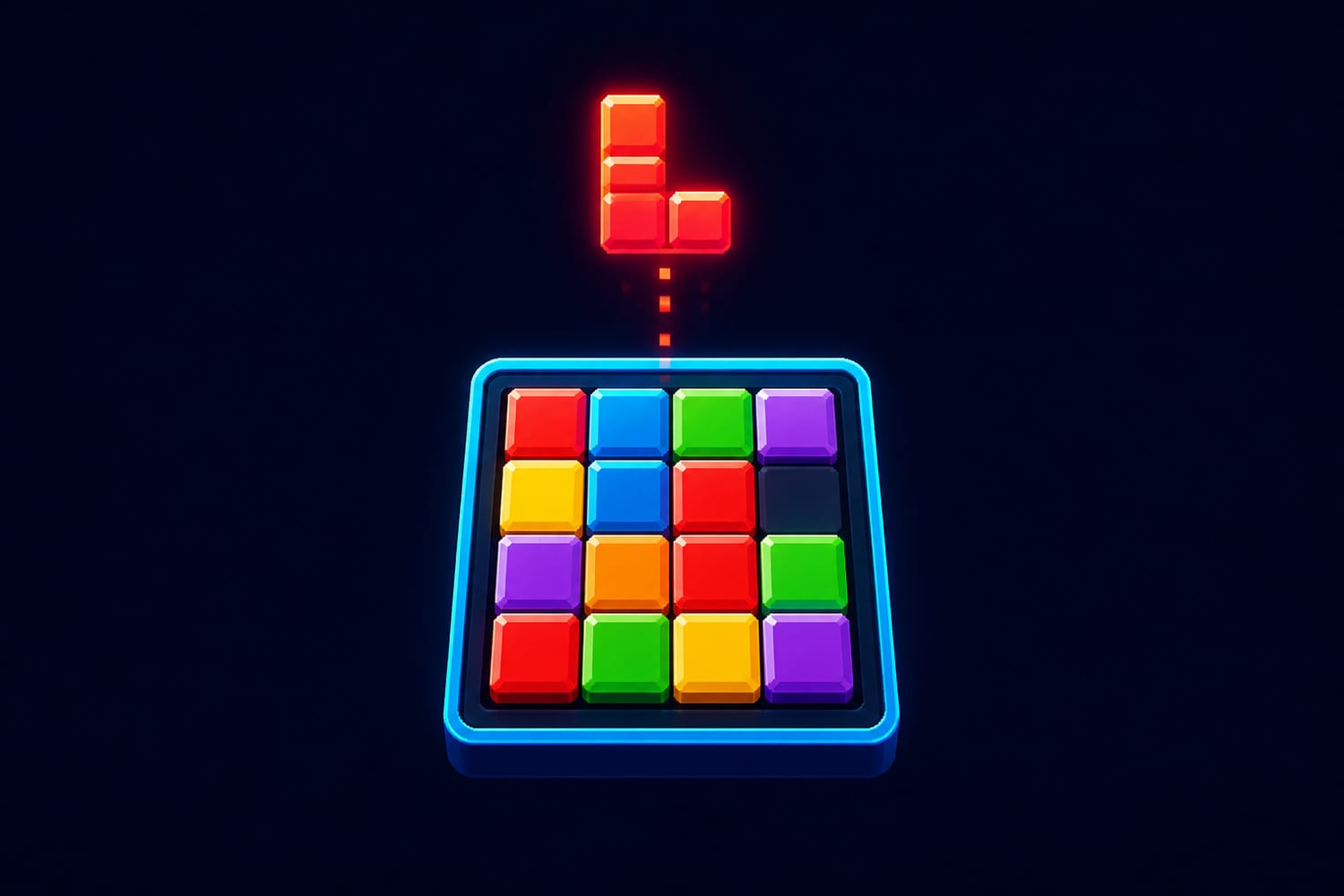
Why Small Puzzle Boards Create Big Decisions: The Design Power of Limited Space
Small puzzle boards create big decisions because limited space makes every position matter. When pieces compete for the same few cells, one move can open a route, block a future action, or reshape the entire problem. The board may be easy to understand at a glance, yet difficult to master several moves ahead.
Less Space Means More Consequence
A large board often gives players room to recover. There may be several routes, unused corners, or open spaces where pieces can wait. A small puzzle board removes much of that flexibility.
This does not mean every tiny board is automatically deep. Tic-tac-toe uses only nine cells, but experienced players can learn its main patterns quickly. Limited space becomes powerful when it is combined with rules that create interaction, commitment, competition, or uncertainty.
Imagine a puzzle with one empty square and three movable blocks. If the board is spacious, moving the wrong block may cause only a short delay. If every square is occupied or strategically important, the same move might trap a block, seal a corridor, or force several corrective moves.
That is the central design power of limited space: actions become connected. A move rarely affects only the piece being moved. It also changes what can occupy the vacated space, which routes remain open, and what will be possible later.
A Small Board Is Easy to Read but Hard to Predict
Good puzzle designs often separate visual simplicity from strategic simplicity. A board can contain only a handful of pieces and still generate a complicated chain of possibilities.
This happens because players must think on several levels:
- Immediate effect: What changes right now?
- Access: Which spaces or objects become reachable?
- Mobility: Will important pieces still be able to move?
- Order: Does this action need to happen before another?
- Recovery: Can the move be reversed if the plan fails?
- End state: Does the position help create the final solution?
The board remains readable because the number of objects is small. The difficulty comes from relationships among those objects. A block may be useful not because of what it is, but because of where it stands, what it prevents, and what could replace it.
This is one reason constraints are so important in games. Harvard’s overview of games and learning through constrained moves explains how games let players experiment with strategies and observe how decisions influence later outcomes. A compact board makes those relationships especially visible.
Empty Space Becomes a Resource
Players naturally pay attention to tiles, blocks, numbers, and other visible pieces. On a small board, however, the empty cells may be just as important.
Consider a sliding puzzle. The blank position is not merely a missing tile; it is the space that allows every other tile to move. To shift one numbered piece into place, the player may first need to guide the empty cell around the board. That means solving the puzzle involves managing both the tiles and the absence between them.
The classic 15 puzzle demonstrates how much structure can fit inside a 4-by-4 frame. It contains 15 sliding tiles and one empty position, yet not every scrambled arrangement can be solved. The reachability of a position depends on mathematical properties of the tile order and the blank square. Wolfram MathWorld’s explanation of the 15 puzzle describes the parity rule that separates reachable arrangements from impossible ones.
Empty space plays other roles in different puzzles:
- In block-pushing games, it provides room to stand behind an object.
- In tile-placement games, it preserves options for future shapes.
- In match puzzles, it may create a route for new pieces to fall.
- In path puzzles, it separates routes or allows them to turn.
- In packing puzzles, it determines whether remaining pieces can fit.
Designers can therefore make a board harder without adding more objects. They can simply reduce the amount of useful breathing room.
Bottlenecks Turn Movement Into Planning
A bottleneck is a narrow space through which pieces, paths, or players must pass. On a limited board, even one bottleneck can organize the entire puzzle.
Suppose two blocks must travel through the same one-cell-wide passage. The player may need to decide which block goes first. If the first block cannot move out of the way at the other end, the second may become permanently trapped.
This creates an ordering problem. The individual moves may be easy, but their sequence is not. The puzzle asks the player to recognize that a future need must influence a present action.
Bottlenecks also create valuable questions:
- What must pass through this area?
- In what order must the pieces pass?
- Where can each piece wait safely?
- Can the passage be reopened?
- Does entering the area prevent the player from leaving it?
These questions encourage players to plan with purpose rather than move pieces randomly.
Reversible and Irreversible Moves Feel Different
Limited space gives designers control over how strongly a move commits the player.
A reversible move allows experimentation. If a tile slides left, perhaps it can slide right again. An irreversible move closes an option: a crate enters a corner, a bridge collapses, a space fills permanently, or a one-way door locks behind the player.
Irreversible moves create tension because they divide the puzzle into “before” and “after.” The player is encouraged to pause, inspect the board, and predict the consequences. Used carefully, this makes a solution satisfying. Used carelessly, it can make a level feel unfair.
Strong puzzle design communicates dangerous commitments through consistent rules, clear layouts, or easy recovery tools. Quick resets and undo systems can preserve the importance of planning without forcing players to repeat work they already understand. Puzzles Arcade’s guide to how designers prove puzzle levels are solvable explores how creators test reachable states, dead ends, and unintended solutions.
The goal is not to punish every mistake. It is to ensure that moves carry understandable meaning.
Simple Rules Can Produce Enormous Possibility Spaces
Board size is only one part of complexity. The rules governing the board determine how many positions and plans can emerge.
Chess takes place on an 8-by-8 board, but its pieces have different movement patterns, captures change the position, and two players continually respond to each other. These interacting rules produce a vast game tree despite the board’s familiar 64-square boundary. Estimates summarized by the Chess Programming Wiki illustrate how quickly possible positions and move sequences multiply.
Puzzle games can create a similar effect on even smaller grids by combining a few mechanics:
- Pieces that move differently
- Objects that block one another
- Goals that must be completed in order
- New tiles that appear after a move
- Colors or numbers that merge under certain conditions
- Hazards that activate when positions change
- Limited moves, time, or storage spaces
A 4-by-4 board has only 16 cells, but each cell may have several possible conditions. More importantly, every action can lead to another set of choices. Complexity grows through sequences, not simply through square count.
This is also why adding a larger board does not always improve a puzzle. Extra room can weaken decisions by creating too many safe or equivalent options.
Limited Space Encourages Efficiency
When space is plentiful, several plans may work. When it is scarce, players must often search for a plan that uses each square efficiently.
This can turn positioning into a kind of budget. A player may need:
- One cell for the goal piece
- One cell for temporary storage
- One cell for turning or changing direction
- A clear route for another object
- Enough room to stand in the correct pushing position
If any one of those spaces is occupied too early, the plan may fail. The challenge is not just reaching the destination but preserving the conditions required to reach it.
Space restrictions often work alongside move limits. Both transform harmless actions into costs that must be considered. The Puzzles Arcade article on how move scarcity creates strategy explains why a small allowance of moves encourages comparison, prediction, and efficient planning.
Small Boards Help Designers Teach Clearly
Compact boards are useful not only for creating difficulty but also for teaching rules.
When a new mechanic appears on a small board, the player can see its effects without being distracted by dozens of unrelated elements. A designer might introduce one movable block, one target, and one obstacle. After the player understands that relationship, later puzzles can rearrange the same elements into more demanding combinations.
This supports a gradual difficulty curve:
- Introduce a rule with plenty of safe space.
- Let the player practice moving and reversing pieces.
- Remove one convenient route.
- Add a bottleneck or competing goal.
- Require several familiar ideas in a precise order.
The board does not need to become larger at every stage. It can become tighter. Puzzles Arcade’s look at how puzzle games increase difficulty without feeling unfair explains how designers build challenge by combining familiar rules, lengthening reasoning chains, and tightening resources.
Why Compact Puzzles Feel So Satisfying
Small puzzle boards make solutions visible. Once the key idea is discovered, players can often see how every piece, wall, and empty square contributed to the answer.
That clarity produces a special kind of satisfaction. A large, complicated board may be conquered through gradual progress, but a compact puzzle can suddenly transform from an impossible knot into an elegant system. The board has not changed—only the player’s understanding has.
The best small boards do not feel cramped by accident. Their boundaries focus attention, strengthen consequences, and make every useful square part of the design. They prove that puzzle depth is not measured by how much space a game provides, but by how many meaningful relationships it can create within that space.

