
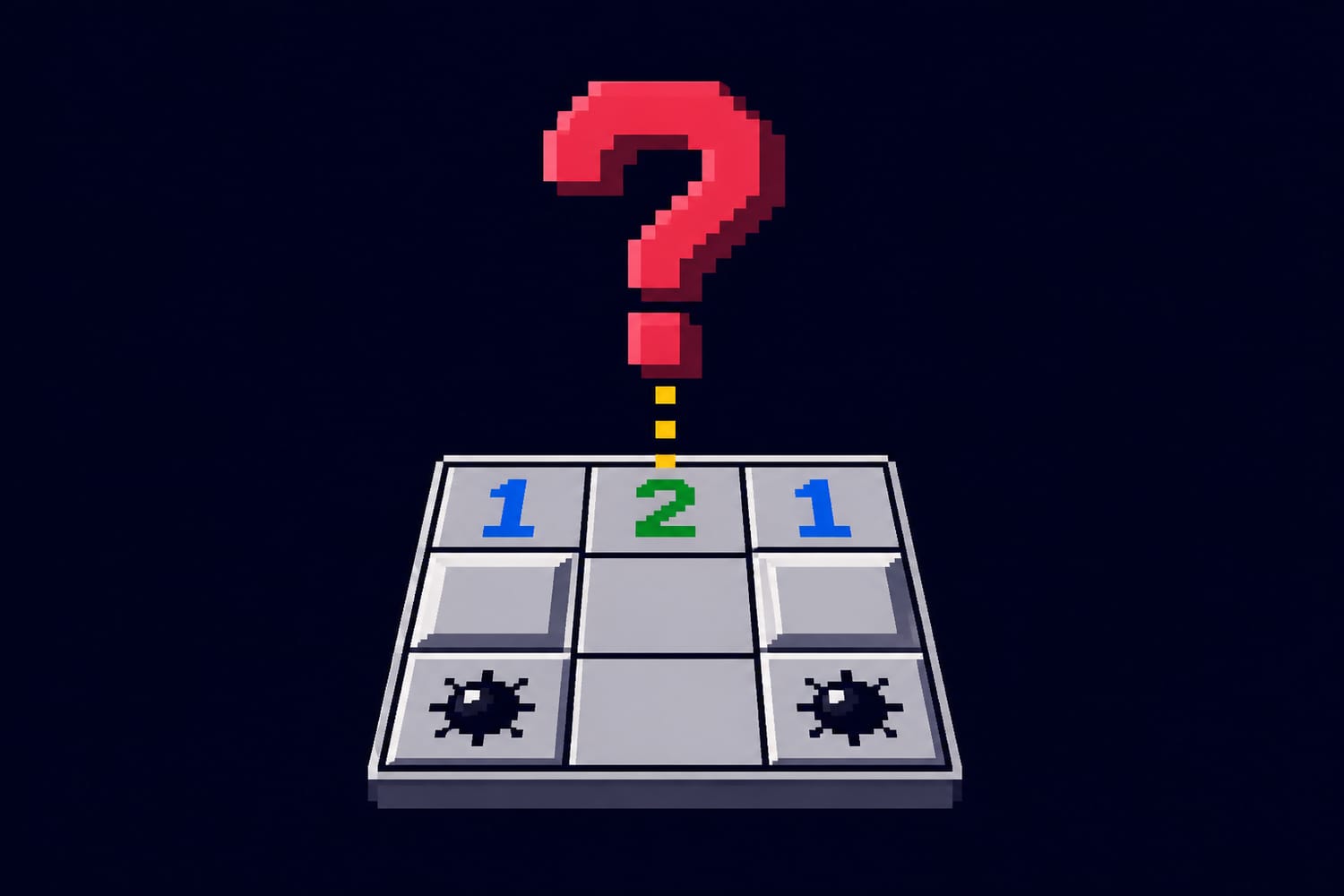
Why Minesweeper Sometimes Forces a Guess: The Math Behind a 50/50
You can study every number on a Minesweeper board, check every flag, and still have to guess. That happens when two or more mine placements fit everything you can see, but none of the remaining safe squares can be identified with certainty. A genuine 50/50 is the simplest case: two covered squares, one mine, and no clue that can tell them apart.
It can feel unfair to lose after playing carefully. Yet understanding why the choice is unavoidable—and how to check whether it really is—turns a frustrating moment into an interesting puzzle of its own.
First, What Does a Number Tell You?
A revealed number counts the mines in the surrounding squares, including those that touch at a corner. A 1 promises one neighboring mine; it does not tell you which neighbor holds it. If only one adjacent square is still covered, the answer is certain. If several are covered, you may need other clues to narrow the possibilities. For a fuller introduction to the rules, see Puzzles Arcade’s story behind Minesweeper.
Think of each number as a small rule that every possible mine layout must obey. A flag helps you remember where you believe a mine is, but a flag is your marker—not fresh evidence from the game. If you placed one incorrectly, deductions built on it can lead you astray.
The Smallest Genuine 50/50
Imagine a revealed 1 beside exactly two covered squares, A and B. Suppose every other neighboring square is already known to be safe. The clue allows precisely two local possibilities:
- A contains the mine; B is safe.
- B contains the mine; A is safe.
Now add an important condition: nothing else on the board distinguishes A from B. Any other revealed number touching A also touches B in the same way, and the total number of remaining mines does not favor one arrangement over the other. Under ordinary, symmetric mine placement, each possibility has the same chance. Opening either square has a 50% chance of being safe.
The hard part is that knowing one of them is safe does not tell you which one. You could flag A and open B, but that would still be a guess: flags do not test a theory. You must eventually open a square to make progress. A Minesweeper solver that specifically detects such pairs describes them as unavoidable 50/50 guesses.
If that is your final choice, losing does not mean you overlooked a magic pattern. Sometimes the visible information simply has no answer to give.
Why “It Looks Like 50/50” Is Not Enough
Before you pick A or B, look beyond the nearest 1. A second clue might touch A but not B. A deduction elsewhere might reveal how many mines remain. Either could break the tie.
Here is a miniature example. One clue says exactly one of A, B, and C is a mine. Another says exactly one of B and C is a mine. Since B and C already account for the first clue’s mine, A must be safe. Looking at only the first clue makes all three squares seem uncertain; combining the two gives you a guaranteed move.
That is why experienced players inspect the whole edge of an open area rather than treating each number separately. Clues can overlap, and the overlap is often where the answer lives. Even distant information matters if it settles the number of mines left to place.
The Math Is Really About Possible Boards
A useful way to reason about a stuck position is to imagine every hidden mine arrangement that agrees with the revealed numbers and the total mine count. If a covered square is safe in every valid arrangement, you may open it confidently. If it is a mine in every arrangement, you may flag it confidently. If valid arrangements disagree, the clues have not settled that square.
This gives us a way to describe probability. Under a game that places eligible mine layouts uniformly, a square’s mine probability is:
Number of valid whole-board layouts with a mine in that square ÷ number of valid whole-board layouts.
For the isolated A-or-B example, there are two equally likely layouts, and A is mined in one: 1 ÷ 2 = 50%. If one mine must lie among three otherwise interchangeable squares, each has a 1 ÷ 3, or about 33%, chance of containing it. Those percentages come from the possible layouts, not from how ominous a corner or a particular number looks. Probability-based Minesweeper solvers use this kind of whole-board reasoning to assess hidden squares.
There is a subtle catch: count complete boards, not just little patterns. One local choice may be compatible with many ways to place the remaining mines elsewhere, while another is compatible with fewer. Even if a nearby clue permits two choices, they are not necessarily equally likely once the rest of the board is considered.
Forced Guess Does Not Always Mean 50/50
A board can require a guess without offering an even coin toss. Perhaps no square is certainly safe, but one has a one-in-three chance of being mined while another has a one-in-two chance. If your immediate aim is to survive the next click, the one-in-three risk is the better choice.
The counter showing remaining mines can help. Suppose you have established where all but one mine must be, and the last mine lies among three untouched squares that are otherwise indistinguishable. Each has a one-in-three mine chance—not 50/50. In a more tangled position, you may have to compare several possible layouts to estimate the odds.
And surviving one click is not always the entire goal. A safe square that reveals a useful new number may help solve the rest of the board; another safe square may tell you almost nothing. Solver designers distinguish between the chance of surviving the next move and the chance of eventually winning. That is a fine point to remember, even if you never calculate exact percentages by hand.
Can You Prove You Have to Guess?
For a small pair of squares, you often can. Write down the two possible mine placements and check each against every visible clue and the remaining-mine count. If both work, no other unopened square offers a certain move, and there is no way to reveal a distinguishing clue first, you have reached a genuine forced guess.
On a larger board, proving that no safe deduction exists can be much harder than spotting an ordinary pattern. It requires accounting for combinations of clues that may be far apart. Computer-science researchers study this difference between checking whether mine layouts fit the clues and determining what a player can safely infer; an MIT Hardness Group paper on Minesweeper inference explores just how demanding those questions can become. None of that means you need advanced mathematics to enjoy a game—it explains why a stubborn board can challenge even a careful player.
When you feel stuck, try a short checklist before accepting the gamble:
- Recheck any flags your reasoning depends on.
- Scan other open areas for a guaranteed safe square.
- Look for clues that share covered neighbors.
- Check whether the remaining-mine count rules out a possibility.
- Only then compare the risks of your available guesses.
Why Some Versions Avoid the Problem
Minesweeper does not have to include unavoidable guesses. A game can choose or generate boards so that a logical move remains available until every safe square is opened. For example, Minesweeper Online’s gameplay guide describes a “no guessing” mode in which the board can be completed without a guess, though its harder boards may still require complex reasoning.
That design choice changes the experience. Traditional random boards mix deduction with the possibility of risk; no-guess boards make the challenge one of finding the deduction. Neither approach makes the other less enjoyable. As Puzzles Arcade’s look at randomness in puzzle games explores, uncertainty can be part of what makes familiar rules feel fresh—but designers can also shape randomness to create a particular kind of challenge.
A 50/50 Is a Limit of the Clues, Not of Your Skill
The next time Minesweeper leaves you staring at two covered squares, pause before clicking. Check the other numbers, your flags, and the mine counter. You might find the clue that breaks the tie—and that discovery is one of the game’s best feelings.
If no such clue exists, you have learned something else: the board supports two answers, and neither is more justified than the other. Making a thoughtful guess is not failing to solve the puzzle. In that moment, you have solved everything the clues allow.

