
The Story Behind Minesweeper: How a Tiny Logic Game Taught a Generation to Think
A Small Grid With a Big Legacy
Minesweeper looks simple at first glance: a blank grid, a few numbers, and the ever-present danger of clicking the wrong square. Yet behind that tiny logic game is a surprisingly rich story about computers, learning, probability, design, and the way one modest puzzle became a shared experience for millions of people.
For many players, Minesweeper was not discovered in an arcade, bought in a store, or recommended by a friend. It was simply there—waiting inside Microsoft Windows. Before app stores, browser games, and mobile puzzle collections, built-in computer games had a special kind of magic. They were available instantly, required no setup, and invited curiosity. Click a square. See what happens. Try again.
That accessibility helped Minesweeper become one of the most widely played puzzle games in the world. But its importance goes beyond nostalgia. Minesweeper quietly taught a generation how to reason through uncertainty, recognize patterns, manage risk, and even use a computer mouse more confidently.
Before Minesweeper: The Roots of a Logic Puzzle
Minesweeper did not appear out of nowhere. Its central idea—using clues on a grid to avoid hidden dangers—belongs to a larger family of logic and deduction games. Earlier computer games explored similar territory, including titles such as Mined-Out, released in the 1980s for home computers. These games involved navigating or revealing spaces while avoiding concealed mines, combining luck with careful reasoning.
The version most people know, however, came through Microsoft. The Windows Minesweeper was created by Curt Johnson and Robert Donner. It first appeared as part of the Microsoft Entertainment Pack in 1990 and became a standard part of Windows with Windows 3.1 in 1992. From that moment, Minesweeper moved from being a clever software extra to a global pastime.
Its timing was perfect. In the early 1990s, personal computers were entering homes, schools, and offices at a rapid pace. Many people were still getting used to the basics of graphical interfaces: pointing, clicking, double-clicking, and using different mouse buttons. Minesweeper gave users a playful reason to practice those skills. Left-click to reveal a square. Right-click to place a flag. Learn by doing.
How the Game Works
The rules of Minesweeper are beautifully compact. The board is divided into squares. Some squares hide mines. The player’s goal is to reveal every safe square without clicking on a mine.
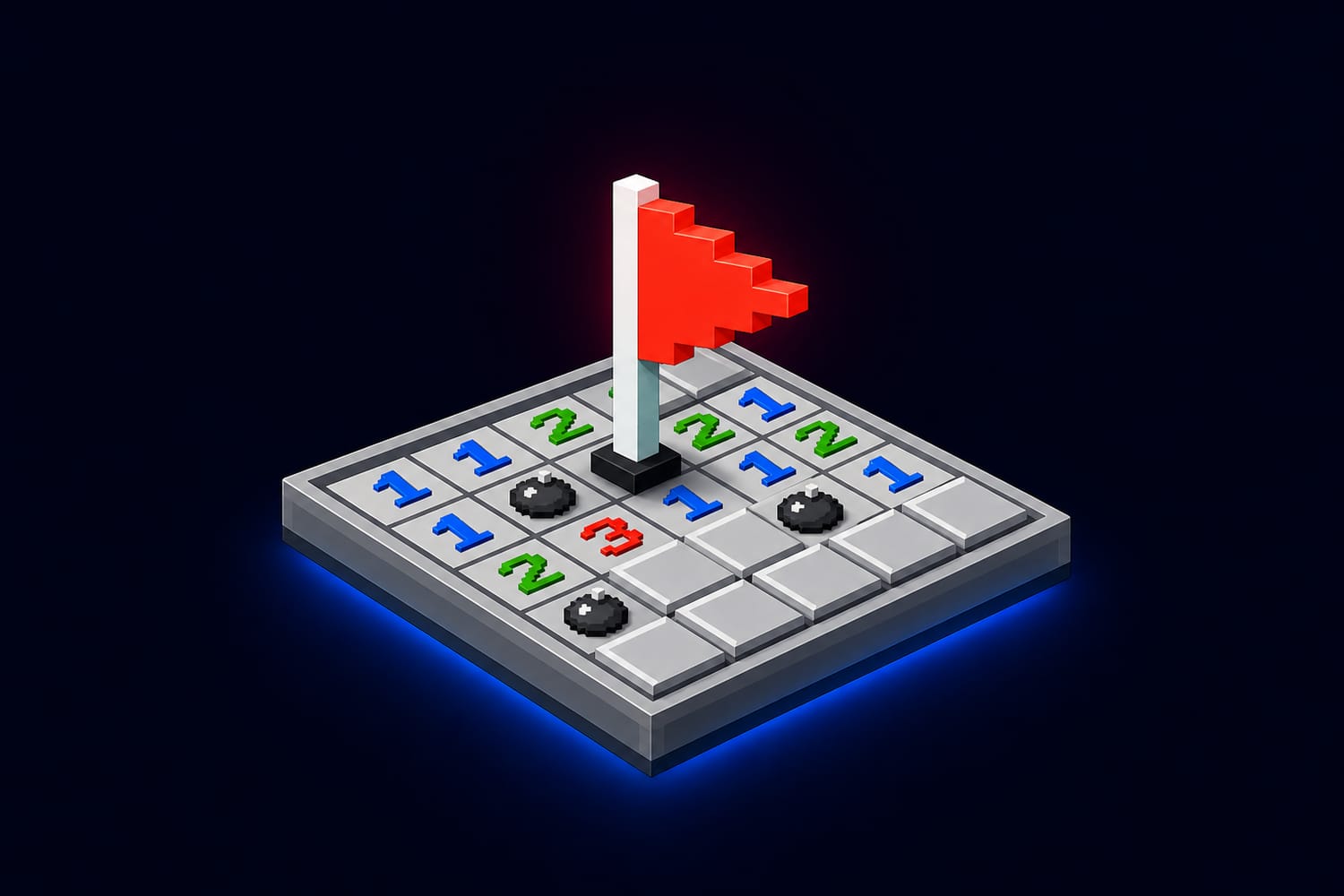
When you reveal a safe square, it may show a number. That number tells you how many mines are hidden in the eight neighboring squares around it: horizontally, vertically, and diagonally. A “1” means one neighboring square contains a mine. A “3” means three of the surrounding squares contain mines. A blank square means there are no neighboring mines, so the game often opens a larger empty area automatically.
The player can place flags on squares believed to contain mines. Flags are not just decorative; they are part of the thinking process. They help players keep track of conclusions and prevent accidental clicks.
What makes Minesweeper brilliant is that it turns the entire board into a conversation between the game and the player. The game never says, “This square is safe.” Instead, it gives information and lets you decide. A number is not an answer—it is evidence.
Why It Feels So Satisfying
Minesweeper creates satisfaction in several ways. First, it rewards attention. If you look carefully at the numbers, many moves become certain. A “1” touching only one unopened square means that square must contain a mine. If that mine is flagged, the other adjacent hidden squares may be safe. These simple deductions build into larger chains of reasoning.
Second, the game offers moments of sudden clarity. A confusing cluster of numbers can seem impossible, and then one square changes everything. You flag one mine, open one safe square, and the pattern unlocks. This “aha!” feeling is one of the strongest pleasures in puzzle design.
Third, Minesweeper balances knowledge and uncertainty. Some boards can be solved mostly through logic. Others eventually require a guess, especially in classic versions where the layout may create unavoidable 50/50 choices. This mixture of deduction and risk gives the game tension. You are not only solving a puzzle; you are managing uncertainty.
That balance is part of why Minesweeper appeals to both casual players and experts. Beginners can enjoy small victories on easy boards. Advanced players can chase faster times, study probability, and memorize common patterns.
The Hidden Lessons Inside the Grid
Although Minesweeper is not usually described as an educational game, it teaches several important thinking skills.
The first is logical deduction. Players learn to ask, “What must be true?” rather than “What do I hope is true?” If a number has exactly enough hidden neighboring squares to account for its mines, those squares can be flagged. If all mines around a number are already flagged, the remaining neighboring squares are safe. These are basic logical principles, presented in a playful form.
The second lesson is pattern recognition. Over time, players begin to recognize familiar arrangements: the classic “1-2-1” pattern along a wall, for example, or situations where a corner square is forced. These patterns help players solve faster, but they also show how experience changes the way we see problems.
The third lesson is probability. Sometimes the board does not offer a guaranteed move. When that happens, skilled players compare risks. One square may have a one-in-two chance of being a mine, while another may have a one-in-three chance. Choosing the better risk is not the same as knowing the answer, but it is still rational thinking.
Finally, Minesweeper teaches patience. Clicking randomly is exciting for about five seconds. Winning requires slowing down, reading the clues, and accepting that a careful move is usually better than a fast one.
A Game That Helped People Learn Computers
One of the most interesting parts of Minesweeper’s history is that it served a practical purpose beyond entertainment. Like Solitaire, another famous Windows game, Minesweeper helped users become comfortable with computer controls.
In the early days of Windows, the mouse was not as familiar as it is today. Many people were used to keyboards and command-line interfaces. Minesweeper encouraged precise clicking, moving the cursor accurately, and using both mouse buttons. Without feeling like a lesson, it taught skills that were becoming essential.
This is one reason built-in games mattered so much. They reduced fear. A new computer could feel intimidating, but a game made it approachable. If someone could open Minesweeper, click around, lose, laugh, and try again, they were already learning how to interact with the machine.
In that way, Minesweeper belongs not only to the history of games, but also to the history of everyday computing.
The Mathematics Beneath the Fun
Minesweeper may look like a casual puzzle, but it has attracted serious mathematical interest. In 2000, mathematician Richard Kaye proved that a generalized version of Minesweeper is NP-complete. In simple terms, that means certain Minesweeper-like problems can be extremely difficult to solve efficiently as they grow larger and more complex.
This does not mean every Minesweeper board is impossibly hard. Most everyday games are manageable with common strategies. But the proof shows that beneath the friendly grid is a surprisingly deep logical structure.
That depth is one reason Minesweeper has lasted so long. The rules are easy enough to learn in minutes, but the possibilities remain interesting for years. It is a classic example of elegant game design: simple rules, meaningful choices, and endless variation.
Variations, Remakes, and Modern Play
Minesweeper has appeared in many forms over the decades. The classic Windows version is the most famous, but countless versions now exist online, on mobile devices, and in puzzle collections. Some modern versions add helpful features such as guaranteed safe first clicks, improved visuals, statistics, daily challenges, or alternative grid shapes.
There have also been cultural and regional changes. In some editions, the mine theme was softened or replaced with less military imagery. For example, later Microsoft versions in some contexts used a flower-themed alternative. These changes show how a game’s presentation can evolve while its underlying puzzle remains the same.
Today, Minesweeper is still played by speedrunners, puzzle fans, casual gamers, and curious beginners. Online leaderboards have turned it into a competitive challenge, while relaxed versions keep it accessible for anyone who just wants a thoughtful break.
Why Minesweeper Still Matters
Minesweeper endures because it respects the player’s intelligence. It does not rely on flashy graphics, a long story, or complicated controls. Instead, it offers a clear challenge: here is what you know, here is what you do not know, and here is a decision only you can make.
That structure mirrors real-world thinking more than many games do. We often make decisions with incomplete information. We gather clues, test assumptions, avoid unnecessary risks, and sometimes accept uncertainty. Minesweeper compresses that experience into a tiny grid.
It also proves that a game does not need to be large to be meaningful. Some of the most memorable designs are built from a few strong ideas. Minesweeper’s numbers, flags, and hidden mines create a puzzle system that is easy to explain but hard to exhaust.
The Little Game That Taught Big Ideas
The story of Minesweeper is the story of a small game with an unusually large influence. Born from earlier logic-game ideas, popularized through Microsoft Windows, and loved by millions, it became part of daily life at home, school, and work. It taught mouse skills to new computer users, introduced players to deduction and probability, and turned simple squares into satisfying mental challenges.
For some, Minesweeper is a nostalgic memory from an old desktop computer. For others, it is still a favorite puzzle to play today. Either way, its legacy is clear: this tiny logic game helped a generation think more carefully, click more confidently, and discover the joy of solving one clue at a time.

