
How Spot-the-Difference Puzzles Are Made: The Art of Hiding Changes in Plain Sight
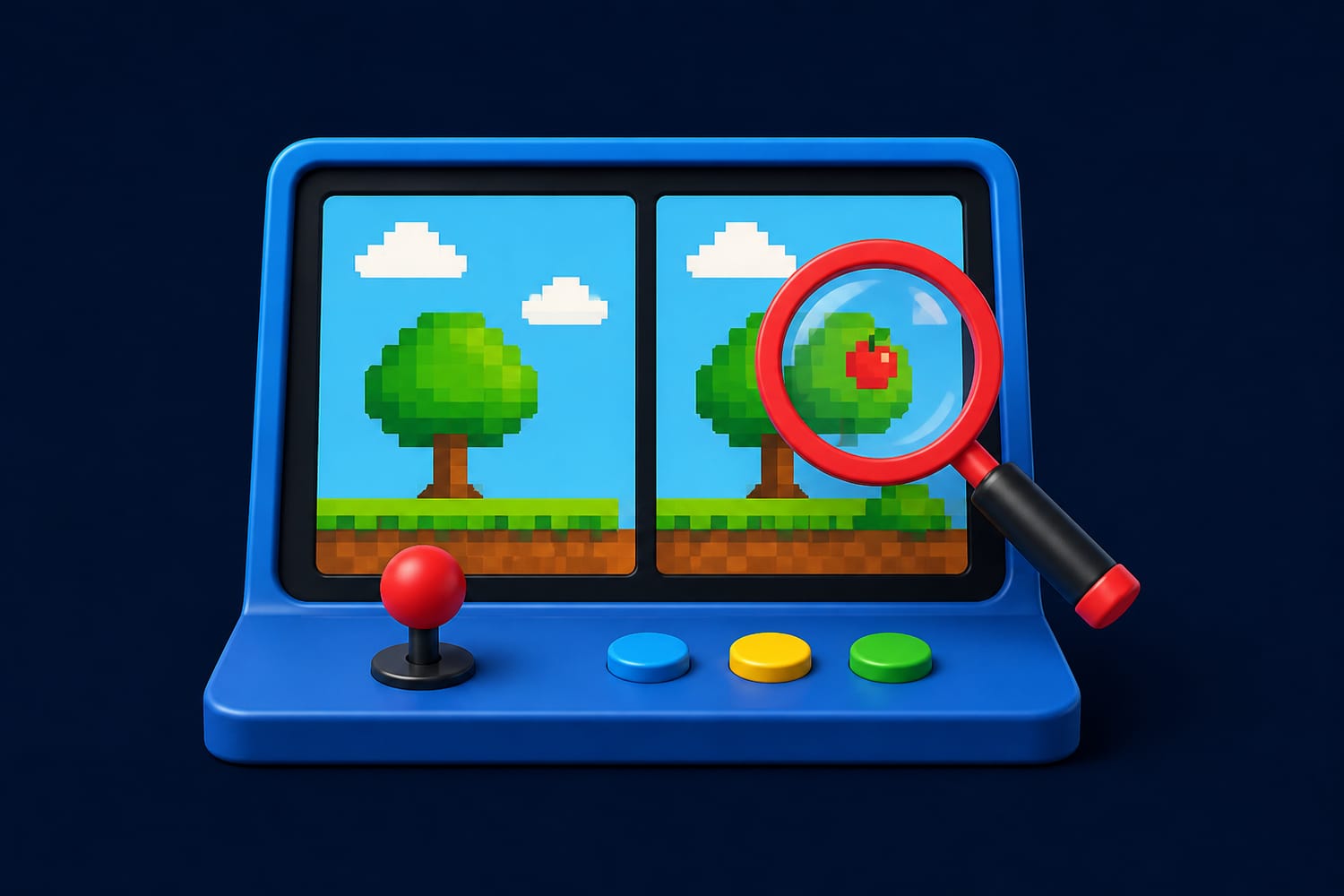
A spot-the-difference puzzle begins with two versions of the same scene. A maker changes a few details in one version, then checks that every change is visible, distinct, and satisfying to find. The trick is not to make differences impossibly small. It is to make them belong so naturally that your eyes pass over them at first.
First, Build a Scene Worth Exploring
Before there are differences, there has to be a picture. A kitchen, garden, busy street, or underwater world gives players recognizable objects to compare. The scene needs enough detail to make searching interesting, but not so much that every corner becomes a blur.
Imagine a seaside café. There is a striped awning, a chalkboard menu, a waiter carrying drinks, and a gull perched on a railing. Each object offers possibilities: one awning stripe could change color, a word could disappear from the menu, or the gull could face the other way.
A maker might draw the scene, arrange digital illustrations, or edit a photograph. Whatever the method, the first version becomes the reference image. The second version is usually made from a copy, so the overall composition stays aligned. If the whole picture shifts, players may see accidental mismatches everywhere instead of the intended differences.
Scene choice matters for another reason: it gives changes a place to hide. A missing cup makes sense on a café table. A different shell makes sense on a beach. The alteration is easier to overlook when it fits the world of the picture.
Then, Choose Changes That Feel Varied
The simplest difference is an object that appears in one picture but not the other. Yet a puzzle made entirely of missing objects can become predictable. Makers can vary what players must notice:
- Presence: A flower is added to a vase.
- Color: One balloon changes from blue to yellow.
- Shape: A round cookie becomes a star.
- Direction: A weather vane points the other way.
- Detail: A jacket gains a button.
- Pattern: One stripe on a rug changes width.
These categories can overlap. If a red kite becomes a green kite and loses its tail, should that count as one difference or two? Unless the answer is made clear, players may reasonably disagree. A tidy puzzle treats nearby edits as one intended change or places them far enough apart to be counted separately.
Placement matters, too. Put every difference in the top half and the bottom half feels pointless. Put every difference on tiny background objects and the puzzle may feel like an eyesight test. A more inviting mix includes changes of different sizes and in different regions: perhaps a noticeable missing cloud, a medium-sized altered sign, and a subtler detail on the café counter.
That variety creates a pleasant rhythm. Some finds give players a quick start; others reward a second, more careful look.
Make the Altered Picture Look Natural
Changing an object is only half the job. The edited image still has to make visual sense.
Suppose the café’s cup disappears. If its shadow remains on the table, the shadow might reveal the edit—or look like a printing mistake. If a flower changes color, its outline should still match. In a photograph, removing an object may require rebuilding the background that was behind it; otherwise, a blurry patch can give away the answer.
Digital tools make this work easier to revise. An editor can keep changes on separate layers and use masks to control which parts appear without permanently changing the original image. Adobe’s explanation of non-destructive editing describes why layers, masks, and reversible adjustments are useful when refining an image. A paper-and-pencil maker can follow the same principle by preserving an untouched original and making changes on a copy.
Consistency is especially important with repeated objects. If eight windows share the same frame, changing one frame can make a satisfying difference. If several frames vary accidentally, players may be left wondering which mismatches count.
Why Can an Obvious Difference Be So Hard to See?
Two pictures can be right beside each other, and a missing object can still take time to find. Your attention has to land on the right place and compare the matching details. Looking at the café’s awning in one image does not help much if you are looking at the menu in the other.
Researchers study related difficulties under the name change blindness: people sometimes miss changes in a scene, even when the changes seem clear once pointed out. Spot-the-difference puzzles deliberately turn careful comparison into the task, rather than relying on someone to notice a change by chance. Research described by Queen Mary University of London found that, in its experiments, adding or removing an object was detected more readily than changing an object’s color. That is a useful reminder that a difference’s type, not just its size, can affect the challenge.
Busy scenes also give attention competing places to go. A bright umbrella might attract your gaze while a quieter change waits on a nearby chair. This is part of the pleasure of the puzzle: the answer is visible, but you have to organize your search to find it. Puzzles Arcade’s guide to hidden-object games and visual attention explores how features, surroundings, and systematic looking shape visual search.
The Fairness Check: Count, Test, and Adjust
A finished-looking pair of pictures is not necessarily a finished puzzle. The maker needs an answer key recording each intended difference, then a careful pass to catch unintended ones. Did an object move slightly while the second image was being edited? Did a texture or label change by accident? Does the puzzle promise six differences but contain only five that a player can reasonably identify?
Next comes the most revealing check: let someone who does not know the answers try it. The maker can watch where that person looks, which differences they find quickly, and whether a particular area causes confusion. An instantly found change may be fine—easy discoveries help players get started. But if several testers cannot tell whether a smudge is a difference, the issue may be clarity rather than difficulty.
This is the broader purpose of a puzzle playtest: it shows how the challenge feels to someone who does not already know the solution. A maker might enlarge one detail, remove an accidental mismatch, or move a change away from another so each find feels unambiguous.
For a digital puzzle, the final checks may also include whether a finger can select a small difference on a phone screen and whether the pictures remain clear when resized. For a printed puzzle, the maker should inspect a printout: a color change that looks obvious on a bright monitor might be much less distinct on paper.
Try Making a Two-Picture Puzzle Yourself
You do not need elaborate artwork to try the process. Draw a simple room with a lamp, plant, window, books, and a pet. Make a copy, then plan five changes before adding any of them. Mix an added object with a changed shape, color, direction, or small detail, and spread them across the room.
Keep a separate list of your five answers. When both pictures are ready, compare them closely yourself, then offer them to a fresh pair of eyes. If your tester finds a sixth difference, you have learned something useful: the artwork needs a correction, or the answer key needs one.
That small experiment reveals the art behind these puzzles. Making a difference is easy; making it hidden, visible, and fair all at once takes care. The best reveal produces a familiar reaction: “It was right there!”

