
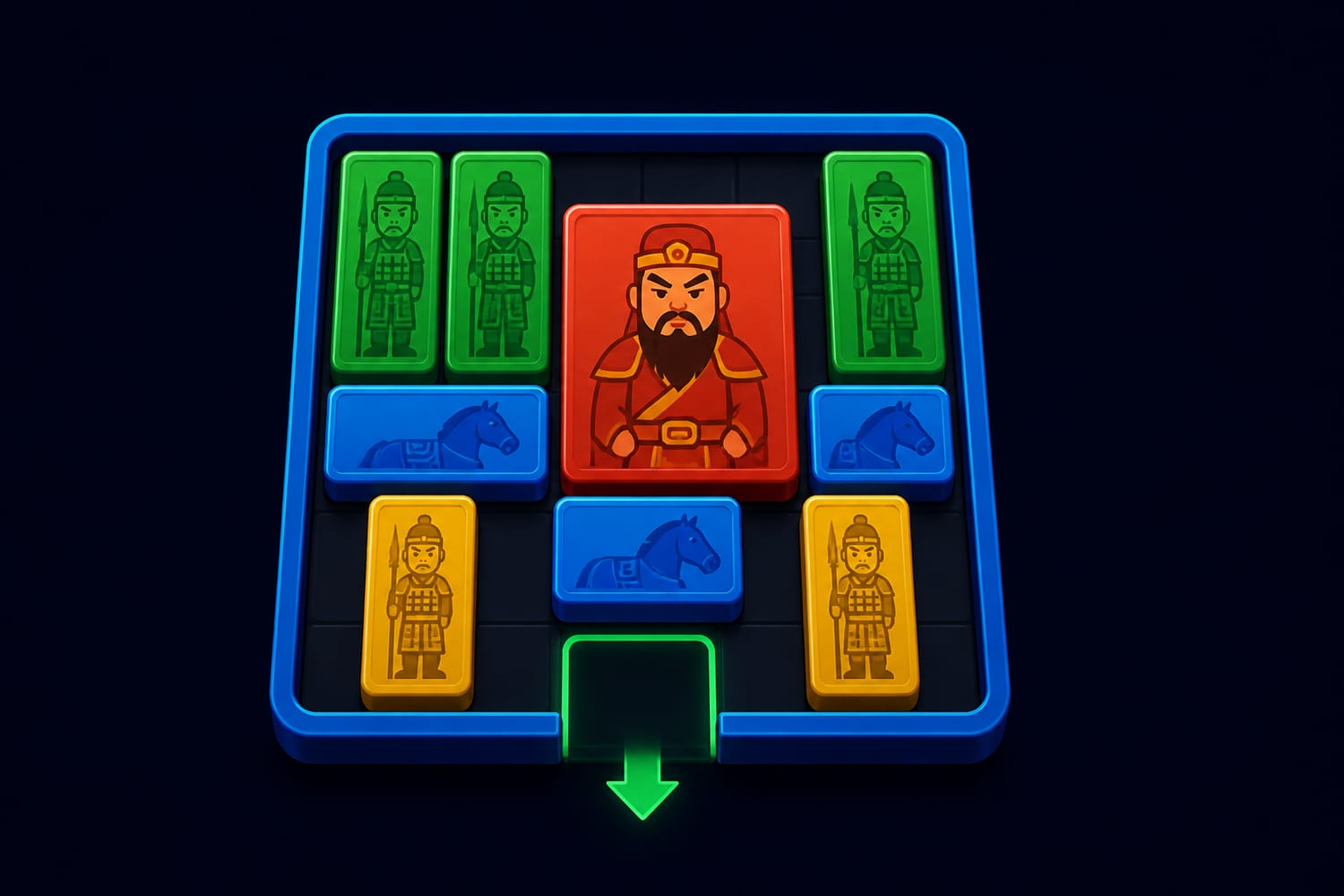
Huarong Dao: The Chinese Sliding-Block Puzzle Inspired by a Legendary Escape
Huarong Dao is a Chinese sliding-block puzzle in which players maneuver a large square block, representing the warlord Cao Cao, toward an exit. Inspired by an episode in Romance of the Three Kingdoms, it turns a legendary escape into a compact challenge of planning, patience, and spatial reasoning.
The objective sounds almost too simple: get one block out of a crowded frame. Yet every helpful movement seems to put something else in the way. The challenge is not merely finding a path—it is creating enough room for that path to exist.
The Legendary Escape Behind the Puzzle
The story begins with a real military defeat. In 208 CE, near the end of China’s Han dynasty, Cao Cao’s southward campaign was stopped at the Battle of Red Cliffs. Allied forces associated with Sun Quan and Liu Bei defeated his army, forcing him to withdraw.
Romance of the Three Kingdoms transforms that retreat into a memorable encounter. In the novel, Cao Cao reaches the Huarong Trail, where the general Guan Yu is waiting to intercept him. Cao Cao appeals to the kindness he once showed Guan Yu, who ultimately allows him to escape.
That distinction matters: the battle belongs to history, while the dramatic act of mercy belongs to the novel’s storytelling. The puzzle draws on this fictionalized escape, rather than reproducing a documented battlefield encounter.
The story gives an abstract task a human purpose. You are not simply moving a square. You are helping a trapped figure reach safety.
An Old Story, but a More Recent Puzzle
Despite its historical setting, Huarong Dao should not be presented as a puzzle invented during Cao Cao’s lifetime.
The specialist ChinesePuzzles.org history of Huarong Pass records Jiang Changying’s description of the puzzle in his 1949 book Science Entertainment. Jiang believed it emerged in the 1930s, although its precise origins remain uncertain.
Related sliding-block designs also appeared outside China. ChinesePuzzles.org notes a very similar British puzzle patented by J. H. Fleming in 1932, illustrating why a neat, single-inventor origin story would be misleading.
What makes Huarong Dao distinctive is its cultural framing: the crowded pieces become opposing commanders and soldiers, and the opening becomes Cao Cao’s escape route.
How to Play Huarong Dao
The familiar board is four units wide and five units tall. Its ten blocks occupy eighteen of the twenty unit squares, leaving just two empty spaces. The classic arrangement contains:
- One large 2-by-2 square.
- Four upright 1-by-2 rectangles.
- One horizontal 2-by-1 rectangle.
- Four small 1-by-1 squares.
The large square represents Cao Cao. In the familiar story-themed arrangement, the horizontal rectangle represents Guan Yu.
The rules are straightforward:
- Slide one block at a time into available space.
- Move horizontally or vertically, never diagonally.
- Do not rotate blocks or lift them over others.
- Clear a route for the large square to reach the opening at the bottom.
You do not need to read Chinese characters or recognize the historical figures to play. The shapes and their positions provide the information needed to solve the puzzle.
Why Two Empty Spaces Make Such a Big Difference
Here is a useful way to understand the challenge: treat the empty spaces as tools, not leftovers.
An upright rectangle needs two vertically aligned empty squares to move sideways by one unit. A horizontal rectangle needs two horizontally aligned empty squares to move upward or downward. The large square likewise needs a clear strip two units long along the edge toward which it moves. These requirements follow directly from the pieces’ shapes and the sliding rules.
Imagine that both empty squares are side by side near the bottom. That may allow the horizontal block to move vertically. Put those same empty squares one above the other, and a different set of movements becomes possible.
This explains why a move that looks unhelpful can be essential. Moving a small square away from the exit might place the empty spaces where a larger block needs them.
If you enjoy this interaction between occupied and unoccupied space, Puzzles Arcade’s article on the 15-puzzle craze explores another sliding challenge built around a tightly constrained board.
A Beginner-Friendly Solving Approach
Rather than searching immediately for a complete solution, try working through small, testable goals.
Start With a Specific Obstacle
Choose one block that prevents Cao Cao from moving. Ask where that block could go, then identify what must move first.
For example, your immediate goal might be to create two empty squares beneath the horizontal rectangle. That is more manageable than asking, “How do I solve everything?”
Plan Short Sequences
Try thinking two or three moves ahead:
- Which block can move now?
- What space will that create?
- Which useful move becomes possible next?
Do not assume that moving Cao Cao closer to the exit is always the best choice. Judge a sequence by whether it creates useful room, not simply whether the largest block advances.
Watch for Repeated Positions
If you keep moving a block out and immediately putting it back, pause. You may be circling through the same few arrangements.
Take a photograph or sketch the board before trying a new idea. If the experiment fails, return to that checkpoint and test a different approach.
Separate Solving From Optimizing
For your first success, ignore the move counter. Concentrate on understanding how the pieces make room for one another.
Afterward, replay the puzzle and look for unnecessary detours. This creates two satisfying challenges: discovering an escape, then making that escape more efficient.
Does the Classic Puzzle Really Take 81 Moves?
The famous figure is 81 moves, but it needs an explanation.
A University of Toronto Huarong Dao teaching assignment explicitly distinguishes between counting conventions. It gives 81 moves for the classic arrangement when consecutive movements of the same block are grouped together, compared with 116 when each one-square movement is counted separately.
For example, sliding a block two squares to the right can count as one grouped move or two single-square moves.
The starting arrangement matters too. An optimum for the classic setup is not a universal minimum for every possible configuration.
From a Handheld Puzzle to Computer Science
Huarong Dao also provides a practical example of a search problem. The University of Toronto has used it to teach students to build solvers using depth-first search and A* search.
In that approach, each board arrangement is a “state.” Legal moves connect one state to another, and the solver searches for a route from the initial arrangement to a winning one. Keeping track of previously explored states helps avoid repeatedly searching the same positions.
You can borrow the spirit of that method without writing any code: record useful checkpoints, notice repeated arrangements, and explore alternatives deliberately.
For another mechanical challenge centered on finding the right sequence, explore Japan’s secret puzzle boxes. Their mechanisms differ, but they offer a rewarding comparison with sliding-block play.
A Small Board With a Memorable Lesson
Approach Huarong Dao as an investigation rather than a race. Study the spaces, choose one obstacle, and experiment with a short sequence.
When an attempt fails, ask what it revealed. Did you discover that a rectangle needs a different opening? Did you create room in the wrong place? That information can guide your next attempt.
The eventual escape is satisfying, but so is the moment when the puzzle begins to make sense. What first looked like a jumble of trapped blocks becomes a system you can understand—one careful slide at a time.

