
The 15-Puzzle Craze: The Impossible Challenge That Fooled a Nation
A Tiny Box That Became a National Obsession
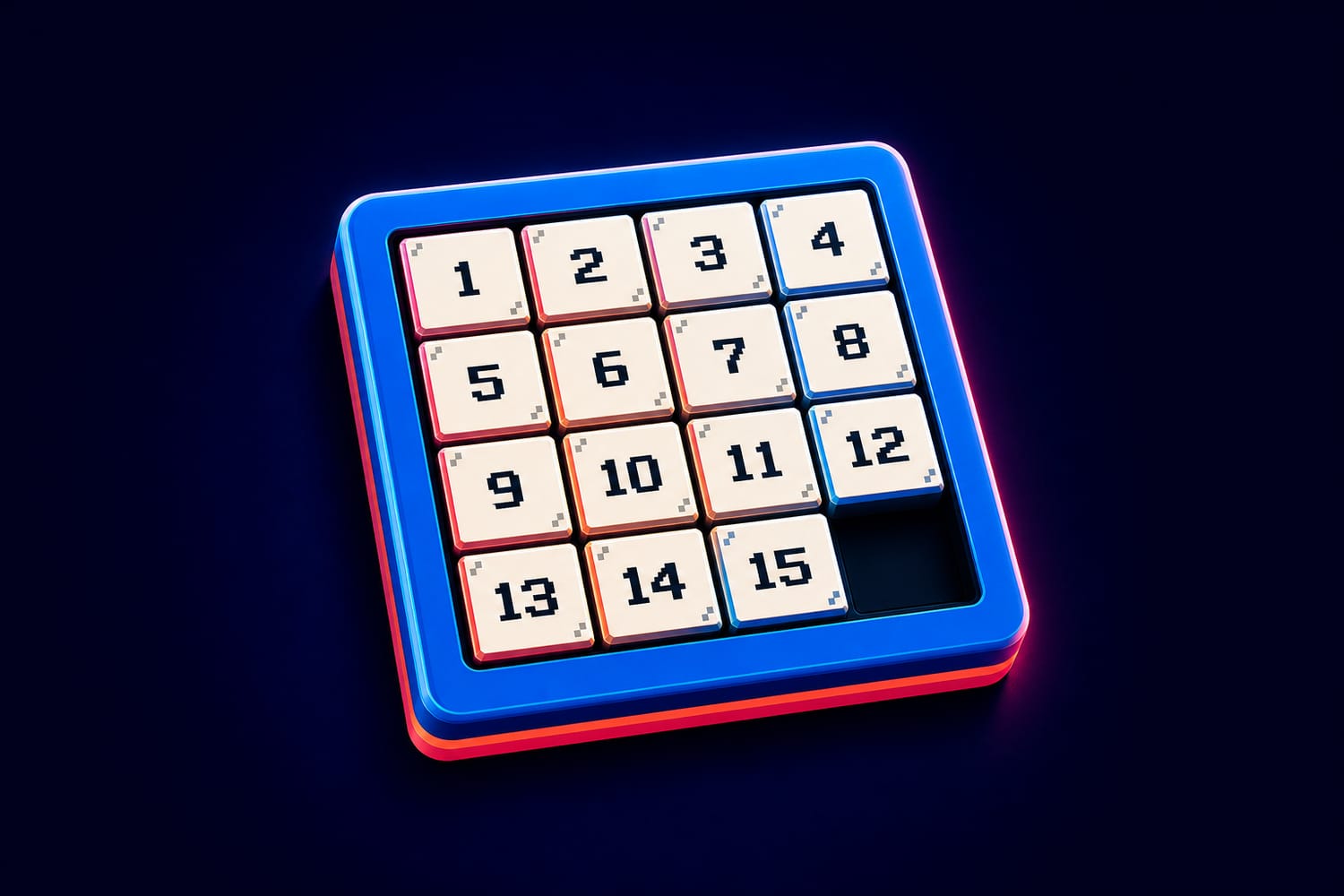
In the late 1800s, a small wooden puzzle swept through homes, offices, schools, train stations, and shop counters with astonishing speed. It had no batteries, no screen, and no complicated rules. It was simply a 4-by-4 frame holding 15 numbered tiles and one empty space. Slide the tiles around, put them in order, and you win.
That little object became known as the 15-puzzle.
At first glance, it looked almost too simple. The tiles were numbered 1 through 15, and the goal was usually to arrange them in order, left to right and top to bottom, with the empty space in the bottom-right corner. Anyone could understand it in seconds. But solving it could take minutes, hours, or—if you were given the wrong challenge—forever.
Around 1880, the puzzle became a full-blown craze in the United States and beyond. Newspapers wrote about it. People carried it in their pockets. Storekeepers sold versions as fast as they could make them. Some employers reportedly complained that workers were wasting time sliding tiles instead of doing their jobs.
What made the craze especially fascinating was not just that the puzzle was hard. It was that one famous version of the challenge was mathematically impossible—and countless people did not know it.
How the Puzzle Works
The classic 15-puzzle is a sliding tile puzzle. It consists of 16 spaces arranged in a square: four rows and four columns. Fifteen of those spaces hold numbered tiles, and one space is empty. A tile next to the empty space can slide into it, which moves the empty space to the tile’s former position.
A solved puzzle usually looks like this:
 1   2   3   4
 5   6   7   8
 9  10  11  12
13  14  15   _
The underscore represents the empty space.
The challenge is to mix up the tiles and then restore them to this order. The rules are beautifully strict: you cannot lift tiles out, rotate the board, or swap two pieces by hand. You may only slide one tile at a time into the empty space.
That limitation is what gives the puzzle its magic. Every move seems small, but each one changes the whole situation. Moving a tile into place can knock another tile out. Fixing the top row can disturb the side. The puzzle rewards patience, planning, and the ability to think several moves ahead.
But there is an even deeper secret: not every arrangement of the tiles can be solved.
The Craze of 1880
The 15-puzzle became wildly popular during the early months of 1880. It spread quickly through American cities and then to other countries. People played it in parlors, on sidewalks, in shops, and during travel. Like later fads such as the Rubik’s Cube, it was easy to share because anyone could pick it up and immediately understand the goal.
Part of its appeal came from competition. Could you solve it faster than your friend? Could you restore the order without getting stuck? Could you solve one of the “special” arrangements that others found impossible?
The puzzle appeared under different names, including versions marketed as the “Gem Puzzle.” Manufacturers produced wooden and metal models, and newspapers printed discussions, solutions, and jokes about the obsession. The craze burned brightly, and while it eventually faded, the puzzle never disappeared. It became a classic of recreational mathematics.
The 15-puzzle also became tangled in myth, especially because of the famous American puzzle-maker Sam Loyd. Loyd later claimed that he invented the puzzle and that he offered a large prize for solving an impossible arrangement. However, modern puzzle historians generally credit the puzzle’s origin to Noyes Palmer Chapman, a postmaster from Canastota, New York, who developed an early version in the 1870s. The puzzle was later manufactured and popularized by others.
Sam Loyd was a brilliant promoter and puzzle creator, but his claim to have invented the 15-puzzle is not supported by the best historical evidence. Still, his name became strongly associated with the puzzle because he helped spread the story of the impossible challenge.
The Impossible Challenge
The most famous impossible version of the 15-puzzle looked almost solved. Every tile was in the correct position except that 14 and 15 were swapped:
 1   2   3   4
 5   6   7   8
 9  10  11  12
13  15  14   _
To a casual player, this looks very close to victory. Surely, with enough clever sliding, you could switch those last two tiles and finish the puzzle.
But you cannot.
That arrangement is impossible to solve using legal sliding moves. No amount of time, cleverness, or determination will transform it into the standard solved position. You can slide tiles all day and all night, but the puzzle will never end with just 14 and 15 corrected while everything else stays in order.
This was the trick that fooled so many people. The impossible arrangement looked reasonable. It looked like a challenge of skill rather than a challenge blocked by mathematics. People assumed they were simply not clever enough yet. In reality, they were trying to do something the rules of the puzzle did not allow.
The Mathematics Hidden Under the Tiles
So why is the swapped 14-and-15 puzzle impossible?
The answer involves a mathematical idea called parity. Parity means whether something is even or odd. In the 15-puzzle, every arrangement has a hidden parity that legal moves cannot change in certain ways.
One way to study an arrangement is to count inversions. An inversion happens when a larger-numbered tile appears before a smaller-numbered tile when you read the board from left to right, top to bottom, ignoring the blank.
For example, in the solved puzzle, there are no inversions. Every number appears in order.
But in the impossible version:
13 15 14 _
the tile 15 comes before 14. That creates one inversion. One is odd.
For a 4-by-4 puzzle, the position of the blank space also matters. The rule is:
- Count the number of inversions.
- Count which row the blank is in, starting from the bottom.
- On a standard 4-by-4 puzzle, an arrangement is solvable if the inversion count and the blank’s row-from-bottom have the correct parity relationship.
More specifically, for the standard goal with the blank in the bottom-right corner, the puzzle is solvable when:
inversions + blank row from bottom = odd
In the solved position, there are 0 inversions, and the blank is in row 1 from the bottom:
0 + 1 = 1
That is odd, so it is solvable.
In the swapped 14-and-15 position, there is 1 inversion, and the blank is still in row 1 from the bottom:
1 + 1 = 2
That is even, so it is not solvable.
This may sound like a small detail, but it has a huge consequence: exactly half of all possible arrangements of the 15 tiles and blank are solvable, and the other half are not. The impossible challenge belongs to the wrong half.
Why People Were So Easily Fooled
The 15-puzzle fooled people because its difficulty was disguised as simplicity. There were only 15 tiles. The goal was obvious. The rules were clear. The impossible arrangement looked just one tiny step away from success.
But that “tiny step” required swapping two tiles while leaving everything else the same. In a sliding puzzle, swapping only two tiles is not a legal outcome. Sliding moves rearrange the board in a way that preserves the puzzle’s parity. You can make the board look wildly different, but you cannot cross from the solvable universe into the unsolvable one.
This is one reason the story remains so memorable. The puzzle teaches a lesson that applies far beyond games: sometimes effort is not enough if the structure of the problem makes the goal impossible. The smartest move is not always to try harder. Sometimes it is to understand the rules more deeply.
That does not make the puzzle less fun. In fact, it makes it more interesting. Once you know that some positions are impossible, you can appreciate the 15-puzzle as both a game and a mathematical machine.
How to Approach a Solvable 15-Puzzle
A solvable 15-puzzle is still a wonderful challenge. Many players use a layered strategy:
- Solve the top row first. Place 1, 2, 3, and 4 without worrying too much about the lower rows.
- Solve the second row. Put 5, 6, 7, and 8 in place while protecting the first row.
- Work on the lower-left section. Place 9 and 13, then 10 and 14, depending on your method.
- Finish with the remaining tiles. The last few tiles require careful cycling, where you rotate groups of tiles around the blank.
The key is not to solve one tile at the cost of destroying everything else. Good solvers learn little patterns, or “algorithms,” that move a few tiles while keeping completed areas intact.
Like many classic puzzles, the 15-puzzle rewards both logic and practice. At first, it feels chaotic. Later, you begin to see the board as a system of controlled movements.
A Lasting Puzzle Legacy
The 15-puzzle craze of 1880 was more than a passing fad. It became a landmark in the history of puzzles because it combined popular entertainment with deep mathematics. It showed that a simple toy could raise serious questions about logic, proof, and possibility.
Its legacy can be seen in countless later puzzles and games. Sliding puzzles appear in toy stores, puzzle books, computer games, mobile apps, and escape rooms. The same basic idea—limited movement inside a constrained space—continues to fascinate people.
The 15-puzzle also helped popularize recreational mathematics, a field that makes mathematical thinking playful and accessible. You do not need advanced training to enjoy the puzzle. But if you look beneath the surface, you find elegant ideas about permutations, parity, and problem-solving.
The Amazing Feat Was Understanding the Trick
The most amazing feat in the story of the 15-puzzle was not solving the impossible challenge. No one could do that under the legal rules. The real feat was discovering and explaining why it was impossible.
That is what makes the 15-puzzle such a perfect classic. It is easy enough for a child to understand, challenging enough for adults to enjoy, and deep enough to interest mathematicians. It fooled a nation not because people were foolish, but because the puzzle hid a powerful mathematical truth inside a friendly wooden frame.
The next time you see a sliding puzzle, remember the great 15-puzzle craze. Behind those little numbered tiles is a story of excitement, frustration, clever marketing, historical myth, and beautiful logic.
Sometimes, the most fascinating puzzles are not the ones that ask, “Can you solve me?” They are the ones that make you ask, “Is this even possible?”

