
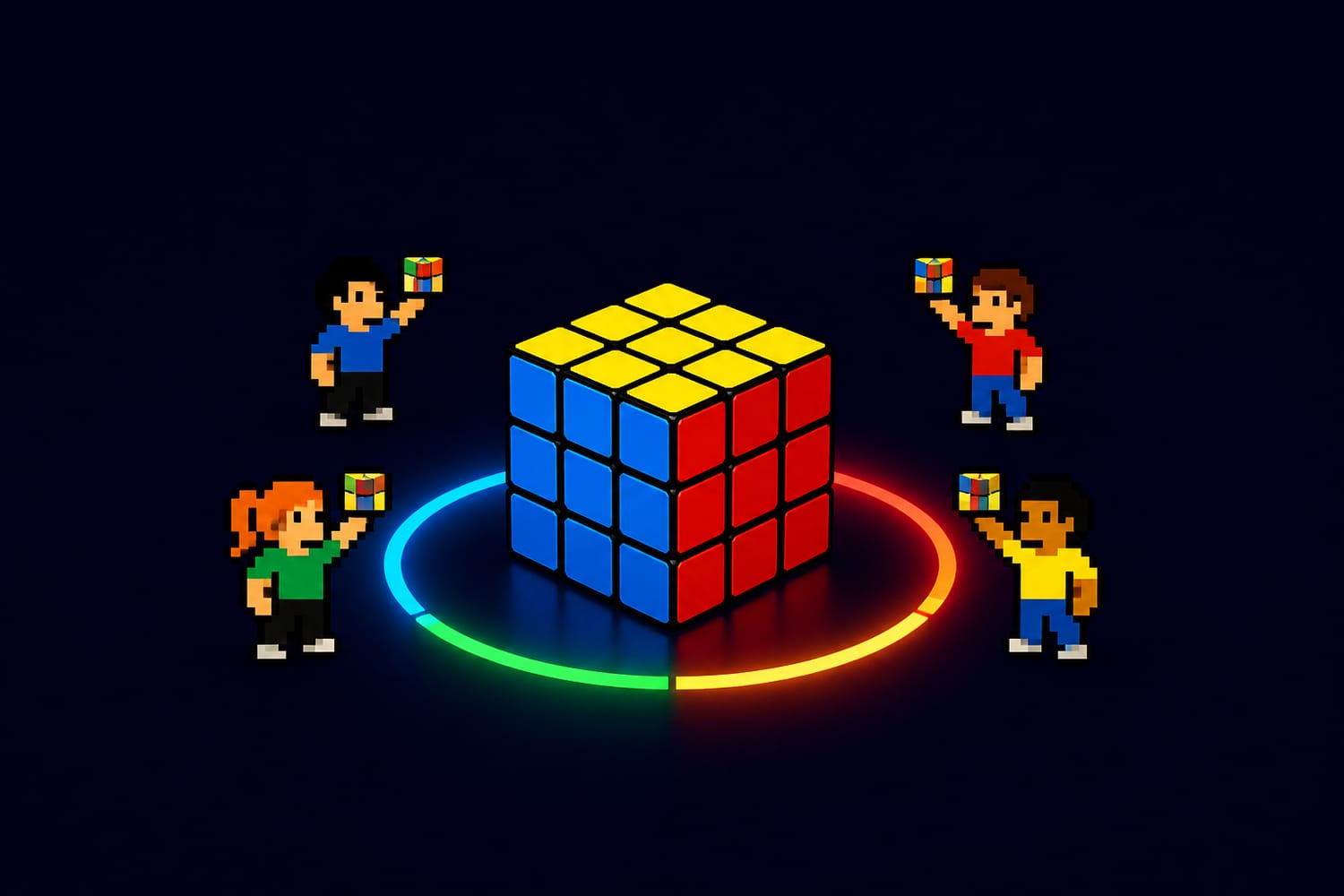
How the Rubik’s Cube Sparked a Worldwide Solving Culture
From Classroom Experiment to Global Phenomenon
The Rubik’s Cube sparked a worldwide solving culture because it combined a simple goal with extraordinary depth. Anyone could understand the challenge—make each face one color—but solving it encouraged experimentation, shared methods, competition and constant improvement. Over time, one small puzzle became a common language connecting millions of curious minds.
Its story began in Budapest in 1974, when Hungarian architect and design professor Ernő Rubik created a movable cube to explore three-dimensional structure. The challenge was mechanical as well as mathematical: how could smaller blocks move independently without causing the whole object to fall apart?
Rubik eventually scrambled his prototype and faced an unexpected problem—he had to figure out how to restore it. That journey from confusion to understanding became the experience that generations of solvers would later share.
The invention was patented in 1975 and appeared in Hungarian shops as the “Magic Cube” in 1977. After attracting attention at international toy fairs, it was licensed for wider distribution, renamed the Rubik’s Cube and released internationally in 1980. The official history of the Rubik’s Cube traces how an educational experiment became one of the world’s most recognizable puzzles.
A Puzzle That Anyone Could Understand
The Cube arrived with several advantages that helped it cross borders. It required no reading, translation, batteries or electronic screen. Its six colors and turning mechanism explained the basic challenge almost instantly.
At the same time, the puzzle was far more difficult than its appearance suggested. A standard 3×3×3 Cube has 43,252,003,274,489,856,000 possible reachable positions—more than 43 quintillion. Random twisting is therefore unlikely to produce a solution within any reasonable amount of time.
That contrast made the Cube irresistible. The destination was obvious, but the route was hidden. Beginners could enjoy forming one face, experienced solvers could study efficient methods, and mathematicians could examine permutations, symmetry and group theory. Readers interested in that deeper layer can explore more of the hidden mathematics behind puzzle games.
In 2010, researchers proved that every legal 3×3×3 position can be solved in 20 moves or fewer when a turn of any face—either 90 or 180 degrees—counts as one move. This maximum is commonly called “God’s Number.” Human-friendly methods usually use more moves, but the result demonstrates that even the most intimidating scramble is never infinitely far from completion.
The First Wave of Cube Mania
The early 1980s brought an explosion of interest. Cubes appeared in homes, classrooms, offices and playgrounds. Solution books became popular because many owners could complete one face but accidentally destroy it while attempting the next.
These books helped establish a central feature of cubing culture: solvers shared knowledge rather than guarding it. A successful sequence could be written down, taught to a friend and practiced until it became automatic.
An early international community was already forming. The MIT Cube Lovers mailing list began in July 1980, allowing enthusiasts to discuss methods and puzzle theory. Mathematician David Singmaster’s Cubic Circular newsletter also circulated ideas, results and discoveries at a time when communication was far slower than it is today.
Competition followed naturally. At the first major Rubik’s Cube World Championship, held in Budapest in 1982, competitors represented 19 countries. American solver Minh Thai won the 3×3×3 event with a time of 22.95 seconds—an astonishing result for the period.
From Solving Methods to a Shared Language
Cubers gradually developed a vocabulary that allowed techniques to travel across languages and continents. Face notation uses letters such as R for right, L for left, U for up and F for front. A written sequence like R U R' U' can be followed by any solver who understands the notation.
These move sequences are commonly called algorithms. In cubing, an algorithm is not a mysterious computer command. It is simply a memorized series of turns that produces a predictable change while preserving pieces that have already been solved.
Different solving systems also emerged:
- Beginner layer-by-layer methods emphasize clarity and a manageable number of algorithms.
- CFOP divides the solve into the cross, first two layers, orientation of the last layer and permutation of the last layer.
- Roux builds blocks on opposite sides before solving the remaining pieces.
- ZZ begins by orienting edges and is designed to reduce certain rotations during a solve.
There is no single method that suits everyone. Some cubers love large algorithm sets, while others prefer more intuitive block building. This variety helps the community welcome different learning styles rather than demanding one “correct” path.
How the Internet Revived Cubing
The original craze faded after the early 1980s, and organized competitions largely disappeared. The Cube never vanished, however. Dedicated enthusiasts continued experimenting, publishing methods and introducing the puzzle to new solvers.
The growth of the internet gave these scattered fans a place to meet. Personal websites began hosting tutorials during the 1990s. In 2000, the Yahoo! Speedsolving Rubik’s Cube Group allowed cubers to compare times and discuss techniques, while Speedcubing.com collected records, rankings and news.
This online revival led back to in-person competition. The 2003 World Rubik’s Games Championship in Toronto attracted 89 competitors and marked the return of a major world championship after a 21-year gap. In August 2004, Ron van Bruchem and Tyson Mao co-founded the World Cube Association, or WCA, creating standardized regulations and a system for recognizing official results.
The WCA’s history of the speedcubing community shows how websites, forums, volunteers and local organizers transformed an informal hobby into a structured international activity.
Why Speedcubing Became So Compelling
Speedcubing changed the central question from “Can you solve it?” to “How smoothly and quickly can you solve it?” That shift gave experienced cubers an endless path for improvement.
Fast solving depends on several connected skills:
- Inspection: Studying the scramble before the timer begins and planning the opening moves.
- Recognition: Identifying familiar piece arrangements immediately.
- Lookahead: Searching for the next pieces while completing the current step.
- Finger tricks: Turning layers efficiently without repeatedly changing grip.
- Execution: Performing algorithms accurately and with minimal pauses.
- Recovery: Remaining calm when a mistake or unexpected case appears.
A solve lasting only a few seconds can represent years of practice. It also creates natural drama: a tiny hesitation matters, a lockup can change the result, and one remarkable solution may become a personal, national or world record.
This combination of mental planning and physical execution has helped turn cubing into a spectator activity. It belongs to a wider world of puzzle speedruns that transform problem-solving into performance.
More Than a Race Against the Clock
Competition may attract attention, but cubing culture is not limited to elite speed. Official events and community challenges include one-handed solving, blindfolded solving, larger cubes, fewest-moves solving and differently shaped twisty puzzles.
At competitions, beginners often sit beside highly ranked solvers. Participants exchange advice, try one another’s puzzles and celebrate personal bests. A competitor who takes two minutes to solve may receive just as much encouragement as someone chasing a record.
The culture also stretches beyond tournaments. Schools use Cubes in clubs and lessons, artists build mosaics from hundreds of solved puzzles, programmers design solving software, and collectors explore increasingly unusual mechanisms. Online creators teach algorithms, review hardware and analyze notable solves frame by frame.
Modern speedcubes have supported this growth with smoother internal mechanisms, adjustable settings, corner-cutting and magnets that help layers align. Yet the essential challenge remains the same as it was in Rubik’s first prototype: understand how movement changes the whole structure.
A Culture Built Around the “Aha!” Moment
The lasting appeal of the Rubik’s Cube is not simply that it is difficult. It is that improvement feels visible. A scrambled object becomes ordered in your hands, one recognizable stage at a time.
The first complete solve can feel almost impossible until the final turn. Then the mystery becomes a process that can be repeated, refined and taught to somebody else. That sudden change in understanding is the classic puzzle “aha!” moment, made especially powerful because the result is physical and unmistakable.
Every solver can choose a different goal: complete one face, learn a full method, break a minute, enter a competition, solve blindfolded or simply enjoy turning the pieces. Each goal opens another part of the same worldwide culture.
The Cube Keeps Turning
The Rubik’s Cube survived its reputation as an early-1980s fad because it offers more than a one-time answer. Every scramble creates a fresh journey, while every new technique changes how the solver sees the puzzle.
Its greatest achievement may not be the records, the mathematics or even its enormous popularity. It is the community built around learning. For more than half a century, people have picked up the same colorful object, struggled with it, discovered a pattern and passed that discovery onward.
The Cube began as one inventor’s exploration of movement. It became a worldwide invitation to think, practice, share—and keep turning until confusion transforms into understanding.

