
The Bridge and Torch Puzzle: How Four People Cross in Just 17 Minutes
Four people who take 1, 2, 5, and 10 minutes to cross a bridge can all reach the other side in 17 minutes. The winning sequence is: send 1 and 2 across, bring 1 back, send 5 and 10 across, bring 2 back, then send 1 and 2 across again.
The arithmetic is simple. The surprising part is discovering why the fastest person should not make every return trip.
This puzzle turns a small cast, one narrow bridge, and a single torch into a satisfying feat of planning. Nobody needs to walk faster or bend the rules. They just need to organize the crossings differently.
The Setup: Four Walkers, One Torch
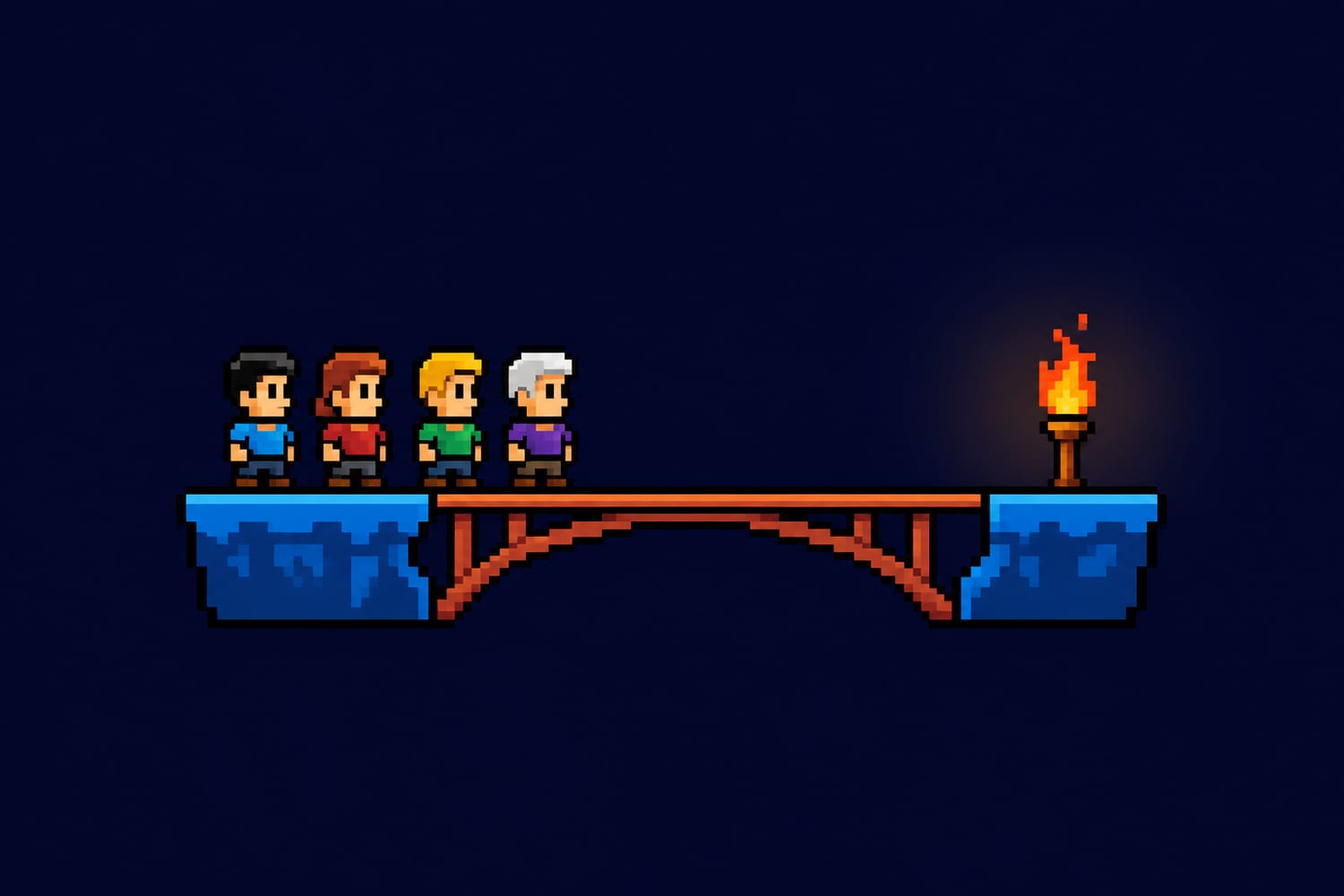
Imagine four friends standing beside a bridge at night. All four must reach the opposite side, but they have only one torch—or flashlight—to share.
Their individual crossing times are:
| Walker | Time to cross alone | |---|---:| | A | 1 minute | | B | 2 minutes | | C | 5 minutes | | D | 10 minutes |
The rules are straightforward:
- At most two people can cross at once.
- Every crossing, including a return trip, requires the torch.
- Two people crossing together travel at the slower person’s pace.
- The torch must be carried across; it cannot be thrown.
- Everyone starts on the same side and must finish on the opposite side.
So A and D take 10 minutes together, not 11. Likewise, C and D take 10 minutes together, not 15.
That distinction is the opening through which the solution appears.
Why the Obvious Plan Takes 19 Minutes
A natural first idea is to make A, the fastest walker, escort everyone across individually.
Try this:
- A and B cross: 2 minutes.
- A returns: 1 minute.
- A and C cross: 5 minutes.
- A returns: 1 minute.
- A and D cross: 10 minutes.
The total is:
2 + 1 + 5 + 1 + 10 = 19 minutes.
This is a perfectly legal solution. It simply is not the fastest one. Both the 5-minute and 10-minute crossings appear separately in the total, which makes this approach more expensive than it first seems.
The tempting assumption is that because A makes the cheapest return trips, A should always bring back the torch.
But “the cheapest next move” and “the cheapest complete plan” are not necessarily the same thing.
That is a useful moment to apply Puzzles Arcade’s counterexample test for challenging a puzzle theory: instead of accepting “A must always return,” investigate what happens if B returns once.
The 17-Minute Solution, Step by Step
The winning plan uses the two fastest walkers as a torch-delivery team while the two slowest walkers cross together.
| Step | Move | Time | Total elapsed | |---|---|---:|---:| | 1 | A and B cross | 2 minutes | 2 minutes | | 2 | A returns with the torch | 1 minute | 3 minutes | | 3 | C and D cross | 10 minutes | 13 minutes | | 4 | B returns with the torch | 2 minutes | 15 minutes | | 5 | A and B cross | 2 minutes | 17 minutes |
This is the same five-step solution presented in mathematician Richard Hoshino’s teaching resource on the bridge problem.
First, Put a Fast Walker on Each Side
A and B cross together. A then returns, leaving B waiting on the far side.
At first, this might seem like wasted movement: after three minutes, only one person has made lasting progress. But B is now in position to perform an essential job later.
Next, Send the Slow Pair Together
C and D cross in 10 minutes.
B is already waiting where they arrive. That means neither C nor D needs to bring the torch back.
Finally, Collect the Remaining Walker
B returns in 2 minutes, joining A on the starting side. They cross together in another 2 minutes.
Everyone is now across:
2 + 1 + 10 + 2 + 2 = 17.
The Clever Part: Sharing the Expensive Crossing
The key move is pairing C with D.
D must spend 10 minutes crossing at least once. When C joins that trip, the crossing still takes only 10 minutes. C’s presence adds no extra time to that particular journey.
However, grouping the slow walkers is only half the insight. The other half is preparing a fast returner on the opposite side.
Compare the two plans by separating their costs:
| Strategy | Forward crossings | Return crossings | Total | |---|---:|---:|---:| | A escorts everyone | 2 + 5 + 10 = 17 | 1 + 1 = 2 | 19 | | Slow pair crosses together | 2 + 10 + 2 = 14 | 1 + 2 = 3 | 17 |
The winning strategy spends one extra minute on returns but saves three minutes on forward crossings. The net saving is two minutes.
That is why optimizing the returns alone leads to the wrong answer. The whole schedule matters. Günter Rote’s mathematical treatment, Crossing the Bridge at Night, explains this trade-off and extends the puzzle to larger groups.
Could Anyone Beat 17 Minutes?
Finding a 17-minute schedule proves that 17 is possible. Showing that it is the minimum requires ruling out faster schedules.
Here is a counting argument derived from the rules.
First, at least five crossings are necessary. Two people can go forward, but someone must return with the torch. After another forward trip, someone must return again before the final people can cross.
Now consider two possibilities.
If C and D Never Cross Forward Together
Their forward journeys require at least 5 and 10 minutes separately. Those two crossings already cost 15 minutes.
At least three additional crossings are necessary, each taking at least one minute. That gives a lower bound of 18 minutes—already too slow to beat 17.
If C and D Cross Forward Together
Their shared trip costs 10 minutes.
At least three two-person forward trips are needed overall. To see why, notice that each forward trip followed by a return can move at most one additional person across permanently; the final forward trip can move at most two. Solo forward trips do not improve that count.
Besides the slow pair’s 10-minute journey, at least two paired forward journeys therefore remain. Each costs at least 2 minutes.
The return journeys must cost at least 3 minutes altogether. A cannot make every return: after each return A is back on the starting side, so a C-and-D crossing would leave A unable to retrieve the torch.
The minimum possible total is therefore:
10 + 2 + 2 + 3 = 17 minutes.
The displayed solution reaches that lower bound, so it is optimal.
Try Changing One Number
Now replace B’s crossing time of 2 minutes with 4 minutes.
The slow-pair strategy becomes:
4 + 1 + 10 + 4 + 4 = 23 minutes.
But having A escort everyone takes:
4 + 1 + 5 + 1 + 10 = 21 minutes.
For these new numbers, the escort strategy wins the comparison. This follows directly from substituting the new times into the two schedules.
The lesson is not “always send the slowest two together.” It is compare complete plans rather than memorizing one pattern.
For another version to explore, try NRICH’s Crossing the Bridge challenge. Its starting times are 1, 2, 7, and 10 minutes, and its interactive activity allows changes to the crossing times.
The Amazing Feat Is Better Planning
The bridge and torch puzzle rewards a small but powerful change in perspective: stop asking who should move fastest, and ask how the entire group can finish soonest.
Its opening moves prepare a later opportunity. Its slowest walkers share one expensive journey. Its fastest walkers take different roles instead of following one rigid rule.
If you enjoy puzzles where a short argument settles a seemingly complicated challenge, explore why the mutilated chessboard cannot be covered by 31 dominoes.
On this bridge, the breakthrough is not a shortcut across the gap. It is a better plan for everyone crossing it.

