
The Mutilated Chessboard: Why 31 Dominoes Can’t Cover 62 Squares
The Puzzle That Looks Perfectly Possible
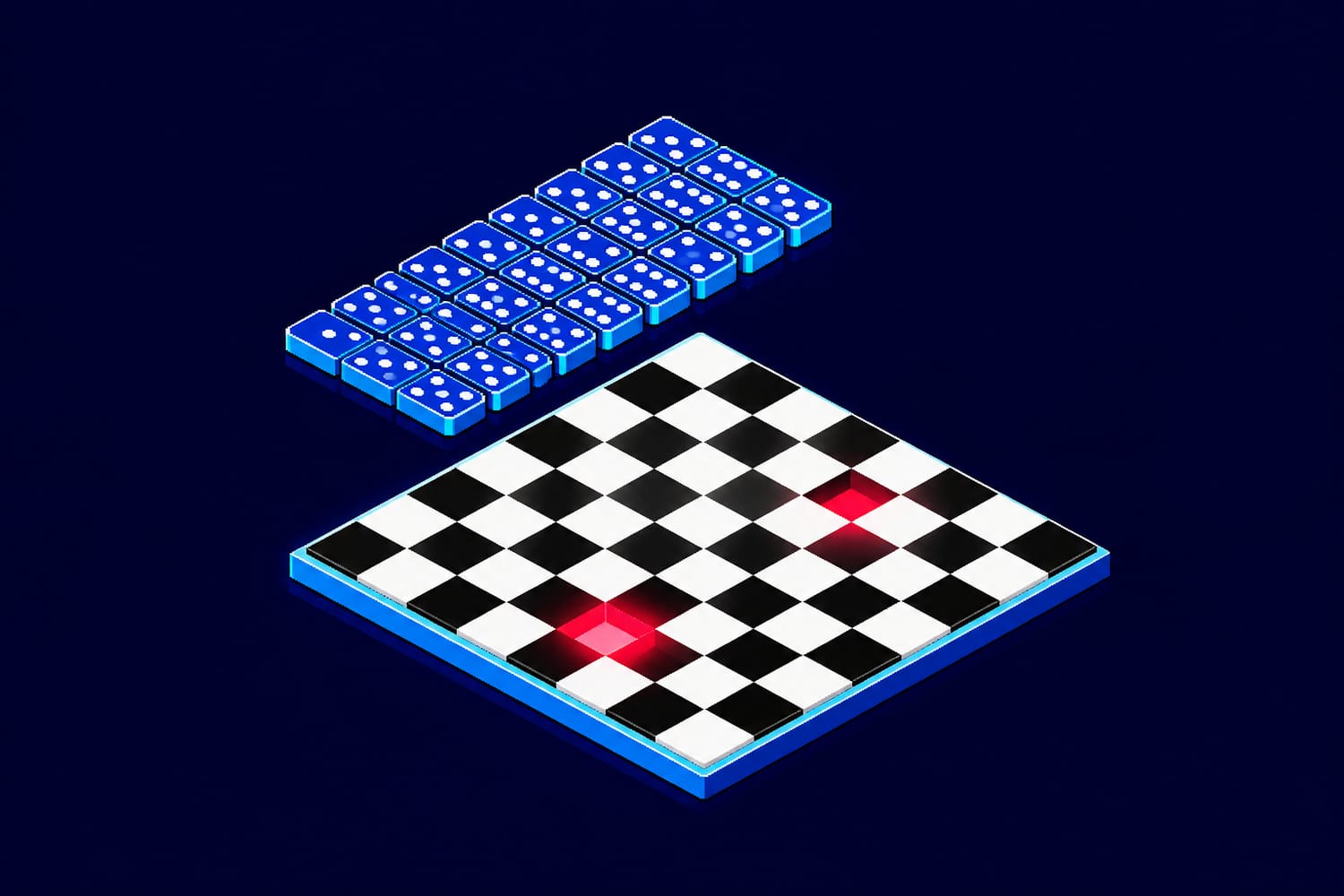
An 8 × 8 chessboard has 64 squares. Remove two diagonally opposite corners, and 62 squares remain—exactly enough space for 31 dominoes, each covering two squares. Yet no arrangement of those dominoes can cover the board. The obstacle is not the shape of the missing corners. It is the colors of the squares left behind.
That is the delight of the mutilated chessboard puzzle: the arithmetic seems to give you a green light, but a second way of counting proves the task impossible.
Imagine the board on a table, with its top-left and bottom-right corner squares cut away. You may turn each domino horizontally or vertically, but it must cover two neighboring squares. Dominoes cannot overlap, hang off an edge, or cover a missing square. Can you fit all 31?
Before reading on, give yourself a moment to picture a possible arrangement. What would you check first?
Why 62 Divided by 2 Is Not Enough
The first calculation is easy: 62 ÷ 2 = 31. If a covering exists, it must use exactly 31 dominoes. But that calculation answers only, “How many would we need?” It does not answer, “Can they fit under the rules?”
Think of trying to fill two boxes with 31 pairs of shoes. Knowing there are 62 shoes tells you the total is right. It does not help if every pair contains one left shoe and one right shoe, while the boxes require 32 left shoes and 30 right shoes.
The chessboard has a similar hidden requirement. Each domino covers two squares, but it cannot cover just any two squares. Its squares must share an edge. That small restriction makes all the difference. A City Tech classroom exploration of mutilated checkerboards invites solvers to compare boards with different squares removed—a useful reminder that the position of a missing square matters as much as the number missing.
The Color Clue
On an ordinary chessboard, dark and light squares alternate. Every row contains four of each, so the complete board has 32 dark squares and 32 light squares.
Now look at the two corners we removed. Diagonally opposite corners of an 8 × 8 chessboard have the same color. If both missing corners are dark, the board now has 30 dark squares and 32 light squares. If both are light, the counts are reversed. Either way, one color outnumbers the other by two.
What happens when you place a domino? Because it covers two squares that share an edge, it always covers one dark square and one light square. Turn it sideways or stand it upright; the rule stays the same.
So 31 dominoes would cover exactly 31 dark squares and 31 light squares. The damaged board does not have 31 of each. It has 30 of one color and 32 of the other. No rearrangement can make those counts agree. As John McCarthy’s explanation of the checkerboard proof emphasizes, coloring reveals a restriction that is easy to overlook when concentrating on the dominoes’ positions.
That is the whole proof. It does not matter whether you place the first domino near an edge, build inward from a corner, or try a dazzling zigzag. Every legal placement uses one square of each color, while the board offers unequal numbers of them.
A Closer Look at the Last Two Squares
There is another way to feel why the proof works. Suppose you place dominoes as successfully as possible. At most, you can cover 30 squares of the less common color, because those are all the squares of that color that remain. Each such domino must also cover one square of the more common color.
That uses 30 dominoes and covers 60 squares. Two squares of the more common color are left. A final domino cannot cover them: squares of the same color are never edge-neighbors on a chessboard.
In fact, you can arrange 30 dominoes to leave only two squares uncovered. If the removed corners are top-left and bottom-right, leave the other two corners uncovered as well. Each shortened top and bottom row has six available squares, and each of the six middle rows has eight. Fill each row with horizontal dominoes. The board will look almost complete—but those last two squares cannot form a legal domino pair.
This makes the result more striking. The problem is not that dominoes immediately get stuck everywhere. You can come remarkably close. Coming close, however, is different from covering the board.
Change the Missing Squares, Change the Answer
What if the two removed squares are next to each other instead? Remove the top-left and top-right corners. They have opposite colors, so 31 dark and 31 light squares remain. The color-count obstacle has disappeared.
In this particular case, you can also build a covering. On the top row, the six squares between the missing corners take three horizontal dominoes. Each of the seven complete rows below takes four. That is 3 + 7 × 4 = 31 dominoes.
The contrast teaches an important lesson. Equal color counts are necessary for a domino covering, because every domino uses one square of each color. But equal counts alone do not promise that every possible shape can be covered; its squares must also be positioned so they can be paired with neighbors. In the adjacent-corners example, we know the covering works because we can describe an actual arrangement.
If you enjoy turning puzzle rules into deductions, Puzzles Arcade’s guide to reading puzzle rules like a designer offers another way to practice that habit. The key question here is not merely “How many dominoes?” but “What must every domino do?”
The Amazing Feat Is Proving You Can Stop
Many puzzles reward persistence: try another pattern, undo a move, search for the opening you missed. This one rewards a different skill—recognizing when no amount of searching can succeed.
The color counts are an invariant: a property that every legal domino placement respects. You may change where the dominoes go, but you cannot change the fact that each covers one dark and one light square. Once you notice that rule, you can rule out all arrangements at once instead of testing them one by one. For another accessible look at why coloring is so useful in mathematics, see Quanta Magazine’s discussion of this chessboard puzzle.
The same mindset can help with other grid challenges. Ask whether every move pairs two kinds of spaces, changes a total by a fixed amount, or preserves a pattern you can count. Puzzles Arcade’s divide-and-conquer puzzle guide explores the broader idea of sorting a complicated-looking challenge into useful categories.
The mutilated chessboard begins with a tempting equation: 62 squares, 31 dominoes. It ends with a stronger one: 30 squares of one color, 32 of the other, and one of each beneath every domino. Sometimes the cleverest move is not finding the perfect placement. It is discovering why no perfect placement could exist.

