
The 17 Camels Puzzle: How Borrowing One Camel Solves an Impossible Inheritance
The Inheritance That Wouldn’t Divide
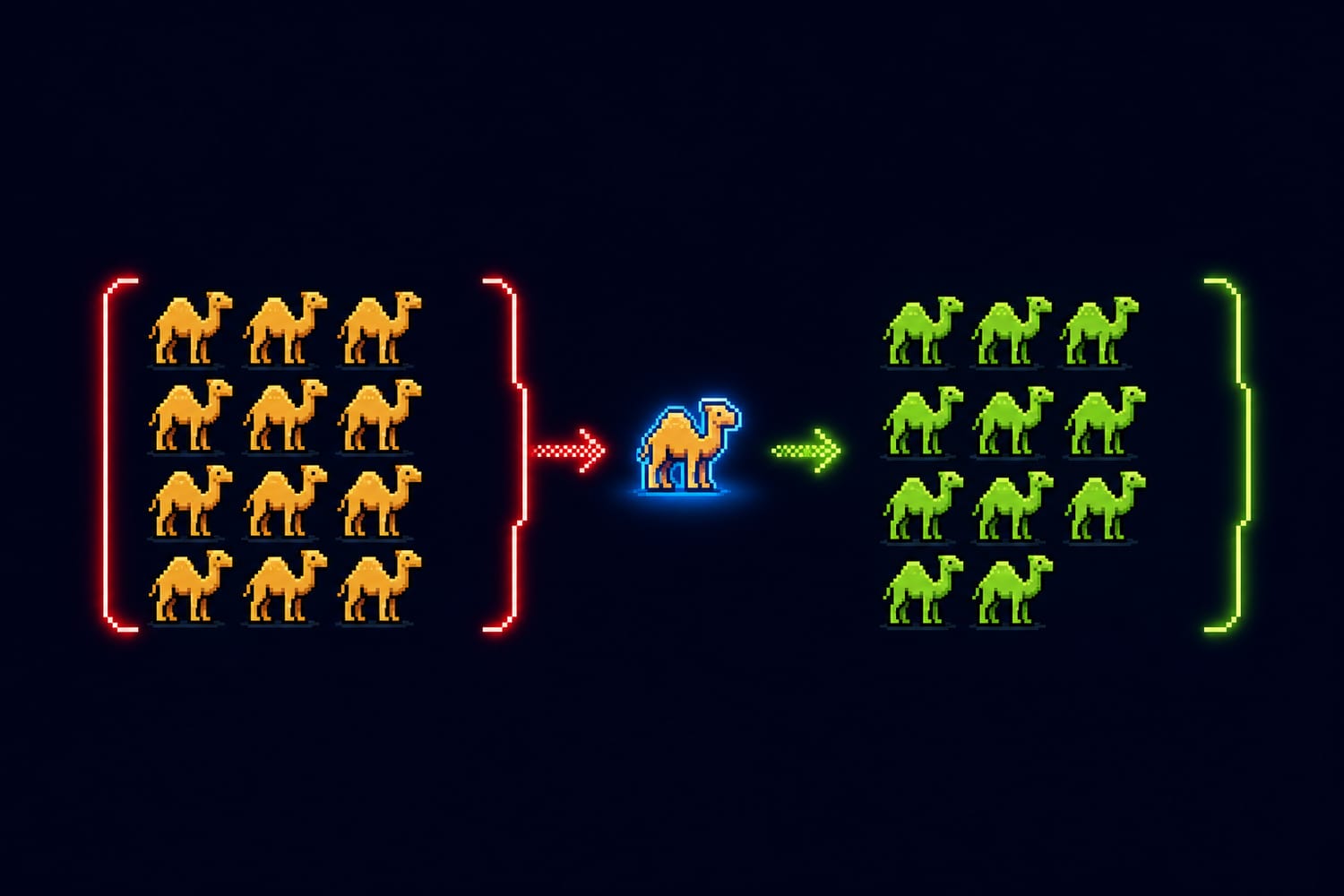
The 17 camels puzzle has a wonderfully simple solution: borrow one camel, divide the resulting herd of 18, and return the borrowed animal. The three heirs receive 9, 6, and 2 camels—exactly 17 altogether. But there is a catch worth exploring: the borrowed camel makes the arithmetic work by changing the number used to calculate each share.
Imagine three siblings whose father leaves them 17 camels. His instructions say that the eldest should receive half the herd, the middle sibling one-third, and the youngest one-ninth. No one wants to divide an actual camel into pieces, yet 17 cannot be divided evenly by 2, 3, or 9.
Then a traveler arrives with a camel of their own. “Borrow mine,” the traveler suggests. It sounds like an odd way to settle an inheritance. How can adding an animal that does not belong to the family help them divide the animals that do?
One Borrowed Camel, Three Whole-Number Shares
With the traveler’s camel standing beside the original herd, there are 18 camels. Suddenly, every requested fraction produces a whole number:
| Heir | Stated share | Calculated from 18 | Camels received | |---|---:|---:|---:| | Eldest | One-half | 18 ÷ 2 | 9 | | Middle | One-third | 18 ÷ 3 | 6 | | Youngest | One-ninth | 18 ÷ 9 | 2 |
Add the shares: 9 + 6 + 2 = 17. One camel remains, so the traveler takes it back. All 17 inherited camels have been handed out, no animal has been split, and the traveler has lost nothing. This is the familiar solution described in mathematician Ian Stewart’s telling of the vanishing-camel puzzle.
The result feels almost like a magic trick. The best part, though, is that you can check every move. The traveler does not secretly contribute a camel to someone’s share: the heirs collectively receive 17, and the traveler leaves with one.
Why the Numbers Add Up to 17, Not 18
The key is that the father’s fractions do not add up to a whole herd. To see this, rewrite them with the same denominator:
1/2 + 1/3 + 1/9 = 9/18 + 6/18 + 2/18 = 17/18
In other words, the three promised shares account for 17 of every 18 equal parts. There is always one part left over when these fractions are applied to a herd of 18. That leftover part is one camel.
Now the traveler’s plan looks less mysterious. Eighteen is divisible by 2, 3, and 9, so each heir’s share is a whole number. At the same time, the fractions distribute only 17/18 of those 18 camels. That is precisely 17 camels, leaving the borrowed one available to return. Tangente’s explanation of the camel puzzle lays out this neat change of herd size.
The missing eighteenth is the secret. If the shares had added up to all 18/18, there would be no camel left for the traveler to reclaim.
Is This Really the Exact Inheritance the Father Requested?
Here is the question that turns a charming answer into a genuinely interesting puzzle: half of which herd?
The father owned 17 camels, not 18. Half of his herd is 8½ camels, one-third is 5⅔ camels, and one-ninth is 1⅞ camels. Those are the exact mathematical shares of the original herd. None is a whole animal.
The traveler instead calculates each fraction from an enlarged, temporary herd of 18. As a result, the eldest receives 9 rather than 8½; the middle sibling receives 6 rather than 5⅔; and the youngest receives 2 rather than 1⅞. Each gets a little more than the literal fraction of 17. As mathematician Sarah Hart explains in her discussion of mathematical puzzles and paradoxes, the trick works partly because the stated fractions do not allocate the entire original herd.
That distinction matters. The borrowed-camel solution is a practical agreement the heirs might happily accept, not a way of making 9 equal to half of 17. It avoids fractional animals by sharing out the portion that the original instructions left unallocated.
There is another way to describe the outcome. The numbers 9, 6, and 2 preserve the relative sizes of the requested shares: half is larger than one-third, which is larger than one-ninth, in exactly the intended proportions. Once all 17 animals have been distributed, however, the heirs own 9/17, 6/17, and 2/17 of the original herd—not literally one-half, one-third, and one-ninth of it.
Why Borrowing One Camel Doesn’t Always Work
The traveler is clever, but this is not a universal recipe for awkward inheritances. Two things must happen together: adding one must make the fractions produce whole animals, and the calculated shares must add up to exactly the number of animals originally owned.
The classic puzzle happens to meet both conditions. With 17 camels, adding one gives 18; the shares become whole numbers; and their total is 17.
Try a similar thought experiment with 35 camels and the same fractions. Borrowing one gives a herd of 36. Half is 18, one-third is 12, and one-ninth is 4. Those shares add up to 34, leaving two camels behind. The traveler can reclaim one, but one of the original 35 remains undistributed. The divisions are tidy; the inheritance is not completely settled.
This is a valuable habit for any number puzzle: check the final total as well as the individual calculations. A result can look promising at every step and still fail the last test. Puzzles Arcade’s guide to breaking overwhelming puzzles into smaller checks offers a useful approach when several rules must hold at once.
Try the Trick With a New Herd
Want to see whether you have the idea? Consider an invented variation with 11 horses. Three heirs are promised one-half, one-third, and one-twelfth of the herd. Can one borrowed horse make the division work?
Start with the fractions:
1/2 + 1/3 + 1/12 = 6/12 + 4/12 + 1/12 = 11/12
Borrow one horse and the herd becomes 12. The shares are now 6, 4, and 1—a total of 11. The twelfth horse can go home with its owner. Just as with the camels, the heirs have received whole animals in the requested proportions, but their shares were calculated from the temporarily enlarged herd.
To invent your own version, work backward. Pick a convenient herd size that divides evenly by all the fractions’ denominators. If the resulting whole-number shares add up to one less than that herd size, you have a one-animal borrowing puzzle.
The Small Change That Makes the Big Difference
The 17 camels puzzle earns its place among memorable mathematical feats because its answer is both simple and subtle. One borrowed animal changes 17 into 18, turning three awkward fractions into whole-number shares. Then the fact that those fractions total only 17/18 leaves exactly one animal to return.
The deeper lesson is not that mathematics can make an impossible division literally exact. It is that a fresh way to frame a problem can produce a useful answer—provided you keep track of what changed. That same willingness to question an initial assumption makes other classics, such as the Monty Hall problem, so rewarding to explore.
The traveler leaves with a camel. The heirs leave with 17. And the rest of us leave with a good question to ask whenever a puzzle seems impossible: What happens if we change the way we count?

