
The Monty Hall Problem: The Three-Door Puzzle That Turned Common Sense Upside Down
Three Doors, One Choice That Changes Everything
In the classic Monty Hall problem, you should switch doors. Your first pick has a 1-in-3 chance of hiding the prize. After a host who knows where the prize is deliberately reveals a losing door, switching wins whenever your first pick was wrong—which is 2 times out of 3.
That answer can feel impossible. Once a door is opened, only two remain. Shouldn’t each have a 50–50 chance? The puzzle’s remarkable feat is showing why two remaining choices are not necessarily equally likely choices.
Step Onto the Game-Show Stage
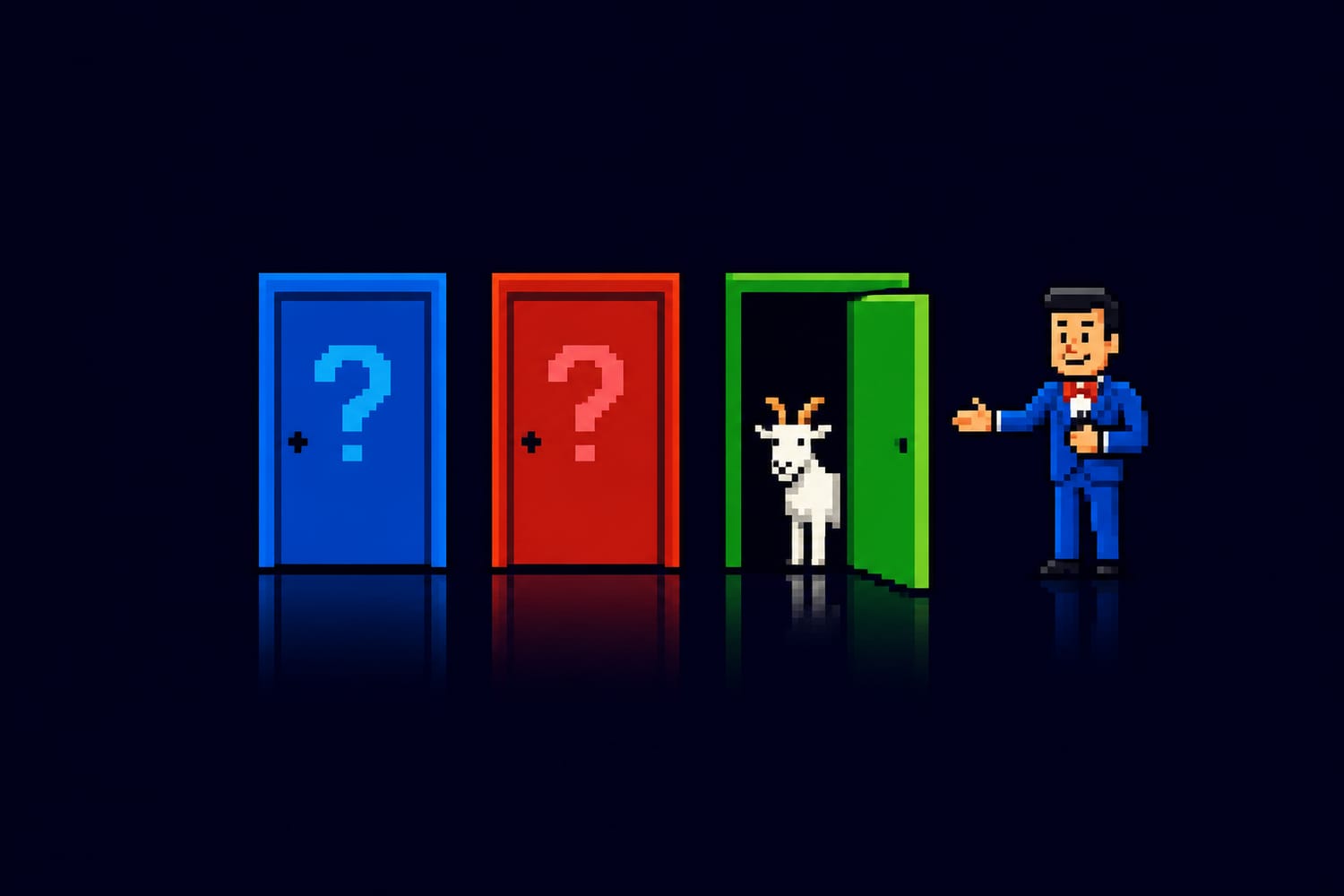
Imagine three closed doors. Behind one is a car; behind the other two are goats. You choose Door 1.
The host knows what is behind every door. Rather than opening your choice, the host opens another door—say, Door 3—and reveals a goat. Then comes the question: Do you keep Door 1, or switch to Door 2?
Before you decide, the rules need to be clear:
- The car was equally likely to be behind any of the three doors when you made your first choice.
- The host knows where the car is.
- The host always opens a door you did not choose, always reveals a goat, and always offers you the chance to switch.
Under those rules, switching gives you a 2-in-3 chance of winning the car. Staying gives you a 1-in-3 chance. The host’s predictable behavior is essential: this is not a stranger opening a door at random and luckily finding a goat.
The Answer Hiding in Your First Pick
When you initially choose one of three doors, there is one way to pick the car and two ways to pick a goat. So your first choice is right one-third of the time and wrong two-thirds of the time.
Now consider what switching actually does:
- If you picked the car first, the host opens a goat door. Switching takes you away from the car, so you lose.
- If you picked a goat first, the host must open the other goat door. The only unopened door you did not pick hides the car, so switching wins.
That is the entire strategy. Switching wins exactly when your first pick was wrong. Because your first pick was wrong two-thirds of the time, switching wins two-thirds of the time. Staying wins only when your first pick was right: one-third of the time.
Here is the same reasoning with Door 1 as your initial pick:
| Car’s location | What the host can reveal | Stay with Door 1 | Switch | |---|---|---|---| | Door 1 | A goat behind Door 2 or 3 | Win | Lose | | Door 2 | The goat behind Door 3 | Lose | Win | | Door 3 | The goat behind Door 2 | Lose | Win |
The three car locations are equally likely. Switching wins in two of them. No advanced formula is required—just a careful look at every possible starting arrangement.
Why Two Doors Do Not Mean Fifty–Fifty
The 50–50 instinct is understandable. We see two closed doors and want to divide the chance evenly. But the doors did not arrive at this moment in the same way.
Your door survived because you chose it before learning anything. The other closed door survived because the knowledgeable host deliberately removed a goat door from the pair you did not choose. Those are different stories, even though both doors look identical from the outside.
At the start, your door has a 1-in-3 chance of hiding the car. Together, the two doors you did not choose have a 2-in-3 chance. The host’s reveal identifies a goat within that pair. Under the classic rules, if your door was wrong, the unopened door in that pair must be right.
It helps to think of switching as choosing the other-door team. At first, that team has two doors and a 2-in-3 chance of containing the car. The host then points out a losing member of the team, leaving you one door to switch to. For a deeper explanation of why the host’s decision matters, see the University of California, Berkeley’s discussion of the Monty Hall problem.
Make the Puzzle Bigger: Try 100 Doors
If three doors still feel slippery, imagine 100 doors instead. One hides a car; 99 hide goats. You choose Door 1.
Your chance of choosing the car immediately is just 1 in 100. The chance that the car is behind one of the other 99 doors is 99 in 100.
Now the host, who knows every door’s contents, opens 98 of those other doors and reveals 98 goats. Just two doors remain closed: your original Door 1 and one other.
Would you switch now? Most people would. Your first choice was almost certainly a goat, and the host has carefully cleared away the other goat doors without exposing the car. Switching wins in 99 of the 100 equally likely starting arrangements; staying wins in only one. The 100-door version does not change the trick—it makes the original three-door logic easier to see.
The Rules Are Part of the Puzzle
There is an important catch: “always reveals a goat” is not the same as “happened to reveal a goat.”
Suppose the host does not know where the car is and opens one of the two unchosen doors at random. Sometimes that door would reveal the car, ending the game. If it happens to reveal a goat instead, the situation is different from the classic puzzle: with equally likely car locations and a random door opening, the two still-closed doors are equally likely to hide the car. Switching then offers no advantage.
Or imagine a host who offers the chance to switch only on certain occasions. You would need to know that policy before working out the odds. The familiar two-thirds answer belongs to the clearly defined game in which the informed host always reveals a goat and always offers a switch. It is a useful reminder that a puzzle’s instructions are clues, not decoration.
How a Door Puzzle Became Famous
The puzzle takes its name from Monty Hall, the host of the television game show Let’s Make a Deal. It became especially famous after Marilyn vos Savant answered a version of it in her Parade column in 1990. She recommended switching, and many readers challenged her answer. Parade’s account of the debate shows just how persuasive the incorrect 50–50 intuition can be. The mathematical puzzle is based on a game-show setting; its carefully specified rules should not be mistaken for a claim that every real game-show round followed them.
The disagreement is part of the story’s appeal. You do not need to be careless or bad at math to find the answer surprising. You simply need to overlook that the host’s reveal is guided by knowledge. The moment you account for that rule, the apparent paradox begins to disappear.
Test It for Yourself
You can run the puzzle with three cups and a small object as the “car.” Ask someone to hide the object under one cup, choose a cup without looking, and have that person reveal an empty unchosen cup. They must always do this, even if your first choice was correct. Record whether you would win by staying and whether you would win by switching, then repeat.
A few rounds may look uneven because short streaks happen. Over many rounds with the car placed fairly, staying should win about one-third of the time and switching about two-thirds of the time. Even without an experiment, the three-row table above proves why.
That is what makes the Monty Hall problem such a satisfying feat of reasoning. The winning move is simple, but understanding it asks us to look beyond the doors and notice how information was revealed. If you enjoy strategies that overturn first impressions, explore the 100 prisoners puzzle and its surprising odds, or try the world’s hardest logic puzzle, where the rules governing an answer matter just as much as the answer itself.

