
God’s Number: The Proof That Every Rubik’s Cube Scramble Can Be Solved in 20 Moves
The Short Answer: 20 Moves Are Always Enough
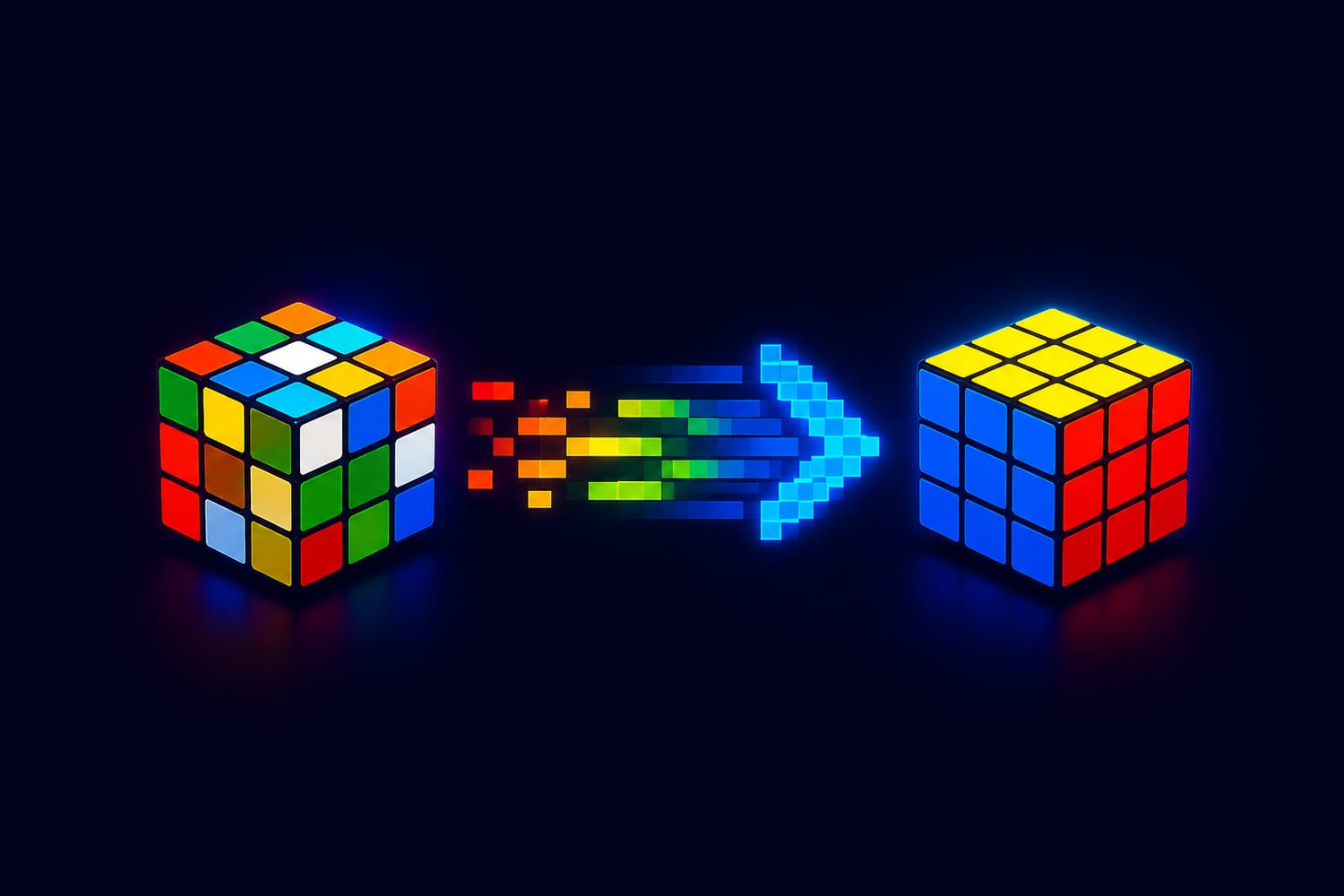
Every legally scrambled standard 3×3×3 Rubik’s Cube can be solved in 20 moves or fewer, provided each face turn—including a 180-degree turn—counts as one move. This maximum is called God’s Number, and a computer-assisted mathematical proof established that the number is exactly 20, not merely an estimate.
What Does “God’s Number” Mean?
Imagine knowing the shortest possible route from every Rubik’s Cube position back to the solved state. That perfect solving method is sometimes called God’s Algorithm because it would never waste a move.
God’s Number answers a related question:
What is the greatest number of moves that God’s Algorithm would need for the most difficult possible position?
The answer for the standard 3×3×3 Cube is 20.
This does not mean every scramble requires 20 moves. Most can be solved optimally in fewer. It means that no legal position is farther than 20 moves from solved—and that at least one position genuinely needs all 20.
That final detail is essential. To prove that God’s Number equals 20, researchers had to establish two separate facts:
- Lower bound: Some positions cannot be solved in fewer than 20 moves.
- Upper bound: Every position can be solved in no more than 20 moves.
Only when those bounds met could mathematicians declare the answer exact.
What Counts as One Move?
The number 20 depends on how moves are counted. The 2010 result used the half-turn metric, also commonly called the face-turn metric.
Under this system:
- Turning a face 90 degrees counts as one move.
- Turning it 180 degrees counts as one move.
- Turning it 270 degrees counts as one move because that is equivalent to one 90-degree turn in the opposite direction.
For example, R, R2, and R' each count as one move. The letter R means turning the right face, 2 indicates a half-turn, and the apostrophe means turning counterclockwise.
Under the quarter-turn metric, a 180-degree turn counts as two moves. With that rule, God’s Number for the Cube is 26, not 20. The famous claim is therefore correct only when its move-counting system is understood.
A Puzzle With 43 Quintillion Positions
A Rubik’s Cube has precisely:
43,252,003,274,489,856,000 reachable positions
That is approximately 43 quintillion. Yet this enormous number does not include every arrangement you could create by pulling the Cube apart and reassembling it incorrectly. It counts only positions reachable through legal face turns.
The size of this puzzle universe makes the 20-move result feel almost unbelievable. A scrambled Cube can appear hopelessly disordered, with corners twisted, edges flipped and colors scattered across all six faces. Nevertheless, the solved position is never more than 20 correctly chosen moves away.
The important words are correctly chosen. There may be many bad routes, long routes and routes that undo their own progress. God’s Number concerns the shortest available route, not the first solution someone happens to find.
For another example of an enormous search space being conquered through mathematics and computing, explore the 17-clue Sudoku challenge.
The Superflip Established the Lower Bound
By the early 1980s, counting arguments had shown that some Cube positions required at least 18 moves. There simply were not enough distinct move sequences of 17 moves or fewer to reach every possible position.
The breakthrough to 20 came in 1995, when Michael Reid proved that a special position called the superflip requires at least 20 face turns. In the superflip, all eight corners are solved and all 12 edge pieces occupy their correct locations—but every edge is flipped.
It looks orderly compared with a random scramble, yet its hidden orientation problem makes it exceptionally distant from the solved state.
Once the superflip had been proved to require 20 moves, researchers knew God’s Number could not be 19 or lower. In mathematical language, 20 had become the lower bound. The remaining challenge was much larger: proving that no position anywhere in the Cube’s 43-quintillion-position universe required 21 or more.
How Researchers Proved That 20 Moves Always Suffice
In July 2010, Tomas Rokicki, Herbert Kociemba, Morley Davidson and John Dethridge completed the computer-assisted proof that God’s Number is exactly 20. Their result was later described formally in the SIAM paper The Diameter of the Rubik’s Cube Group Is Twenty.
They did not simply ask a computer to try every possible solution from every possible position. That approach would have been overwhelmingly inefficient. Instead, they combined group theory, symmetry, search algorithms and carefully optimized software.
The process can be summarized in five stages:
Divide the Cube’s positions into sets.
The team partitioned all 43 quintillion positions into 2,217,093,120 large sets known mathematically as cosets.Use symmetry to remove repeated work.
A Cube viewed from a different orientation may represent an equivalent problem. Rotational and mirror symmetries allowed the researchers to study one case and apply its result to many others.Reduce the required search.
Through symmetry and a mathematical technique involving set covering, the number of sets requiring direct examination fell to 55,882,296.Search for solutions of 20 moves or fewer.
The software did not have to find the absolute shortest solution for every position. Because the superflip had already proved the lower bound, the researchers only needed to demonstrate that every position had some solution no longer than 20 moves.Run the computation at enormous scale.
Google donated idle computing resources amounting to approximately 35 CPU-years. The team’s optimized program could process a complete set in about 20 seconds.
The researchers’ God’s Number project site explains the proof, its history and the reduction techniques in reader-friendly terms. It also makes source code and examples available for examination.
Why Symmetry Made the Impossible Manageable
Suppose you scramble a Cube, rotate the entire object in your hands and place it back on the table. The colors now face different directions, but the puzzle has not become fundamentally harder. A solution can be rotated along with the Cube.
That simple observation creates enormous computational savings. There are 24 ways to orient a Cube in space, and mirror-related cases provide further reductions. Instead of repeatedly solving equivalent problems, researchers could solve one representative and transfer the result.
This is a powerful lesson in puzzle solving and computer science: sometimes the biggest improvement comes not from working faster, but from recognizing that several apparent problems are really the same problem in disguise.
A similar structural idea appears in the classic 15-puzzle and its impossible arrangement, where hidden mathematical rules determine which positions are reachable.
What the Proof Does Not Mean
God’s Number is often misunderstood. It does not mean:
- A beginner can look at any Cube and immediately solve it in 20 moves.
- Every memorized beginner method produces a 20-move solution.
- Every speedcuber regularly solves in 20 moves or fewer.
- Any sequence of 20 turns will solve the Cube.
- A 20-move scramble must take 20 moves to reverse optimally.
A scramble may contain unnecessary turns. For example, moving one face clockwise and then immediately counterclockwise changes nothing, even though two moves were made. A long scramble can also finish at a position that has a much shorter route back.
Likewise, ordinary solving methods are designed to be understandable, memorable and reliable—not perfectly move-efficient. A human solver might use dozens of moves because the method handles the Cube in manageable stages. An optimal computer solver can search for a shorter route, although finding that route may demand far more calculation.
God’s Number Versus Speedcubing
Move count and solving time are different measurements. A 20-move solution is not automatically the fastest solution for a human to perform. It may contain awkward turns, pauses or difficult-to-recognize patterns.
Speedcubers usually favor methods that let them recognize and execute familiar sequences rapidly. Those solutions can use more moves while taking less time. Efficient finger movements, advance planning and smooth transitions may matter more than achieving the mathematical minimum.
This distinction helps explain how competitors can produce astonishing performances without following God’s Algorithm. You can learn more about that side of cubing in the story of solving a 3×3×3 Cube in under four seconds.
God’s Algorithm asks, “What is the shortest route?” Speedcubing asks, “What route can this person execute fastest?” Those questions overlap, but they are not identical.
Why This Proof Is Such an Amazing Feat
The achievement was not merely about solving a popular toy. It demonstrated how mathematics and computing can cooperate to settle a question too large for unaided calculation.
Human insight supplied the structure: group theory, symmetry, partitions and intelligent search methods. Computers supplied the speed and persistence needed to examine millions of reduced cases without skipping one.
The conclusion is wonderfully simple:
Every legal 3×3×3 Rubik’s Cube position has a solution of 20 face turns or fewer.
Behind that one sentence lies a search across a universe of 43 quintillion positions, decades of improving bounds and approximately 35 CPU-years of computation. The Cube may still confuse us when we hold it in our hands, but mathematically, no scramble is ever more than 20 perfect moves from home.

