
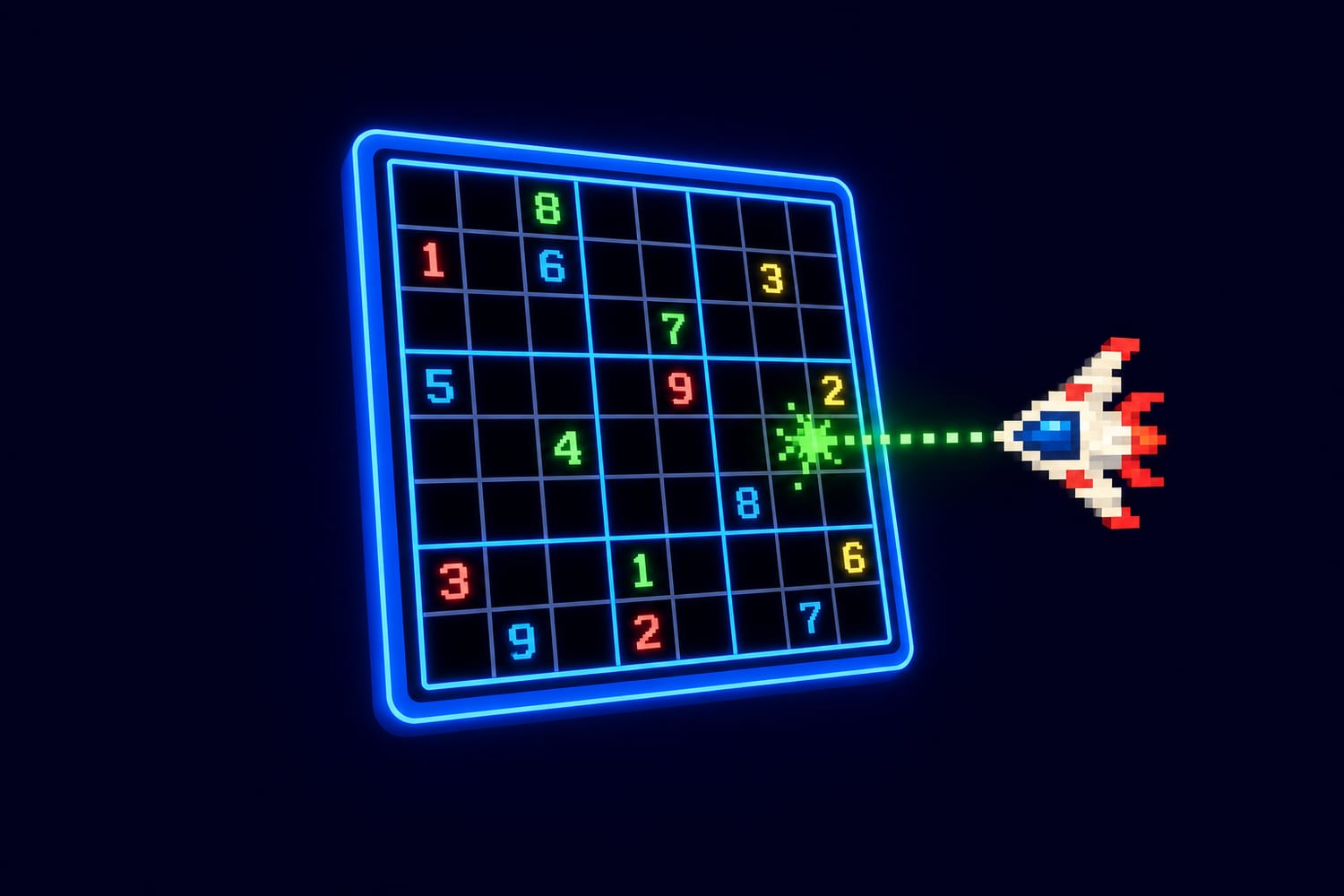
The 17-Clue Sudoku Challenge: How Solvers Crack the World’s Sparsest Grids
Why 17 Clues Is a Big Deal
Sudoku looks simple: fill a 9×9 grid so that every row, column, and 3×3 box contains the digits 1 through 9. But behind that tidy rule is a surprisingly deep mathematical world. One of its most fascinating achievements is the 17-clue Sudoku puzzle—a valid Sudoku puzzle that begins with only 17 given numbers.
That is astonishingly sparse. A standard Sudoku grid has 81 cells, so a 17-clue puzzle gives you just over one-fifth of the information up front. The rest must be discovered through logic, search, or a combination of both.
The key word here is valid. In Sudoku, a proper puzzle must have exactly one solution. If a puzzle has no solution, it is broken. If it has two or more solutions, it is ambiguous. The challenge is not merely to place a few numbers on a grid—it is to place so few numbers that the final solution is still forced.
For years, Sudoku fans wondered: could there be a valid puzzle with only 16 clues? What about 15? The question became one of the great “amazing feats” of recreational mathematics. In 2012, mathematician Gary McGuire, along with Bastian Tugemann and Gilles Civario, proved that no standard 9×9 Sudoku puzzle with 16 clues can have a unique solution.
That means 17 is the minimum.
The Difference Between Sparse and Difficult
It is tempting to assume that fewer clues always means a harder puzzle. Surprisingly, that is not always true.
A 17-clue Sudoku puzzle is “sparse,” meaning it starts with very little information. But difficulty depends on how that information is arranged. Some puzzles with more than 25 clues can be brutally hard, while some 17-clue puzzles can be solved with a manageable chain of logical deductions.
Think of it like a treasure map. A map with only a few landmarks might still lead you clearly to the treasure if those landmarks are perfectly chosen. Another map with many landmarks might be confusing if they are placed in awkward or misleading ways.
Sudoku difficulty comes from several factors:
- How quickly the first deductions appear
- Whether basic techniques are enough
- How many candidate possibilities remain in each cell
- Whether advanced patterns are needed
- Whether the solver must use long chains of reasoning
- Whether the puzzle “opens up” after one key discovery
So, a 17-clue puzzle is not automatically the hardest kind of Sudoku. But it is always special because it sits at the edge of what is mathematically possible.
How a Sudoku Grid Hides Its Solution
Every Sudoku puzzle begins with a completed solution grid. From that finished grid, some numbers are revealed as clues. The puzzle designer’s job is to remove as many numbers as possible while preserving a unique solution.
This is much harder than it sounds. If you remove too many clues, the grid may allow multiple completed solutions. If you leave too many, the puzzle may not be very elegant or challenging. A 17-clue puzzle is like a carefully balanced bridge: remove one wrong support and the whole structure collapses into ambiguity.
To understand why uniqueness is so important, imagine a Sudoku where a certain empty cell could be either 4 or 7, and both choices lead to complete valid grids. There would be no logical reason to prefer one over the other. That puzzle would fail as a Sudoku challenge because it would not have one correct answer.
The art of 17-clue Sudoku is finding clue placements that force one—and only one—completed grid out of an enormous sea of possibilities.
And that sea is truly enormous. There are
6,670,903,752,021,072,936,960
possible completed standard Sudoku grids. That is about 6.67 sextillion. Even after accounting for symmetries such as rotating, reflecting, or relabeling digits, there are still billions of essentially different completed grids.
No wonder finding and proving the minimum number of clues took serious computational power.
The Great 16-Clue Question
For a long time, Sudoku researchers knew many valid 17-clue puzzles existed. Gordon Royle, a mathematician and Sudoku researcher, famously maintained a large collection of 17-clue puzzles, with tens of thousands catalogued.
But the big question remained: Could there be a 16-clue Sudoku with a unique solution?
At first glance, this sounds like a simple search problem. Just try every possible arrangement of 16 clues and check whether any produce a unique solution. But the number of possible arrangements is unbelievably large. Even with computers, a direct brute-force search would be wildly inefficient.
The breakthrough came from using a clever mathematical idea called unavoidable sets.
An unavoidable set is a group of cells in a completed Sudoku grid with an important property: if none of those cells are given as clues, then the puzzle cannot have a unique solution. In other words, every valid puzzle based on that grid must include at least one clue from each unavoidable set.
This allowed researchers to reduce the problem. Instead of checking every possible 16-clue arrangement blindly, they could show that any valid puzzle would need to “hit” all these unavoidable sets. If no 16 clues could hit them all in the required way, then no valid 16-clue puzzle existed for that solution grid.
McGuire, Tugemann, and Civario used a massive exhaustive computation to prove the result across all possible grids, accounting for symmetries and equivalences. Their conclusion was clear:
There are no uniquely solvable 16-clue standard Sudoku puzzles.
That made 17 not just a record, but a proven lower limit.
How Human Solvers Approach 17-Clue Puzzles
Solving a 17-clue Sudoku begins like any other Sudoku: with observation. The solver asks, “Where can this number go?” and “What numbers are possible in this cell?”
A common first step is to write small candidate numbers in empty cells. These candidates represent the digits that might legally fit based on the row, column, and box.
From there, solvers use techniques such as:
- Naked singles: A cell has only one possible candidate.
- Hidden singles: A digit can go in only one place within a row, column, or box.
- Naked pairs and triples: Two or three cells share the same limited candidates, allowing eliminations elsewhere.
- Pointing pairs/triples: Candidates in a box line up in one row or column, eliminating possibilities outside the box.
- Box-line reduction: A row or column restricts a candidate to one box.
- X-Wing and other fish patterns: Candidates form geometric patterns that remove other candidates.
- Chains and coloring: Solvers follow linked possibilities to prove that certain candidates must be true or false.
Some 17-clue puzzles can be solved by humans using elegant logic. Others may require advanced techniques or carefully controlled trial reasoning. Importantly, responsible solvers distinguish between random guessing and structured analysis. A logical “if this, then that” chain can be a valid solving method if it leads to a contradiction or forced conclusion.
How Computers Crack the Sparse Grids
Computers approach Sudoku differently from most humans. A program does not need the puzzle to feel elegant. It can explore possibilities quickly, reject contradictions, and verify uniqueness with precision.
One common computational method treats Sudoku as an exact cover problem. In an exact cover problem, the goal is to choose a set of options so that every requirement is satisfied exactly once. Sudoku fits beautifully into this framework:
- Each cell must contain one digit.
- Each row must contain each digit once.
- Each column must contain each digit once.
- Each 3×3 box must contain each digit once.
Donald Knuth’s Algorithm X, often implemented with a technique called Dancing Links, is especially famous for solving exact cover problems efficiently. Sudoku programs can use this method to find solutions or confirm that only one solution exists.
Another approach is backtracking search. The computer selects an empty cell, tries a candidate, and continues. If it reaches a contradiction, it backtracks and tries another candidate. Smart programs improve this by choosing the most constrained cell first—the one with the fewest candidates—because that is most likely to expose contradictions quickly.
For generating 17-clue puzzles, computers often start with a complete grid, remove clues, and test uniqueness repeatedly. But finding truly minimal puzzles requires careful strategy. Random removal usually does not work well because most 17-clue arrangements do not produce unique puzzles.
Why 17-Clue Puzzles Feel Magical
A good 17-clue Sudoku has a sense of mystery. At the start, the grid may look almost empty. You might wonder how such a small amount of information could determine all 81 cells. Yet if the puzzle is valid, every digit is already locked in by invisible relationships.
That is the magic of constraints.
Sudoku is not about arithmetic. You never add, subtract, multiply, or divide. Instead, Sudoku is about relationships: this digit cannot go here because it already appears there; that cell must be a 6 because every other place is blocked; these two cells control those three candidates.
In a 17-clue puzzle, those relationships stretch across the grid like a hidden web. Pull one thread, and something far away may move. A number placed in the top-left box might eliminate a candidate in a row, which affects a column, which forces a digit in the bottom-right box.
This is why Sudoku appeals to so many people. Beginners can enjoy simple puzzles with basic scanning, while experts can explore deep patterns, mathematical proofs, and computer-assisted discoveries.
What the 17-Clue Challenge Teaches Us
The 17-clue Sudoku challenge is more than a puzzle curiosity. It shows how a familiar newspaper game connects to serious mathematics and computer science.
It teaches us about:
- Combinatorics, the study of counting and arranging possibilities
- Logic, because every valid Sudoku solution must be forced
- Algorithms, which help computers search enormous spaces efficiently
- Proof, because finding many 17-clue puzzles was not enough; researchers had to prove that 16 was impossible
- Human creativity, because puzzle designers and solvers continue to find beauty in these sparse grids
The story also highlights an important lesson: sometimes the hardest achievement is not finding an example, but proving that no smaller example can exist. Before 2012, people knew 17-clue puzzles were possible. After the proof, the Sudoku world knew they were minimal.
That changed the question from “How low can we go?” to “How many beautiful ways can 17 clues define an entire grid?”
A Tiny Puzzle With a Giant Legacy
The 17-clue Sudoku challenge is one of the great feats of modern puzzle culture. It combines the patience of human solvers, the inventiveness of puzzle makers, and the power of mathematical proof.
A nearly empty grid may not look impressive at first. But when just 17 numbers uniquely determine the other 64, you are looking at an extraordinary structure. Every clue matters. Every absence matters. Nothing is wasted.
That is what makes the world’s sparsest Sudoku grids so fascinating. They remind us that complexity can grow from simplicity, that logic can reveal hidden order, and that even a humble number puzzle can lead to discoveries big enough to challenge mathematicians and computers alike.

