
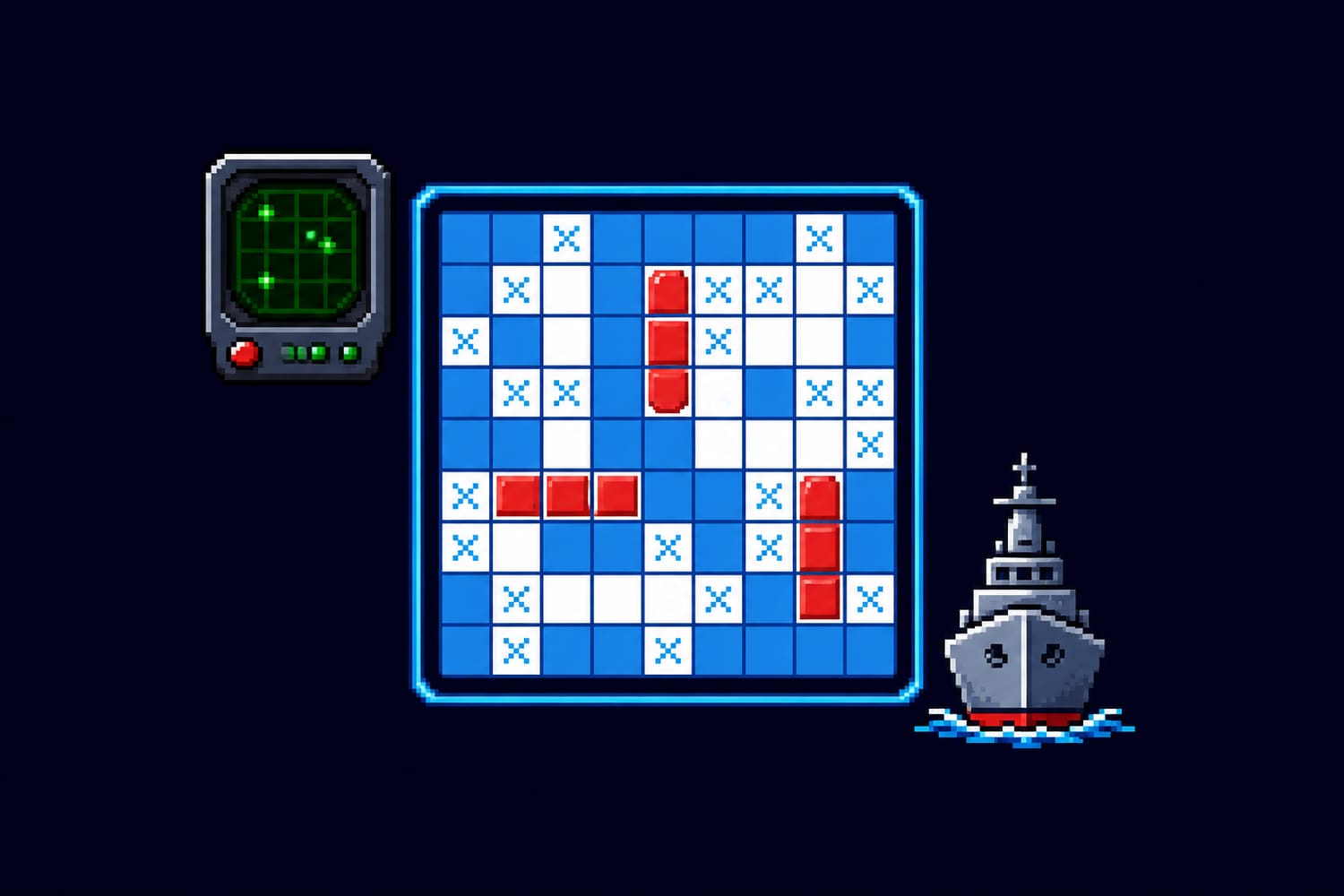
How to Solve Battleship Logic Puzzles: Row Counts, Ship Sizes, and Forced Water
To solve Battleship logic puzzles, combine three kinds of information: row and column counts, the fleet’s ship sizes, and squares that must be water. Start with zero-count lines and given clues, then update crossing lines after every deduction. The aim is to prove where ships belong—not guess their locations.
The satisfying part is how these clues work together. A single water square can block a long ship, force it elsewhere, and suddenly finish a column. Here is how to build those chains of reasoning, from your first move to the final fleet check.
Understand What the Clues Actually Tell You
In a standard Battleship logic puzzle, you must locate a specified fleet inside a grid. Each ship occupies a straight, unbroken line of cells, horizontally or vertically. Different ships cannot touch—not even at a corner. Numbers beside the grid tell you how many cells contain ship segments in each corresponding row or column.
A row clue of 4 means four occupied cells in total. It does not necessarily mean one four-cell ship: those cells might belong to several ships, including vessels running vertically through the row. The clue counts segments, not individual vessels. See GM Puzzles’ Battleships rules for a concise reference.
A common fleet contains:
- One four-cell ship.
- Two three-cell ships.
- Three two-cell ships.
- Four one-cell submarines.
That fleet occupies 20 cells, but always use the fleet shown with your puzzle; sizes and quantities can vary.
Before beginning, check the legend for any special symbols. Turning restrictions into useful deductions is the approach explored in Puzzles Arcade’s guide to reading puzzle rules like a designer.
Start with Zeroes and Completed Lines
Your easiest opening move is often a row or column marked 0. Every cell in that line must be water. Next, find lines where the given ship segments already satisfy the clue: all their remaining cells must also be water. These are two basic counting deductions described in Conceptis’ Battleships techniques guide.
For example, imagine an eight-cell row with a clue of 3. If three cells already contain confirmed ship segments, mark the other five as water. It does not matter whether you have identified the complete ships yet—the row has reached its total.
Use a clear distinction between unknown and water. For a paper puzzle, you might use:
#for a confirmed ship segment.~for confirmed water.?for an unresolved cell in your notes.
Choose whatever symbols feel comfortable, but keep them consistent. Puzzles Arcade’s article on making puzzles easier with diagrams, tables, and symbols develops this organizational approach.
Compare Remaining Counts with Available Cells
Counting works in the opposite direction, too: when every remaining unknown cell is needed to reach a line’s total, all those cells must contain ship segments.
Try this calculation:
Segments still needed = line clue − confirmed ship segments
Suppose a column has a clue of 5, with three confirmed ship segments and only two unknown cells. Both unknown cells must be occupied.
Here is a smaller hypothetical example:
Row clue: 3

#  ~  ?  ~  ?  ~
One segment is confirmed, so two more are needed. Exactly two cells remain unknown. Both become ship cells.
However, this does not automatically identify three submarines. Those occupied cells might connect to segments above or below the row. Knowing that a cell is occupied is different from knowing which ship it belongs to.
If a line ever needs more segments than its available cells can hold, something is wrong. Recheck earlier marks rather than trying to squeeze in an illegal arrangement.
Treat Forced Water as Valuable Progress
Forced water means a cell that cannot contain any ship segment. It is a positive deduction, not merely an empty space.
The no-touching rule makes water especially powerful. Every diagonally adjacent cell around a confirmed ship segment must be water. But do not automatically mark all four edge-adjacent cells: some may continue the same ship. Once an entire ship is confirmed, all surrounding cells within the grid must be water.
Use the shapes of given clues
Where the puzzle provides specific ship-part symbols, they carry extra information:
- Submarine: A complete one-cell ship; all neighboring cells are water.
- End segment: The ship must continue inward from that end, according to the symbol’s orientation.
- Middle segment: The ship continues through the cell in a straight line, with occupied cells on opposite sides.
Check the legend rather than assuming how unfamiliar symbols work. A middle segment beside the top boundary, for example, cannot belong to a vertical ship because that would require another segment outside the grid.
Use Ship Sizes to Eliminate Impossible Locations
Row and column totals tell you how much of the fleet is present. The fleet list tells you how those segments must be grouped.
Look for the longest ship you have not yet located. Ask where it can fit without crossing water, exceeding a line’s count, or touching another ship. Conceptis recommends checking where longer ships cannot fit when simpler deductions stop producing moves.
Imagine that your remaining fleet includes a four-cell ship. A three-cell opening cannot hold it. Neither can a four-cell horizontal opening in a row that has room for only three additional segments.
Be careful: “there is enough physical space” is only the first test. Each proposed placement must also respect crossing counts and the no-touching rule.
Track completed ships separately from partial ones. Two adjacent occupied cells might be a finished two-cell ship—or part of something longer. Do not remove a ship from the fleet merely because a matching-length fragment appears.
Find Overlaps Without Placing the Whole Ship
Sometimes you can prove part of a ship’s location before finding its ends. This is the overlap technique: compare all legal placements of a required ship and mark any cells shared by every placement.
Suppose you have established that a four-cell ship must fit horizontally inside one particular six-cell stretch. Its possible placements are:
Cells:       1 2 3 4 5 6
Placement A: # # # # . .
Placement B: . # # # # .
Placement C: . . # # # #
Cells 3 and 4 are occupied in every placement, so both are confirmed ship segments.
The dots here mean “not occupied by this proposed ship,” not automatically confirmed water. Most importantly, the deduction depends on knowing that the ship belongs in this stretch. An arbitrary six-cell opening does not guarantee a ship.
Build a Repeatable Solving Routine
Rather than searching the whole board without a plan, try this cycle:
- Scan counts: Mark zeroes and finish lines whose totals are satisfied.
- Check availability: Fill lines where every unknown cell is needed.
- Apply ship restrictions: Add diagonal water and use specific ship-part clues.
- Review the fleet: Search for legal locations of the longest remaining ships.
- Revisit changed lines: Follow each deduction through its row and column.
This routine combines the basic counting methods with longer-ship elimination recommended by puzzle publishers.
For harder puzzles, use a short contradiction argument. Temporarily suppose a cell is occupied or water, then check the consequences. If that assumption forces an impossible fleet or breaks a count, the opposite must be true. Keep temporary reasoning separate from confirmed marks.
Check the Fleet, Not Just the Numbers
Before declaring victory, check that every supplied row and column count matches, every given clue is respected, the fleet has exactly the required ships, and different ships remain separated at edges and corners. Matching the numerical totals alone is not enough.
The central habit is simple: connect counts, ship shapes, and forced water. You do not need to discover a whole vessel with every move. One justified square is progress—and it may be the square that makes everything else fall into place.

