
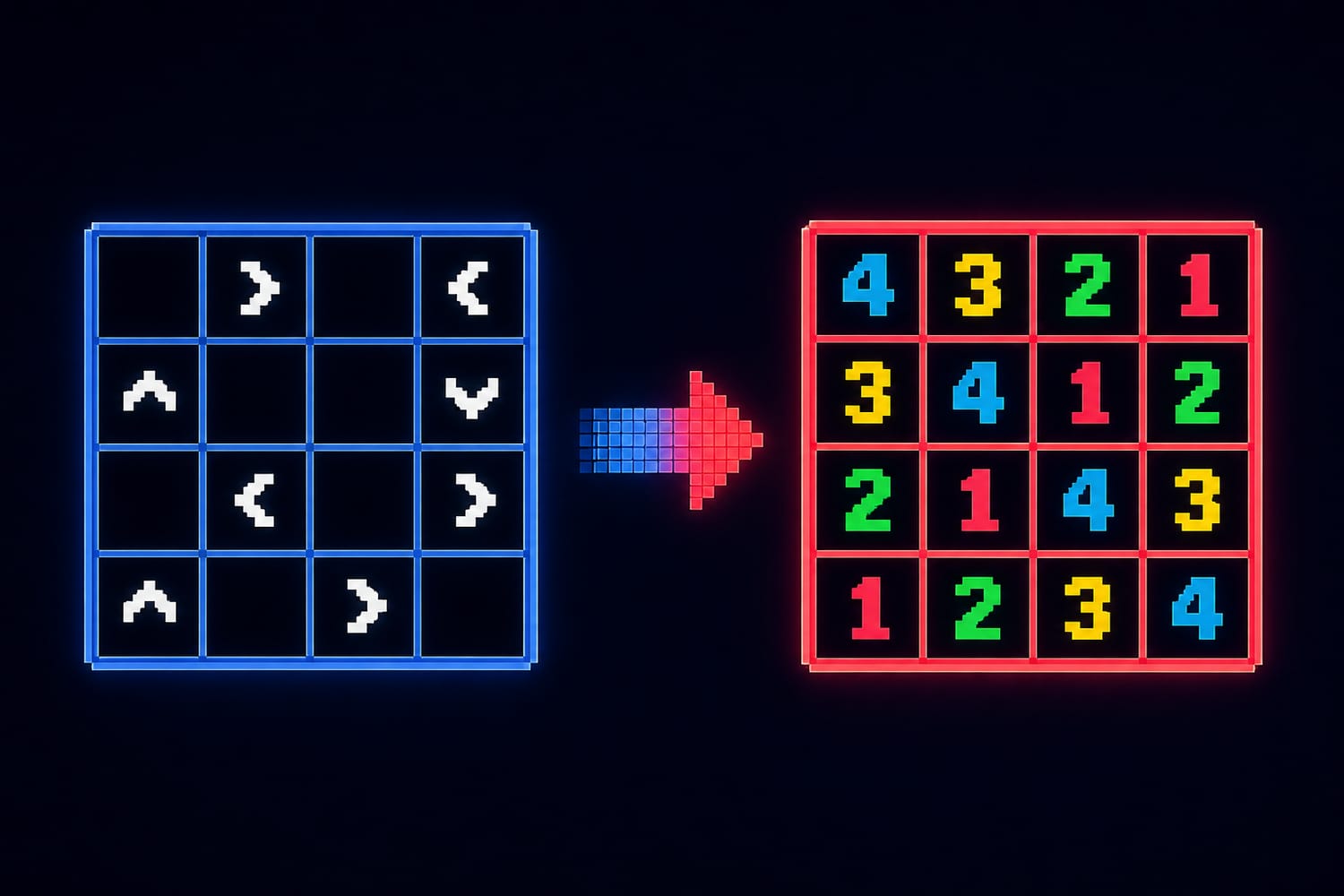
Futoshiki for Beginners: How to Turn Inequality Signs Into Solved Squares
To solve Futoshiki, fill each row and column with the numbers 1 through the grid’s size, without repeats, while making every inequality sign true. Start by ruling out impossible numbers, then combine the signs with row-and-column clues until each empty square has only one possible value.
Those little < and > symbols might look like extra obstacles. In fact, they are your best clues. A sign can narrow two squares immediately, and a connected sequence can reveal several numbers before you place anything.
Here is how to turn “smaller than” and “larger than” into a practical solving method.
Learn the Rules Before Reading the Clues
In standard Futoshiki, the grid’s size determines the available numbers:
- A 4×4 grid uses 1, 2, 3, and 4.
- A 5×5 grid uses 1, 2, 3, 4, and 5.
- Each number appears exactly once in every row and column.
Unlike standard Sudoku, Futoshiki has no smaller boxes requiring their own sets of numbers. Keep any printed starting numbers unchanged, and satisfy every inequality between neighboring squares. Puzzler’s Futoshiki rules guide provides a useful reference.
An empty space between squares adds no comparison rule. Without a sign, either neighboring number may be larger, provided the completed grid obeys its other rules.
Read the Point, Not Just the Symbol
The pointed end faces the smaller number; the wide opening faces the larger number.
For example:
2 < 4means 2 is smaller than 4.5 > 3means 5 is larger than 3.
Vertical signs follow the same principle: look at which square touches the pointed end. Remember, an inequality means strictly smaller or larger—not equal.
Start With the Smallest and Largest Numbers
Before hunting for exact answers, ask what each sign makes impossible.
On a 5×5 board, suppose two squares satisfy A < B. Then:
- A cannot be 5, because B would need something larger.
- B cannot be 1, because A would need something smaller.
Known numbers can make the deduction stronger: A < 2 forces A to be 1, while B > 4 forces B to be 5. These are among the basic techniques illustrated in the Futoshiki.com solving tutorial.
Now apply that idea across a row. Imagine four squares in a five-square row must each be larger than some neighboring square. None of those four can contain 1. The remaining square must therefore be the row’s 1.
Notice the shift: you did not solve a square by asking only what fits inside it. You solved a number by asking where it can still go.
Use Chains to Find Hidden Limits
One sign compares two squares. Several connected signs can place tighter limits on all of them. You can follow such chains around corners as well as along straight lines, provided each comparison continues in the same increasing or decreasing direction.
Consider this increasing chain on a 5×5 board:
A < B < C
Here are the possible ranges:
| Square | Possible values | Reason | |---|---|---| | A | 1, 2, 3 | It needs two larger values after it | | B | 2, 3, 4 | It needs a smaller and a larger value | | C | 3, 4, 5 | It needs two smaller values before it |
The chain does not force consecutive numbers. Both 1 < 2 < 3 and 1 < 3 < 5 could satisfy it.
However, a five-square increasing chain on a 5×5 board must be:
1 < 2 < 3 < 4 < 5
There is no room to skip a number. This full-length chain principle is also covered in Futoshiki.com’s tutorial.
Watch for Chains That Change Direction
Compare:
A < B < C
with:
A < B > C
The second pattern says B is larger than both neighbors. It does not establish whether A is smaller or larger than C.
On a 5×5 board, 1 < 3 > 2 is perfectly valid. Do not treat every connected group of signs as a continuously increasing chain.
Combine Inequalities With Rows and Columns
Signs become especially useful when you combine them with the no-repeat rule. A number excluded by a column may leave only one value that also satisfies an inequality.
Try this hypothetical 4×4 row fragment:
A < B | 3 | D
The vertical bars simply separate cells; they are not puzzle clues. Suppose A’s column already contains 1.
Work through the deductions:
- List the missing row numbers. A, B, and D must contain 1, 2, and 4.
- Check A’s column. A cannot be 1, leaving 2 or 4.
- Apply A < B. A cannot be 4, because no available number is larger.
- Place A = 2. B must then be 4.
- Complete the row. D is 1.
The row becomes:
2 < 4 | 3 | 1
Neither the inequality nor the column clue solved everything alone. Together, they completed the row.
Use that as your model: whenever a deduction seems unfinished, look for another rule that can narrow it further.
Make Pencil Marks Work for You
Write small candidate numbers inside an unresolved square to record what remains possible. Keep those notes separate from confirmed answers, and update them whenever a placement changes the available choices.
For a practical note-taking approach, see Puzzles Arcade’s guide to using pencil marks without cluttering the grid. Apply its organizational advice to Futoshiki’s rows and columns, but leave out Sudoku’s box rules.
Look for these patterns:
One Candidate in a Square
If every number except 3 has been eliminated, write 3 as the answer.
One Place for a Number
If only one square in a row can contain 4, that square must be 4—even if your notes currently include other candidates there.
Two Squares Reserving Two Numbers
Suppose two squares in the same row each have exactly {2, 4} as their candidates. Those squares must hold 2 and 4 in some order, so no other square in that row can contain either number. Puzzler describes this useful two-number elimination technique in its guide.
Be careful: a pair deduction requires complete candidate information for those two squares. Writing only selected possibilities is not enough to prove it.
Follow a Repeatable Solving Routine
Try this sequence rather than jumping randomly around the board:
- Confirm the number range. Identify the grid size and fixed starting numbers.
- Scan signs beside known numbers. Look for immediate limits or forced values.
- Trace long increasing or decreasing chains. Mark the ranges they allow.
- Check nearly completed rows and columns. Compare missing numbers with their possible positions.
- Add candidates where needed. Look for single possibilities, single locations, and pairs.
- Update after each placement. Recheck the affected row, column, and connected inequalities.
- Repeat the scan. A new number may make an earlier clue decisive.
Treat this as a working checklist, not a strict order you must follow every time.
When You Get Stuck, Check Before You Guess
First, revisit the basics. Did you reverse a vertical sign? Forget to remove a candidate? Assume a chain had consecutive values? Apply a Sudoku box rule that does not belong?
If you discover a mistake, note its cause rather than simply erasing it. Puzzles Arcade’s puzzle solver’s error-log guide offers a framework for reviewing recurring errors.
For now, choose a small beginner grid and aim to explain each placement in one sentence: “This must be 2 because…” Make understanding—not speed—your target.
The habit to practice is simple: use every sign to eliminate possibilities, then let rows and columns finish the argument. Square by square, an unfamiliar grid becomes a series of understandable decisions.

