
How to Use Pencil Marks in Sudoku Without Cluttering the Grid
Why Pencil Marks Matter in Sudoku
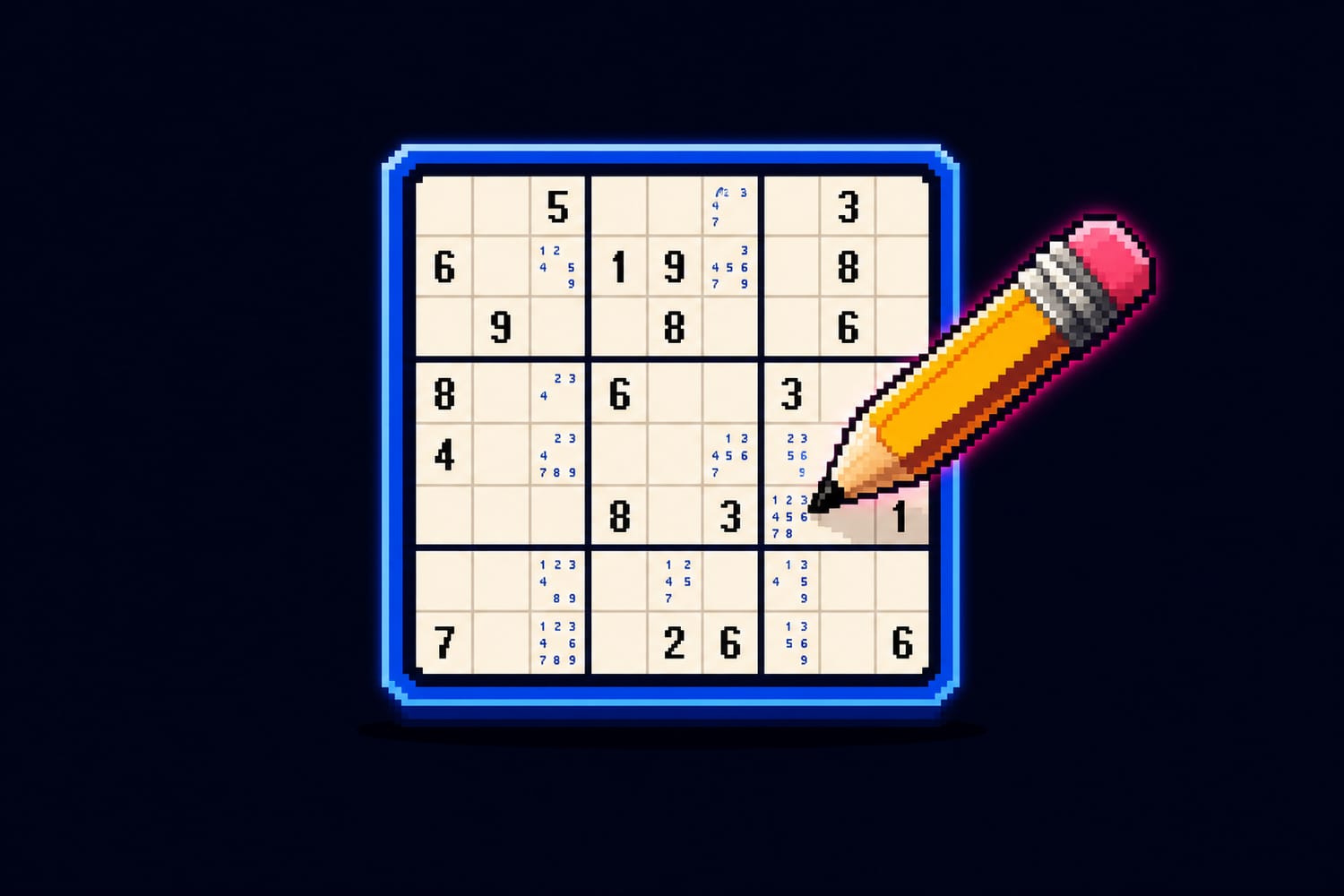
Pencil marks—also called “notes” or “candidates”—are small numbers you write inside empty Sudoku cells to show which digits could still fit there. Used well, they turn a confusing grid into a map of possibilities. Used too much, they can make the puzzle look like a cloud of tiny numbers.
The goal is not to fill every empty square with every possible candidate as fast as possible. The goal is to record useful information in a way that helps you think clearly.
In a standard 9×9 Sudoku, each row, column, and 3×3 box must contain the numbers 1 through 9 exactly once. A pencil mark simply says, “This number has not been ruled out yet.” For example, if a cell cannot be 1, 2, 3, 5, 7, 8, or 9 because those numbers already appear in its row, column, or box, then it might only be 4 or 6. Writing “46” in that cell can be very helpful.
But if your grid is filled with tiny “123456789” notes everywhere, your eyes have to work too hard. Good note-taking is about balance: enough information to guide you, not so much that the puzzle becomes harder to read.
Start With Observation Before Writing Notes
Before making any pencil marks, scan the puzzle for obvious placements. Many easy and medium Sudoku puzzles can be started without notes at all. Look for rows, columns, or boxes that already contain many numbers.
A useful first question is: “Where can this number go?” Pick a number from 1 to 9 and check one 3×3 box at a time. If a box is missing a 5, for example, look at the rows and columns crossing that box. If only one empty cell can accept a 5, place it.
This approach is often called “crosshatching” or “scanning.” It is clean, fast, and keeps the grid uncluttered. Pencil marks should support this kind of thinking, not replace it.
If you write notes too early, you may spend time recording possibilities that disappear a minute later. Starting with observation keeps the puzzle cleaner and helps you build confidence in the structure of the grid.
Choose a Pencil Mark System and Stick to It
One reason pencil marks become messy is inconsistency. If you write candidates in random positions inside each cell, you will have to reread every note carefully. A simple system makes the grid easier to scan.
The most common method is the “keypad layout.” Imagine the cell divided like a phone keypad or calculator grid:
- 1 goes in the top-left
- 2 goes in the top-center
- 3 goes in the top-right
- 4 goes in the middle-left
- 5 goes in the center
- 6 goes in the middle-right
- 7 goes in the bottom-left
- 8 goes in the bottom-center
- 9 goes in the bottom-right
With this system, your eyes can quickly detect patterns. If you are looking for all possible 7s in a box, you do not have to read each note; you simply look at the bottom-left corner of each empty cell.
Some players prefer writing candidates in a small row, such as “248,” but the keypad method is usually easier for spotting advanced patterns like pairs and triples. Whichever system you choose, use it consistently throughout the puzzle.
Use Full Notes Only When the Puzzle Needs Them
There are two main styles of pencil marking: partial notes and full notes.
Partial notes record only certain candidates—usually numbers you are actively tracking. For example, you might mark where all the 6s can go in each box. This keeps the grid clean and is excellent for easier puzzles.
Full notes record every possible candidate in every empty cell. This is more detailed and can be extremely useful in harder puzzles, but it also creates more visual clutter.
For beginners, a good rule is: start with partial notes, then move to full notes only if you get stuck. This allows you to solve as much as possible using logic and scanning before committing to a busier grid.
For example, suppose a 3×3 box has only two possible places for the number 9. Marking a tiny 9 in those two cells is helpful. You do not necessarily need to fill every other candidate in the box. You are simply recording a useful fact: the 9 must be in one of these two places.
On harder puzzles, full notation may become necessary. When that happens, do it carefully and systematically. Work through each empty cell and eliminate numbers already found in its row, column, and box. Accuracy matters. A wrong pencil mark can mislead you later.
Clean Up Notes Every Time You Place a Number
The most important habit for avoiding clutter is updating your notes immediately after placing a number.
If you place a 4 in a cell, then 4 can no longer appear anywhere else in that row, column, or 3×3 box. Remove all pencil-marked 4s from those related cells right away. This keeps your grid accurate and often reveals new moves.
For example, imagine a row has two empty cells with candidates “28” and “248.” If you place a 4 somewhere else in the same box, the second cell might become “28.” Now you may have a naked pair: two cells in the same row containing exactly 2 and 8. That can help eliminate 2 and 8 from other cells in the row.
If you do not clean up notes, you miss these discoveries. Even worse, outdated marks can make you think a number is possible when it has already been ruled out.
Think of note cleanup as part of the move itself. Placing the big number is only half the action; removing the now-impossible small numbers completes it.
Learn the Difference Between Helpful Notes and Noise
Not all pencil marks are equally useful. A cell with candidates “13789” may be accurate, but it may not help you much yet. A cell with “37,” however, is more interesting because it is close to being solved. The fewer candidates a cell has, the more attention it deserves.
Here are some high-value notes to watch for:
- Singles: A cell has only one candidate left. This number must go there.
- Hidden singles: A number appears as a candidate in only one cell within a row, column, or box. Even if that cell has other candidates, the number must go there.
- Pairs: Two cells in the same unit contain the same two candidates, such as “26” and “26.” Those two numbers must occupy those two cells, so they can be removed from other cells in that unit.
- Triples: Three cells in a unit contain only the same three candidates among them, such as “1/5/9” spread across three cells. These can also eliminate candidates elsewhere in the unit.
A cluttered grid hides these patterns. A clean grid makes them stand out. When you use notes, try to make the important relationships easy to see.
One practical technique is to focus on one number at a time. Instead of staring at every pencil mark, ask, “Where can 7 go in this box?” or “Which columns still need a 2?” This keeps your attention organized.
Use Snyder Notation for a Cleaner Grid
One popular partial-note method is called Snyder notation, named after Sudoku champion Thomas Snyder. In this approach, you only mark a number inside a 3×3 box when that number has exactly two possible positions in the box.
For example, if a box needs a 5 and the 5 can go in only two cells, you write small 5s in those two cells. If it can go in three or more cells, you do not mark it yet.
This method reduces clutter dramatically while still capturing powerful information. It helps you spot situations where a number is “locked” into a row or column within a box. For instance, if the two possible 5s in a box are both in the same row, then no other cell in that row outside the box can be a 5.
Snyder notation works especially well for easy and medium puzzles. It encourages you to think in terms of boxes, rows, and columns instead of filling the grid with every possible candidate.
However, it has limits. In harder puzzles, you may eventually need full candidates to find more advanced patterns. That is perfectly fine. Many skilled solvers begin with Snyder notation and switch to full notation only when needed.
Avoid Guessing With Pencil Marks
Pencil marks are not guesses. They are logical possibilities based on the current state of the grid. This distinction is important.
If you write a candidate because “it feels right,” you may accidentally build your solution on a mistake. Instead, every pencil mark should answer this question: “Has this number been ruled out by the row, column, or box?” If not, it may be a valid candidate.
Similarly, do not place a final number just because it is one of two candidates and you prefer it. Sudoku is designed to be solved by logic. A proper puzzle has one solution, and each placement should be justified.
If you get stuck, review your notes rather than guessing. Look for hidden singles, pairs, locked candidates, or places where an old note should have been erased. Many “stuck” moments come from a missed cleanup step or an overlooked candidate that appears only once in a unit.
Keeping pencil marks accurate gives you a reliable path forward. Guessing may sometimes work, but it can also lead to contradictions that force you to undo many moves.
Make Your Grid Easier on the Eyes
Clutter is not just about the number of notes. It is also about how readable your grid feels. A few small habits can make a big difference.
If you are solving on paper, use a sharp pencil and write lightly. Keep big confirmed numbers bold and clear so they stand apart from small candidates. If you erase often, avoid pressing too hard or the cells may become smudged.
If you are solving digitally, explore the game’s note settings. Many Sudoku apps and websites include automatic candidate removal, highlighting, or different note styles. These tools can be helpful, especially for beginners, but try not to rely on them so much that you stop practicing the logic yourself.
Spacing also matters. Do not squeeze candidates into random corners. Use your chosen layout and keep the marks small. A neat grid helps your brain recognize patterns faster.
It can also help to take short breaks. After staring at a note-filled puzzle for several minutes, everything may start to blur together. Looking away for a moment often makes the next clue easier to see.
Know When to Add More Notes
A common question is: “How do I know when it is time to add more pencil marks?”
The answer depends on the puzzle. If you are still finding placements through scanning, keep going. If several minutes pass without progress, it may be time to add more information.
A good step-by-step approach looks like this:
- Scan for obvious numbers without notes.
- Add partial notes for numbers with only two possible positions in a box.
- Use those notes to find singles, hidden singles, and locked candidates.
- If progress stops, expand to more candidates.
- Clean up after every placement.
This gradual method prevents unnecessary clutter while still giving you the tools needed for tougher puzzles.
You can also add notes by region instead of all at once. For example, choose the most filled-in 3×3 box and complete candidates only for that box. Or focus on a row with several solved numbers. Smaller note-taking tasks are less overwhelming and often reveal immediate progress.
Common Pencil Mark Mistakes to Avoid
Even experienced Sudoku players sometimes make note-related mistakes. The good news is that most are easy to fix with better habits.
One common mistake is forgetting to remove candidates after placing a number. This creates false possibilities and makes the grid look more complicated than it really is.
Another mistake is writing too many notes too early. If the puzzle is still open and many cells have five or six candidates, full notation may not help yet. It may be better to continue scanning for missing numbers in rows, columns, and boxes.
A third mistake is ignoring hidden singles. Many players look only for cells with one candidate, but a hidden single can be just as decisive. If a number can go in only one place in a row, column, or box, it must go there—even if that cell has several pencil marks.
Finally, some solvers fail to trust their notes. If your candidates are accurate and a logical pattern appears, use it. Pencil marks are there to reduce uncertainty, not decorate the grid.
Practice: The Secret to Clean Pencil Marks
The more Sudoku you solve, the better you become at knowing which notes are worth writing. At first, you may need more pencil marks because you are still learning what to notice. That is normal. Over time, you will start seeing patterns before you even write them down.
Try practicing with a specific goal. For one puzzle, focus on using fewer notes. For another, practice cleaning notes immediately after every placement. For a harder puzzle, try full candidates and look for pairs and hidden singles.
You can also replay easier puzzles and solve them with different note styles. First, use no notes. Then try partial notes. Then try full notes. Comparing the experience will teach you when each method is useful.
Sudoku is not about speed alone. It is about clear thinking, patience, and pattern recognition. Pencil marks are one of the best tools for building those skills.
Final Thoughts: Keep Notes Useful, Not Noisy
Pencil marks can make Sudoku easier, cleaner, and more enjoyable—but only when they serve a purpose. Start by scanning the grid, use a consistent notation system, add notes gradually, and clean them up every time you place a number.
The best pencil marks are not the most numerous. They are the ones that help you see what must be true.
Whether you are solving your first beginner puzzle or working through a challenging grid, remember that neat notes lead to better logic. Keep your grid readable, trust the process, and enjoy the satisfying moment when a small pencil mark turns into a confident final answer.

