
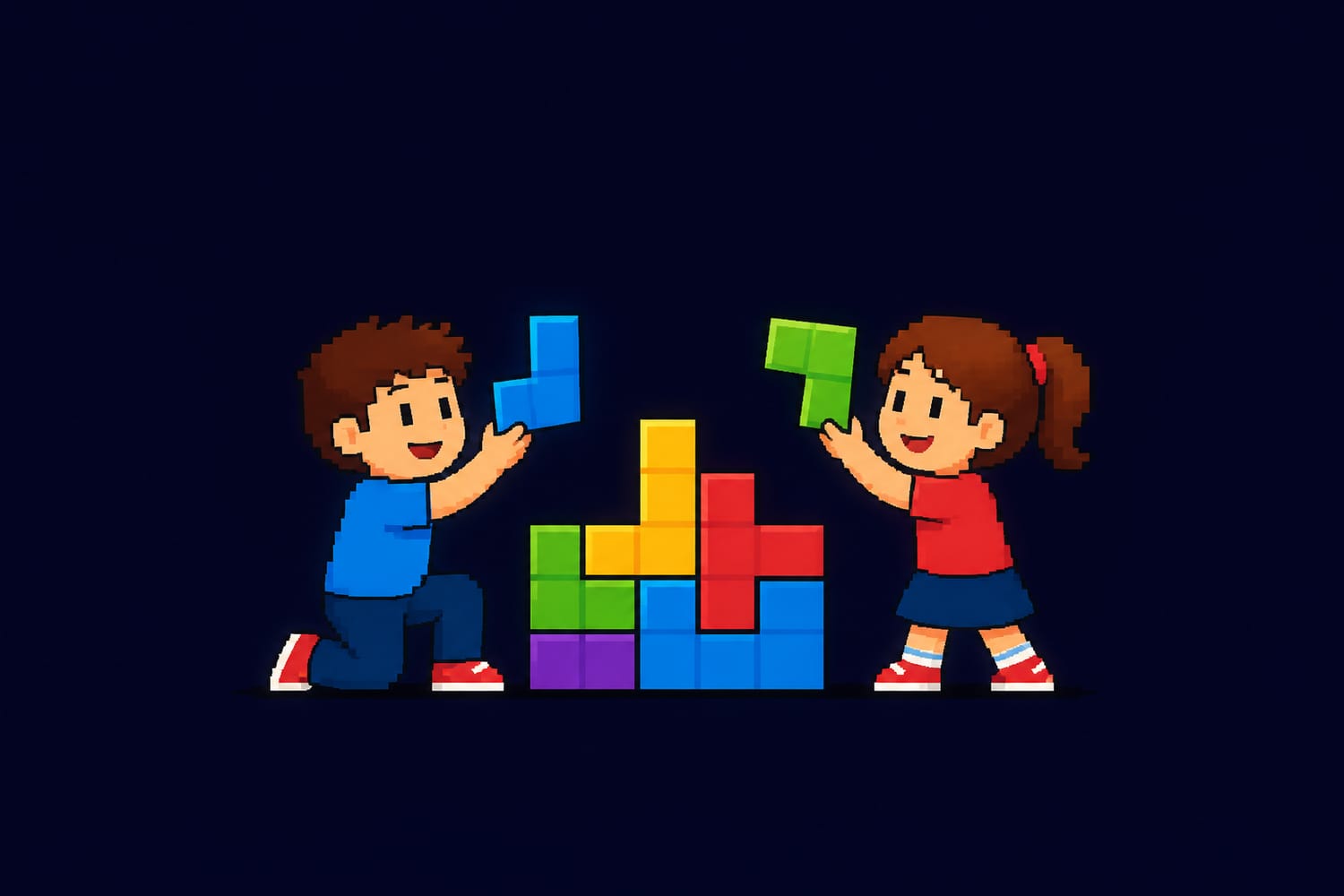
Why Solving Puzzles Together Helps Kids Practice Teamwork
Why a Puzzle Can Become a Team Activity
Solving a puzzle together gives kids a shared goal and a practical reason to listen, explain ideas, take turns, and make decisions. The teamwork practice happens not only when they find the right answer, but also when they disagree about a piece, ask for help, or change their plan. A puzzle turns those everyday moments into something playful.
Picture two children working on a jigsaw. One notices that several pieces have blue stripes; the other spots the same stripes on a kite in the box picture. Neither child had the whole answer alone. By sharing what they noticed, they move the puzzle forward—and experience what it feels like to contribute to a group effort.
Puzzles are not a shortcut to perfect cooperation. Children still need time, encouragement, and opportunities to practice. But a shared puzzle offers a friendly place to start.
A Shared Goal Changes the Conversation
When children work separately, each has their own task. With a shared puzzle, they can ask a new question: How can we solve this together? That shift creates opportunities to compare ideas and coordinate what they do next.
A jigsaw team might decide to find the corner pieces first. Children tackling a word search might split the word list, then check each other’s discoveries. A pair solving a riddle might test two possible answers against the clues. In each case, the puzzle gives their conversation a purpose.
The American Academy of Pediatrics describes shared play as a way to practice back-and-forth communication. During a puzzle, that communication can be as simple as pointing to a pattern, asking “What do you think?” or explaining why a piece might fit. Kids who prefer not to talk much can still take part by sorting, pointing, drawing, or moving pieces.
The Teamwork Skills Hidden in Puzzle Play
Listening before acting
A child may be certain a piece belongs in the top corner. A teammate sees a different possibility. If they pause to hear each other out, they can check the colors and shapes rather than arguing over whose guess is right.
That pause is small, but valuable. It gives children practice treating another person’s idea as information worth considering. The puzzle supplies a gentle way to test both suggestions: try the piece and see what happens.
Sharing roles—and switching them
Puzzles often contain several useful jobs. Someone can sort pieces by color, another can study the picture, and a third can assemble a section. In a word puzzle, one child might read clues while another writes down answers.
Roles help children see that contributing does not always mean doing the same thing. They also make room for different strengths. A child who is new to reading may be an excellent pattern-spotter; an older child who finds answers quickly can help by asking questions rather than taking over.
Keep roles flexible, though. If one child always gets the “important” job, the group loses a chance to practice sharing responsibility. Swap jobs partway through or let children choose something new for the next puzzle.
Disagreeing and trying again
Wrong guesses are part of puzzle-solving. They also create low-stakes opportunities to handle disagreement: “I thought it went there, but let’s test your idea.” Children can learn that changing their minds is not the same as losing.
Adults can help by describing the problem without assigning blame. The National Association for the Education of Young Children suggests involving children in identifying a problem and brainstorming solutions. At the puzzle table, that might sound like, “We both want to move this section. How can we decide where it goes?”
Noticing other people’s contributions
Finishing a puzzle as a group lets children celebrate more than the final answer. They can notice who found a missing edge, explained a tricky clue, or kept trying when the first plan failed.
Be specific with praise: “You showed us the pattern you spotted” tells a child more than “Good job.” It highlights an action the team can use again. For more on the social side of shared solving, explore how working on puzzles together can create moments of connection.
Choose a Puzzle That Leaves Room for Everyone
The best teamwork puzzle is not necessarily the hardest one. If children can solve it instantly, there may be little to discuss. If it is so difficult that nobody knows where to begin, frustration can crowd out cooperation. Aim for a challenge that invites several people to look, try, and contribute.
For younger children, consider a large-piece jigsaw, a picture-matching activity, or a simple pattern to complete together. For children who enjoy words, try a word search with familiar vocabulary or a short crossword that allows everyone to suggest answers. Older kids may like logic clues, more complex jigsaws, or a mystery with several pieces of information to organize. The American Academy of Pediatrics includes simple puzzles among play materials for young children and emphasizes the value of caregiver involvement.
You can also adapt a familiar game instead of searching for a special “teamwork puzzle.” Choose an untimed option from Puzzles Arcade’s puzzle games, then have children discuss their ideas before making a move. On a single screen, take turns controlling the game so that one person does not become the player while everyone else watches.
For physical puzzles, check the age guidance and the size of the pieces, particularly when babies or toddlers are nearby. Small toy parts can be choking hazards for young children; keep unsuitable pieces out of their reach.
How Adults Can Help Without Solving It for Kids
An adult’s most useful role is often to guide the conversation, not supply the answer. Try questions that make children look and think together:
- “What have we noticed so far?”
- “Does anyone see a different way to try this?”
- “Which part could each of us work on?”
- “What should we do if that idea does not fit?”
These questions leave the discovery with the children. They also make it easier to include a child who has gone quiet. Instead of putting them on the spot with “Do you know the answer?”, invite a manageable contribution: “Could you look for pieces with this color?”
If a disagreement grows, pause the puzzle. Let each child explain what they want to try, then agree on a fair next step—perhaps testing both ideas or taking turns with the pieces. Preschoolers are still learning to share and cooperate, and adult encouragement can help them navigate those moments.
Some children enjoy solving side by side before they are ready to share every decision. That counts as a starting point. You might give each child a small section, then invite them to connect the sections when they are ready. The goal is to make participation feel possible, not to demand constant conversation.
Make the Teamwork Visible Afterward
When the puzzle is done—or when it is time for a break—ask one or two questions about how the group worked. “What helped us when we got stuck?” and “Who noticed something we had missed?” can help children recognize the value of listening and combining ideas.
It is also fine to stop before the final piece. A team that sorts half a jigsaw, tries several approaches, and agrees to return tomorrow has still practiced planning and cooperation. In fact, deciding what to do next can be part of the challenge. For more ways to think about changing strategies, see how puzzle play encourages flexible problem-solving.
One Piece at a Time
A puzzle gives children something concrete to build together. As they search, suggest, listen, test, and try again, they get repeated chances to practice the habits that make teamwork work.
The finished picture or solved clue is satisfying. So is the moment a child realizes, “Your idea helped me find mine.” That is a lesson worth carrying beyond the puzzle table.

