
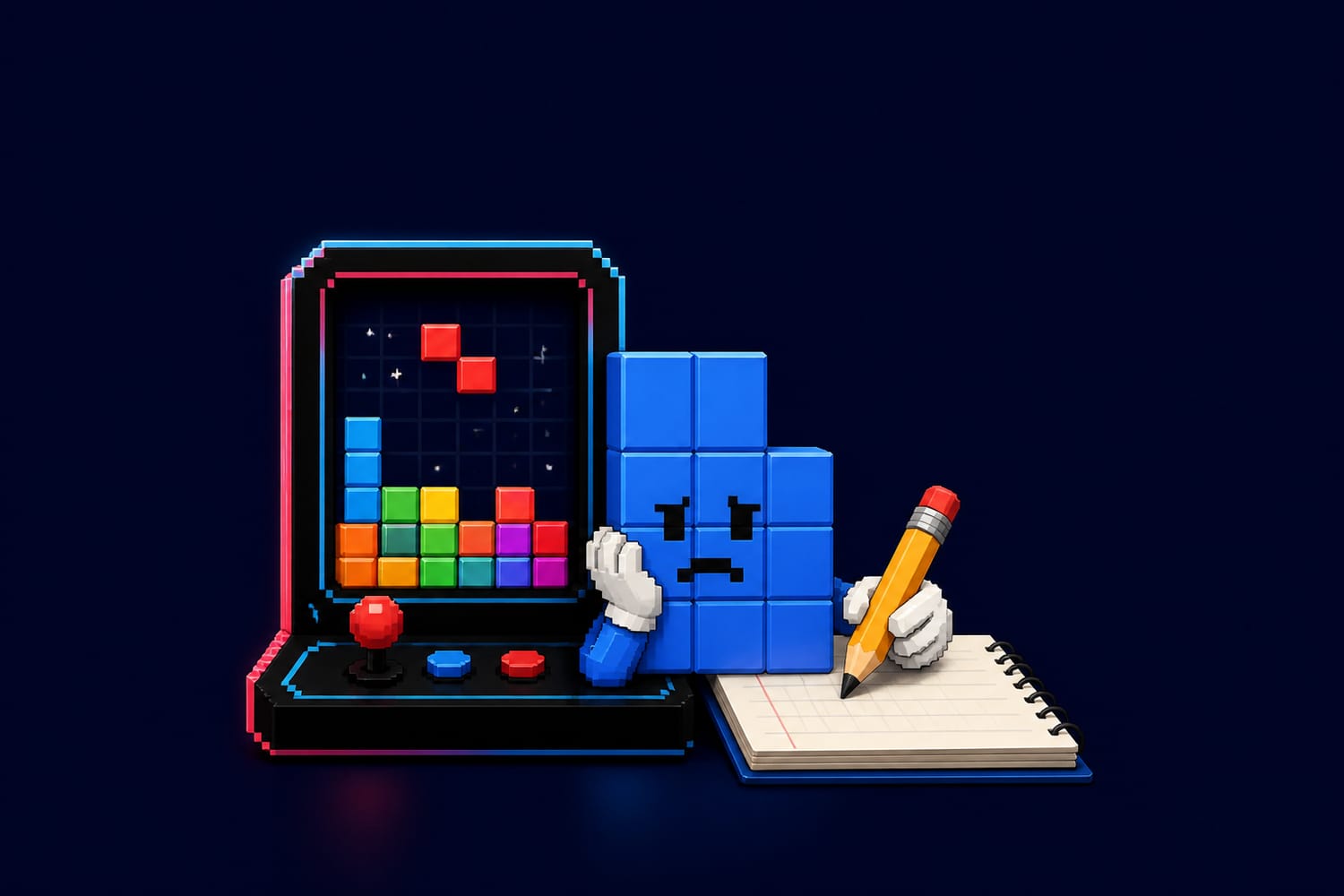
When Puzzle Play Feels Like Homework: How to Keep a Healthy Hobby Fun
If a puzzle starts to feel like an assignment, you do not need to try harder. Try changing the way you play. Choose an easier game, ignore the timer, ask for a hint, or stop for the day. A healthy hobby should leave room for curiosity and enjoyment—not require you to earn a good grade.
That can be easy to forget. A crossword offers a blank grid to fill. A Sudoku board has a correct solution. A game may display your fastest time, your longest streak, or a challenge you have not completed. Those features can be exciting, but they can also make a few minutes of play feel like another task on a busy to-do list.
The answer is not to avoid challenges. It is to remember that you get to decide what a satisfying puzzle session looks like.
How Does a Hobby Turn Into Homework?
Usually, the change is subtle. Perhaps you began doing a daily word game because it was fun, then started worrying about missing a day. Or you enjoyed learning Sudoku until you felt that choosing an easy level meant you were not improving.
Scores and goals are not bad. Some players love beating their best time or tackling the hardest grid. Trouble starts when the goal stops being a choice. If you are playing mainly to preserve a streak, prove something, or avoid feeling guilty, pause and ask whether the game is still giving you what you came for.
There is a useful distinction between playing because an activity interests you and playing mainly for an outside reward. The American Psychological Association’s explanation of intrinsic motivation describes the first kind as doing something because it feels personally rewarding. A badge can add excitement, but it does not have to be the reason you play.
Give Each Session a Purpose That Fits Your Day
Before you open a puzzle, try asking: What do I want from this today? Your answer can change from one day to the next.
- I want to unwind. Pick a familiar format, an easy level, or an untimed game.
- I want to learn. Choose a puzzle that makes you think, and allow time to experiment.
- I want a quick break. Settle on one short puzzle rather than an open-ended session.
- I want company. Solve with someone else and trade ideas instead of racing.
- I am not in the mood. Do something else. The puzzle will still be there later.
Consider the difference between opening a crossword to enjoy a few clues and opening it with a rule that you must finish before bed. The grid has not changed, but the expectation has. A more flexible goal—“I’ll explore the clues for a while”—can make the same puzzle feel inviting again.
Choose the Right Amount of Challenge
An enjoyable puzzle does not have to be difficult. Easy games give beginners a chance to learn the rules and experienced players a way to relax. A harder game may be appealing when you have the energy to test a new strategy. Neither choice says anything about your worth as a solver.
If a puzzle feels too demanding, change one thing. Try a smaller grid, turn off the timer if the game allows it, or switch from a word puzzle to a visual one. If you are bored, move in the other direction: pick a less familiar format or a slightly tougher level. Puzzles Arcade’s article on why easy puzzles still count as worthwhile play offers a helpful reminder that difficulty is not the only reason to play.
You can also keep a small “puzzle menu” for different moods. A word search might suit a tired evening; a crossword might suit a quiet morning; a number puzzle might be fun when you want to concentrate. Browsing the Puzzles Arcade game collection makes it easier to try another format instead of forcing yourself through one that is not working today.
Treat Getting Stuck as a Choice Point
Being stuck is not proof that you are bad at puzzles. It is simply the moment to decide what would make playing enjoyable again.
You might inspect a different part of the grid, set the game aside for a few minutes, or ask for a small hint. In a crossword, solving another clue may supply a useful letter. In Sudoku, checking a different row or box may reveal a move. For a large puzzle, Puzzles Arcade’s guide to breaking overwhelming puzzles into smaller pieces shows how to turn “solve everything” into a manageable next step.
Hints are tools, not marks off a test. If you enjoy the discovery, ask for the smallest nudge available and try again. If you would rather see the answer and move on, that is fine too. The point of a leisure activity is not to demonstrate how long you can remain frustrated.
Keep the Health Benefits in Perspective
Puzzle play can offer a pleasant chance to focus, notice patterns, and work through a problem. It may also be a welcome change of pace. Those are good reasons to play without turning every session into a workout for your brain.
Be cautious, though, of the idea that you must solve puzzles daily to protect your memory. The National Institute on Aging notes that research on certain forms of cognitive training is promising, but there is not enough evidence to assume that commercially available brain-training games produce the same effects seen in clinical trials. Puzzles can be part of an enjoyable life; they are not a guaranteed way to prevent dementia or a replacement for other healthy activities.
That perspective can take some pressure off. You do not have to finish an expert-level grid to justify your playtime. An easy puzzle you enjoy is still an enjoyable activity.
Let Your Body and Your Mood Set the Pace
A hobby is easier to enjoy when you pay attention to how you feel while doing it. Are you leaning closer to the screen because the text is hard to see? Have you been sitting in one position for longer than you intended? Are you still having fun, or are you clicking “next” out of habit?
For screen-based puzzles, look away regularly and take breaks when your eyes feel tired. The American Academy of Ophthalmology’s guide to digital eye strain includes practical advice for making screen use more comfortable. Stretching, changing position, or swapping a digital game for a paper puzzle can also provide a change of pace.
Mood deserves the same attention. A tricky clue can be satisfying when you feel curious about it and aggravating when you are already exhausted. You are allowed to save the tricky one for another day.
Redefine What Counts as a Win
Finishing is satisfying, but it is only one possible ending. You might discover a clever approach, laugh at an unexpected clue, enjoy solving beside a friend, or notice that today is not a puzzle day. Each can be a perfectly good outcome.
Try ending a session with a question other than “Did I win?” Ask, “Would I like to do this again sometime?” If the answer is yes, you have found a way to keep the hobby alive. If the answer is no, adjust the format, difficulty, or expectations next time.
The best puzzle routine is not necessarily the longest or the most impressive. It is one with enough freedom to stay fun. Some days that means taking on a challenge. Other days it means enjoying an easy win—or putting the puzzle down and going to do something else.

