
Can Puzzles Interrupt Rumination? How Focused Play Helps Break Repetitive Thought Loops
The Short Answer
Yes—puzzles may temporarily interrupt rumination by giving attention a clear, concrete and emotionally neutral task. Matching shapes, testing numbers or decoding clues can help the mind disengage from repetitive thoughts and reconnect with the present moment. However, puzzles are a coping tool, not a treatment for persistent anxiety, depression, trauma or obsessive thinking.
What Rumination Actually Is
Rumination is the habit of repeatedly dwelling on distress, its causes and its consequences. It may sound like:
- “Why did I say that?”
- “What if I made the wrong decision?”
- “Why can’t I stop feeling this way?”
- “I should have handled everything differently.”
This is not quite the same as productive reflection. Helpful reflection usually moves toward a conclusion, decision or action. Rumination circles the same material without producing much new information. The American Psychiatric Association’s explanation of rumination notes that this repetitive negative thinking can intensify difficult emotions and interfere with problem-solving.
Rumination often concerns the past, while worry tends to focus on possible future events. In everyday life, however, the two can overlap. Both can feel repetitive, difficult to control and mentally exhausting.
Everyone replays upsetting moments occasionally. The problem is not having a negative thought; it is becoming stuck in a loop that consumes attention, lowers mood or prevents useful action.
Why a Puzzle Can Interrupt the Loop
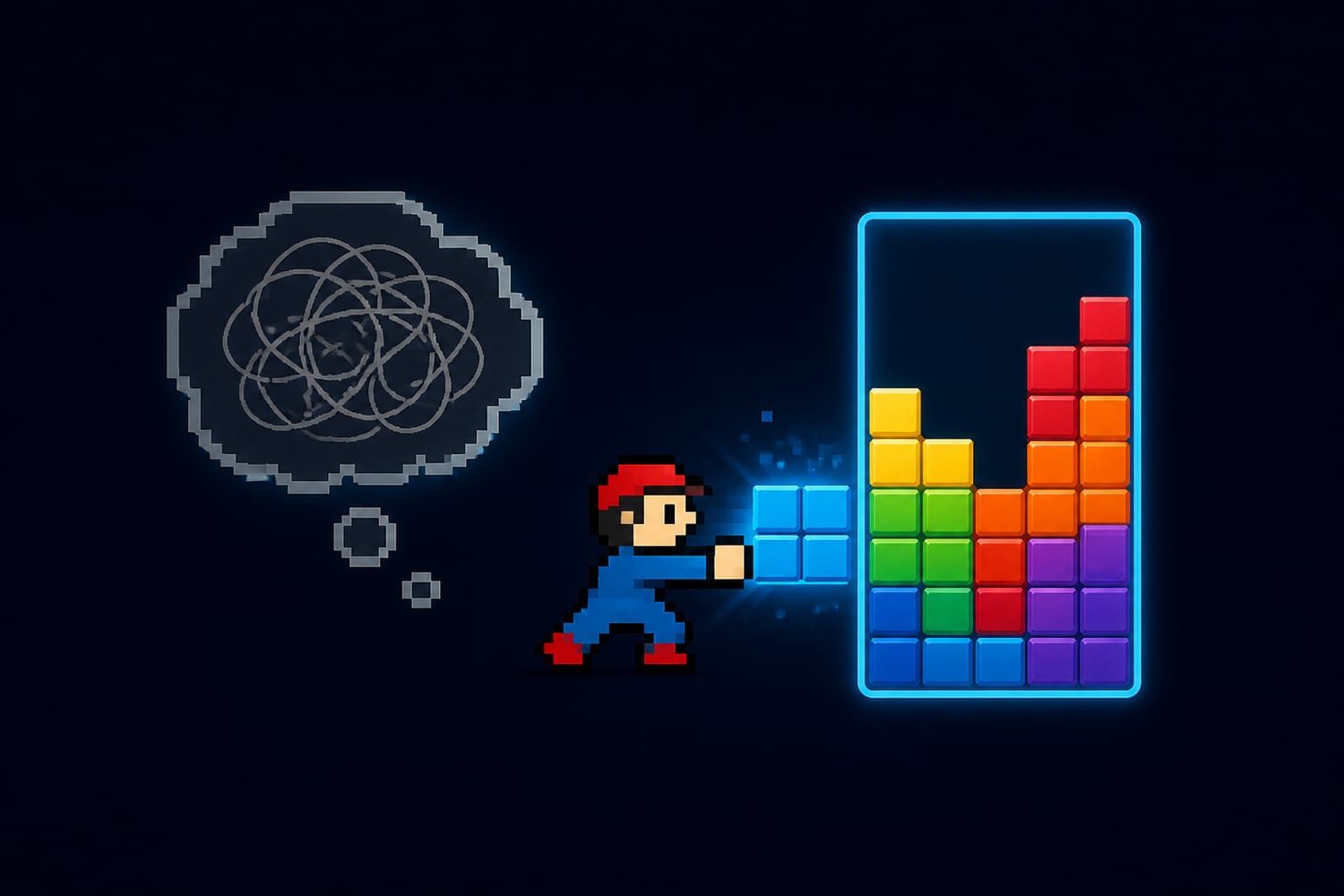
A puzzle cannot erase an upsetting experience, but it can change what your mind is doing for a few minutes. Rumination is internally focused and open-ended. A puzzle is external, structured and specific.
Instead of asking an unanswerable question such as “Why does everything go wrong?”, the mind receives a manageable one: “Which piece fits here?” or “What number belongs in this square?”
Puzzles compete for attention
Attention is limited. A crossword asks you to retrieve words, examine letter patterns and evaluate clues. Sudoku requires you to track possibilities and avoid contradictions. Jigsaws involve visual comparison, sorting and spatial judgment.
These demands can leave fewer mental resources available for replaying an argument or imagining worst-case outcomes. A small preliminary study found that an attentionally demanding activity helped participants disengage cognitive resources from induced rumination more effectively than a low-demand activity. That does not prove that every puzzle will stop rumination, but it supports the broader idea that sufficiently absorbing tasks can interrupt a repetitive thought cycle.
This is also why the best puzzle for the moment is not necessarily the hardest one. It needs to be engaging enough to capture attention without becoming another source of frustration.
Puzzles replace vague thoughts with concrete feedback
Rumination thrives on uncertainty. Its questions are often broad, emotional and impossible to settle immediately. Puzzles provide boundaries:
- There are rules to follow.
- Actions produce visible results.
- Mistakes can usually be corrected.
- Progress can be measured.
- The activity has an identifiable stopping point.
That structure matters. It turns attention away from a problem with no clear endpoint and toward a task in which the next step can be discovered.
They bring the mind back to the present
When you search a grid or rotate a jigsaw piece, you must notice what is in front of you now. Colors, letters, numbers, shapes and patterns become anchors to the immediate environment.
This resembles one element of mindfulness: repeatedly returning attention to the present after noticing that it has wandered. Puzzle solving is not identical to meditation, but it can provide an accessible form of present-centered engagement. Readers interested in this connection can explore how puzzle games support mindfulness and present-moment focus.
Interruption Is Not the Same as Suppression
Trying to force a thought away can become a struggle of its own. You may keep checking whether the thought has disappeared—which means you are still paying attention to it.
A healthier puzzle break begins with recognition rather than denial:
“I am caught in a repetitive thought loop. I do not have to solve it this minute. I’m going to give my attention a different task for ten minutes.”
The goal is not to prove that the thought is unimportant. It is to create enough mental distance to choose what happens next.
Temporary redirection can be useful when it helps you settle, regain perspective and return to life. It becomes less helpful if puzzles are used constantly to avoid necessary conversations, decisions or emotions. After the break, you may still need to write down a concern, speak to someone, solve a practical problem or accept that an uncertainty cannot be resolved today.
A Simple Puzzle Reset for Repetitive Thoughts
The following routine can turn casual play into an intentional attention reset.
- Name what is happening. Say, “This is rumination,” rather than treating every repeated thought as a new emergency.
- Choose one bounded puzzle. Pick a short crossword, word search, logic problem, jigsaw section or number game.
- Set a timer for 5 to 15 minutes. A clear limit makes the break feel purposeful rather than avoidant.
- Remove competing distractions. Silence notifications and use one screen, book or puzzle board.
- Describe the task concretely. Think, “I am looking for a six-letter word,” or “I am sorting blue edge pieces.”
- Return gently when your mind wanders. Do not criticize yourself. Notice the thought and redirect attention to the next clue or move.
- Check in afterward. Ask whether the thought feels equally urgent and whether there is one practical action to take.
If action is possible, choose a small next step. If no action is currently possible, deliberately move to another meaningful activity.
Which Puzzles Work Best?
Different mental states may call for different kinds of play.
When your mind feels busy or scattered
Try a visually simple activity with repetitive actions, such as a small jigsaw, tile-matching puzzle or word search. These offer clear sensory targets without requiring extensive background knowledge.
When you need strong mental engagement
Crosswords, Sudoku, cryptograms and logic-grid puzzles place greater demands on working memory and reasoning. They may be useful when a gentler activity does not capture enough attention. Regular solvers can also learn more about how puzzle games strengthen focused attention.
When you feel emotionally tired
Choose a familiar puzzle format at an easy or moderate level. Familiar rules reduce the burden of learning something new and let you begin quickly. This predictability is one reason well-known puzzle formats can feel comforting.
When frustration is already high
Avoid timed modes, competitive rankings and punishing difficulty settings. A puzzle break should not become a test of intelligence. Hints, easier levels and unfinished puzzles are all acceptable.
How to Tell Whether the Break Helped
Success does not require your thoughts to vanish. A useful interruption may simply reduce their intensity or make them feel less convincing.
After playing, notice whether:
- Your breathing or muscles feel more relaxed.
- The thought feels less urgent.
- You can see the situation from a wider perspective.
- You are ready to complete a practical task.
- You can shift into rest, conversation or another activity.
- You recognize that no further thinking is useful right now.
Even a partial shift matters. The purpose of the break is to restore choice—not to guarantee a perfectly quiet mind.
When Puzzles Are Not Enough
Frequent or intense rumination can be associated with depression, anxiety and other mental health difficulties. Consider speaking with a doctor or qualified mental health professional if repetitive thoughts regularly disrupt sleep, school, work, relationships or daily routines.
Professional support is especially important when rumination involves trauma, compulsions, severe hopelessness or thoughts of self-harm. Evidence-based approaches such as cognitive behavioral therapy can address the patterns that maintain repetitive negative thinking. Harvard Health’s guidance on how to break cycles of rumination also emphasizes recognizing the loop and taking constructive steps rather than endlessly analyzing it.
Puzzles are best viewed as one tool within a broader well-being toolkit that may include sleep, physical activity, social connection, mindfulness, practical problem-solving and professional care.
A Small Task Can Create Valuable Space
Rumination makes the mind feel trapped inside one story. A puzzle opens a temporary side door: a clue to interpret, a pattern to test or a piece to place.
That brief shift may not solve the original problem, but it can interrupt its momentum. Once attention has loosened from the loop, it becomes easier to decide whether the situation needs action, acceptance, support—or simply permission to rest. In that sense, focused play is more than distraction: it is a small, structured way to regain control of where your attention goes next.

