
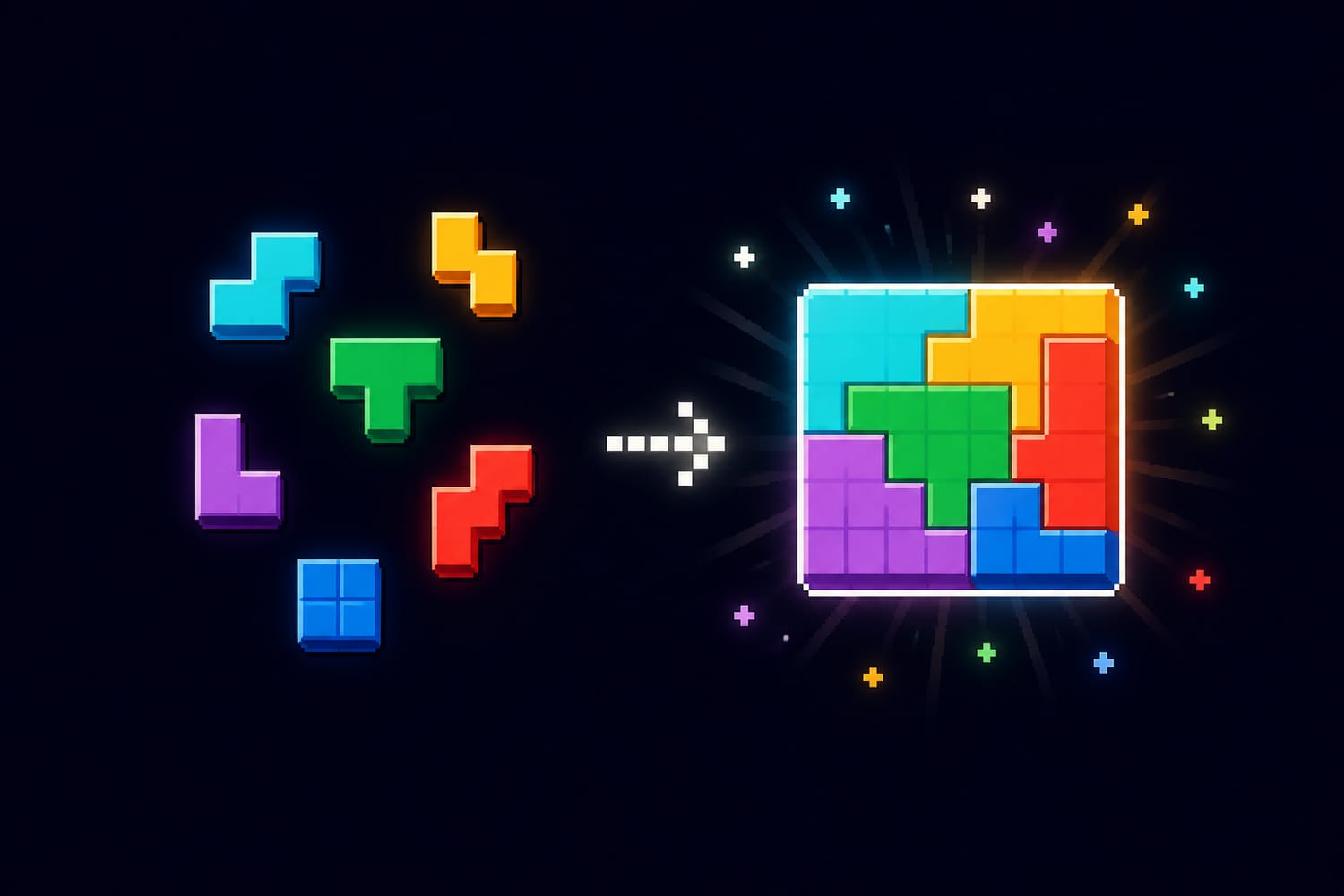
The Puzzle Behind the Puzzles: How Metapuzzles Turn Answers Into One Big Reveal
A metapuzzle is a puzzle built from the answers or information gathered from other puzzles. Instead of treating each solution as the finish line, it turns those solutions into fresh clues. Discover how they connect, and a collection of separate challenges becomes one larger mystery.
Imagine finishing a crossword, cracking a code, and untangling a logic problem. You have three answers and three small victories. Then you notice something strange: those answers seem to belong together.
Suddenly, you are not finished. You have just collected the pieces.
That change of perspective is the heart of a metapuzzle—and the reason its final reveal can feel bigger than any individual solution.
When an Answer Becomes a Clue
Metapuzzles are a familiar feature of puzzle hunts: collections of puzzles that players solve individually or in teams. The smaller puzzles supplying information to a meta are often called feeder puzzles. Their answers become material for another challenge. The puzzlehunt.net glossary explains this vocabulary, including the distinction between a metapuzzle and a final challenge that does not use earlier answers.
That distinction matters. A difficult puzzle placed at the end of a game is not automatically a metapuzzle. The defining connection is that earlier puzzle results help you solve it.
Think of the difference this way:
- A sequence of puzzles: Solve one challenge, then move to another.
- A metapuzzle structure: Solve several challenges, then discover how their results work together.
The individual puzzles need not resemble one another. A picture puzzle and a word puzzle can contribute equally useful answers to the same larger mystery. Microsoft’s Puzzlehunt FAQ describes hunts containing varied puzzle types alongside metapuzzles that combine information from other puzzles.
A Small Metapuzzle You Can Follow
Here is an invented example that shows the basic mechanism without spoiling an existing puzzle.
Suppose four short puzzles produce these answers:
VENUS — COMET — EARTH — MARS
A final page contains a “space explorer’s checklist”:
| Checklist clue | Letter to collect | |---|---:| | An icy object that can develop a tail near the Sun | 1 | | The Red Planet | 2 | | The second planet from the Sun | 1 | | Our home planet | 1 |
First, match each answer to its clue. Then take the indicated letter, counting from the beginning of the answer:
- COMET, letter 1 → C
- MARS, letter 2 → A
- VENUS, letter 1 → V
- EARTH, letter 1 → E
The result is CAVE.
If the story asks where the explorer should search next, that word supplies the reveal.
This miniature example contains three distinct jobs: matching, ordering, and extraction. Matching identifies which answer belongs in each row. The checklist establishes the reading order. Extraction turns the answers into the final message.
Notice that the order in which you solved the earlier puzzles does not matter here. The final page supplies its own order.
Two Common Metapuzzle Styles
Puzzle hunters commonly distinguish between pure metas and shell metas. The terminology describes how much additional puzzle material accompanies the feeder answers—not how difficult the puzzle is.
Pure Metas: The Answers Supply the Puzzle
A pure meta uses the feeder answers themselves, with little or no additional content beyond possible introductory hints. Your task is to discover a relationship hidden in that collection.
For an invented illustration, imagine receiving BRUSH, PASTE, and ACHE. Each can follow TOOTH to form a familiar word: toothbrush, toothpaste, toothache.
That is only a tiny demonstration, but it captures the central move: stop considering each answer separately and examine their shared behavior.
Shell Metas: The Answers Enter a Framework
A shell meta provides additional puzzle content into which the feeder answers fit. That framework might be a grid, diagram, set of clues, or another structure. Our space checklist is a simple shell meta because the checklist provides information beyond the four answers.
Neither style is inherently superior. A pure meta can offer an elegant moment of recognition; a shell can give the designer more ways to guide placement, ordering, and extraction.
How Designers Build the Bigger Reveal
For a constructor, a metapuzzle creates an unusual challenge: the smaller puzzles must be enjoyable on their own while producing answers that serve the larger design.
One practical approach is to work backward. Decide how the meta works, establish the answers it needs, and then construct feeder puzzles leading to those answers. Puzzled Pint’s authoring guide explicitly encourages writers to begin with the meta, warning that starting with unrelated feeder answers can leave the final puzzle overly constrained.
In our example, the constructor needs answers that fit the space clues and yield CAVE. Changing COMET to ASTEROID would break the intended first letter, even if both seemed suitable for a space-themed puzzle.
This illustrates an important design principle: an answer can have two jobs. It must conclude its own puzzle convincingly and contribute something useful to the meta.
A beginner-friendly meta also need not be the hardest challenge in the set. Puzzled Pint’s requirements generally call for its meta to be the easiest main-set puzzle, providing an approachable conclusion rather than one last exhausting obstacle.
What Makes a Metapuzzle Feel Fair?
A fair reveal should invite recognition, not require the solver to read the constructor’s mind.
For the space example, the checklist answers several potentially frustrating questions: Which word goes where? In what order should the letters be read? Which letter should be taken?
Remove all that guidance, and the same four answers could support countless guesses.
Puzzled Pint’s guidelines emphasize subtle hints, recognizable final answers, rational ordering, and avoiding intentional red herrings for its beginner audience. These are useful principles to borrow when designing an approachable meta.
Testing matters, too. Give the puzzle to someone who does not know its mechanism and watch where they hesitate. Puzzles Arcade’s look at the puzzle-game creative process explores how testing helps identify confusing elements and refine the player’s experience.
For a homemade meta, ask testers to explain their reasoning. A correct answer reached through a lucky guess is different from a clear, satisfying solving path.
How to Approach a Metapuzzle Without Getting Lost
You do not need a huge bag of tricks to begin. Start by organizing what you know, then test ideas supported by the puzzle.
A useful checklist is:
- Collect exact answers. Keep uncertain guesses separate from confirmed solutions.
- Read the title and introductory text again. Look for language suggesting an operation or relationship.
- Examine letters and meanings. Check for shared word parts, categories, or other distinctive features.
- Find a justified order. Do not assume the order of completion is meaningful.
- Look for a supported extraction. Numbers, marked positions, and other clear signals may explain what to collect.
These approaches reflect techniques discussed in puzzle constructor betaveros’s Introduction to Puzzlehunts, including shared answer properties, ordering, and letter selection.
You also do not always need every feeder answer before making progress. Depending on the design, enough solved entries may reveal the mechanism. Sometimes that knowledge even helps identify a missing feeder answer—a process called backsolving.
Why the Final Connection Matters
Return to those four space answers. At first, they are simply completed tasks. After the meta, each has a specific role in a larger construction.
That is the special pleasure metapuzzles offer: the ending changes how you understand what came before.
It is closely related to the shift explored in Puzzles Arcade’s article on how puzzle designers create “aha!” moments: familiar information becomes useful when you recognize a new way to interpret it.
The final answer need not be long or elaborate. CAVE is only four letters. What gives it meaning is the route that brings those letters together.
A well-built metapuzzle makes every earlier answer feel like part of a plan. You thought you were collecting solutions. All along, you were assembling one more question.

