
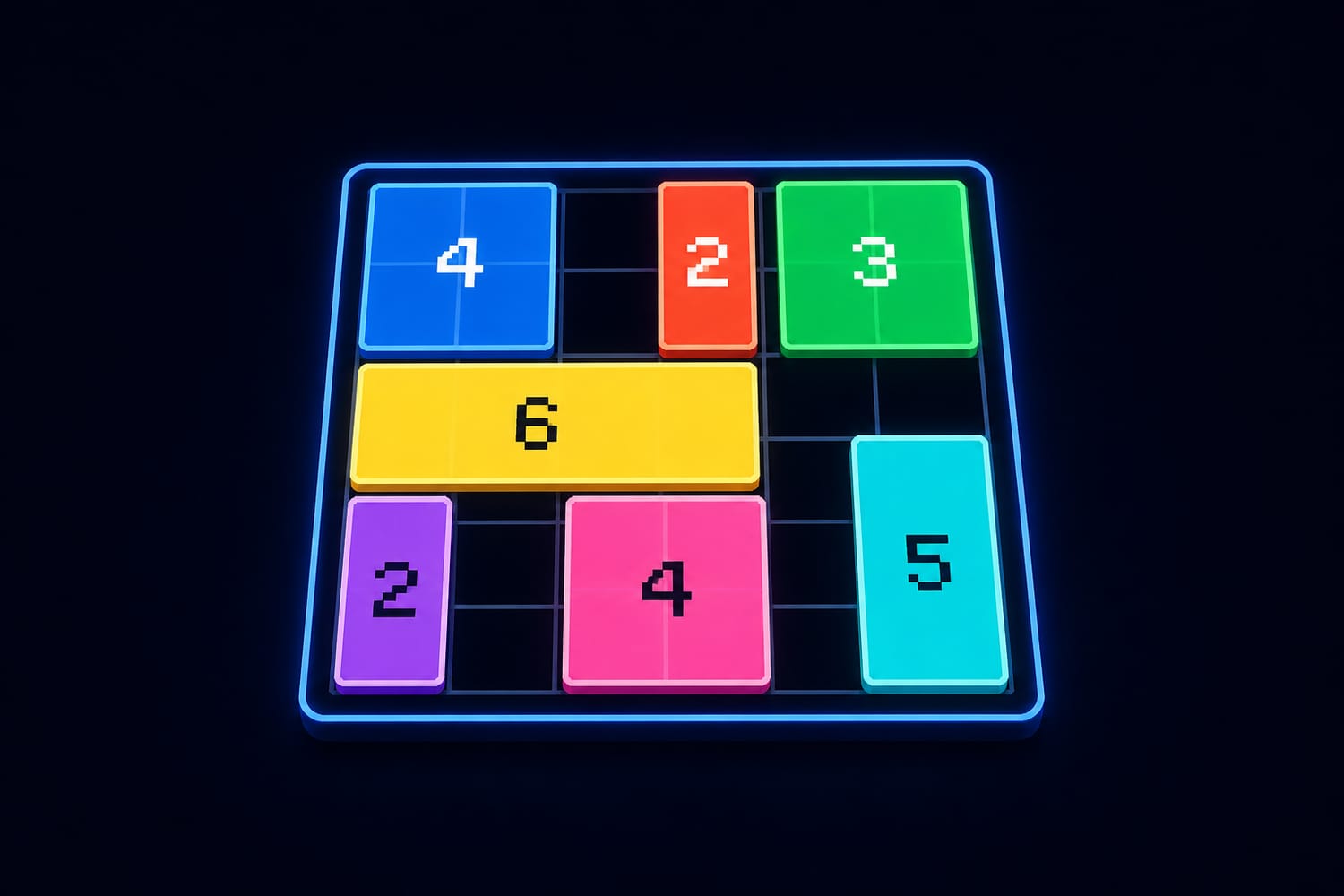
Shikaku: The Japanese Grid Puzzle Where Numbers Become Rectangles
Shikaku is a Japanese logic puzzle with a wonderfully simple goal: divide a grid into rectangles so that each rectangle contains exactly one number, and that number equals its area in cells. A 6 might occupy a 2-by-3 block or a 1-by-6 strip. The challenge is finding shapes that fit together without leaving a single cell behind.
A Grid Full of Possibilities
At first glance, a Shikaku puzzle can look almost unfinished. Most of its cells are blank. A few contain numbers, but there are no equations to complete and no long list of clues to read. Your job is to draw boundaries along the gridlines until the entire board becomes a patchwork of rectangles.
Here are the rules:
- Every region must be a rectangle. Squares count, too.
- Every rectangle must contain exactly one numbered cell.
- The number must equal the rectangle’s area: its width multiplied by its height.
- The rectangles must cover every cell, with no gaps or overlaps.
That final rule gives Shikaku its bite. A rectangle can look perfect around one number yet make the rest of the board impossible to fill. You are solving a connected set of clues, not a collection of separate little problems.
Shikaku is among the original puzzles presented by Japanese puzzle publisher Nikoli, which calls it “Divide by Box”. Its rules need little translation, but its appeal travels easily: wherever you play, a six-cell rectangle is still a six-cell rectangle.
Start With Area, Not Arithmetic Anxiety
The numbers in Shikaku tell you how many cells belong to a shape. They do not need to be added across rows or entered into empty squares as they are in some other number puzzles. If a cell says 4, its rectangle could be 1-by-4, 2-by-2, or 4-by-1—provided the shape stays on the board and contains no other clue.
A 12 offers more dimensions: 1-by-12, 2-by-6, 3-by-4, and their rotated versions. Nikoli points to these factor pairs as part of what makes the puzzle a friendly way to explore multiplication. On a narrow grid, several possibilities may not fit at all; nearby numbered cells can rule out still more.
There is also a quick check for the puzzle as a whole: the clues must add up to the number of cells on the board. A 5-by-5 grid has 25 cells, so its clues must total 25. This does not tell you where the rectangles go, but it helps explain why every clue claims a distinct piece of the grid.
How to Find Your First Rectangle
The easiest opening move is often a 1. Its rectangle can cover only its own cell. Draw its four sides, unless an outer edge already supplies one of them, and you have made your first certain placement.
Next, look at numbers with few possible shapes. A 5 can only form a 1-by-5 or 5-by-1 strip. If the grid is four cells high, the vertical option is impossible. You still need to work out where the horizontal strip lies, but you have learned a great deal about its direction. More generally, a prime-number clue can only make a one-cell-wide strip.
Edges and corners help, too. A clue in the middle of a grid might sit toward the left, right, top, or bottom of its rectangle. A clue in a corner has fewer places to expand. Test each possible shape against the edge of the board and the positions of other numbers.
For example, imagine a 6 near the top of a grid. A 1-by-6 strip might extend too far beyond the right edge, while a 2-by-3 rectangle could fit—until you notice a second clue inside it. That placement is illegal. Another 2-by-3 position may avoid the clue and remain possible. Possible, however, is not the same as proven: check what the placement would leave for its neighbors before drawing a firm boundary.
Let Empty Cells Ask Questions
Once you have placed a few rectangles, shift your attention from the numbers to the unclaimed cells. Every cell must eventually belong to a numbered rectangle. An isolated corner or a narrow passage can therefore tell you which clue has to reach it.
Suppose two confirmed rectangles surround a short run of empty cells. Ask which remaining clue could cover that run while keeping a rectangular shape. Perhaps only one nearby 3 can reach it. You may have found its placement without starting from the number at all.
The same idea can expose an attractive mistake. If drawing a rectangle strands a single empty cell where no remaining clue can reach it, that rectangle cannot be right. If it seals off an area whose cells cannot be divided among the clues inside, reconsider the boundary. This is the moment when Shikaku changes from “Which shapes fit this number?” to “How can the entire board fit?”
A Calm Routine for Tricky Grids
You do not need to solve every clue in order. Work where the restrictions are strongest, then revisit the rest of the board as new boundaries appear. A useful routine is:
- Mark certainties first. Place any 1s and any clues with just one legal rectangle.
- Check constrained clues. Examine primes, large numbers, edges, and corners.
- Compare neighboring shapes. If one candidate takes cells another clue needs, rule it out.
- Inspect the leftovers. Look for uncovered cells or pockets that would be impossible to fill.
- Repeat. Each confirmed boundary may remove an option elsewhere.
If a clue has several plausible rectangles, leave it for now. There is no need to turn an uncertainty into a guess. Another part of the grid may settle it later. For a longer explanation of this style of play, this Shikaku rules and techniques guide walks through the move from individual clues to board-wide deductions.
Why Shikaku Feels Different
Shikaku shares the quiet satisfaction of other grid puzzles, but it asks you to think in areas. You do not fill blank cells with digits. Instead, you decide which cells belong together. A number gives a shape its size, while the surrounding clues and boundaries reveal its position.
That makes it a welcoming companion to other puzzles from Japan. In nonograms, numbered clues gradually reveal a picture; in Shikaku, numbers gradually reveal a tiled board. And if you enjoy the way numbers guide you toward a spatial answer, the story of KenKen’s journey from a Japanese classroom to puzzle pages offers another route into number-based play.
No special vocabulary is needed to begin. Children can practice recognizing rectangles and factor pairs; experienced solvers can enjoy the subtler question of how every shape constrains every other one. Nikoli itself describes Shikaku as both a logic puzzle and a way for young players to encounter multiplication through play.
Give the Grid a Try
The next time you see a Shikaku grid, begin with one modest question: What rectangles could this number make? Check their dimensions, watch for other clues, and notice what each choice would leave uncovered. Soon the blank grid starts to feel less empty. Its numbers are quietly drawing the boundaries—you just have to find them.

