
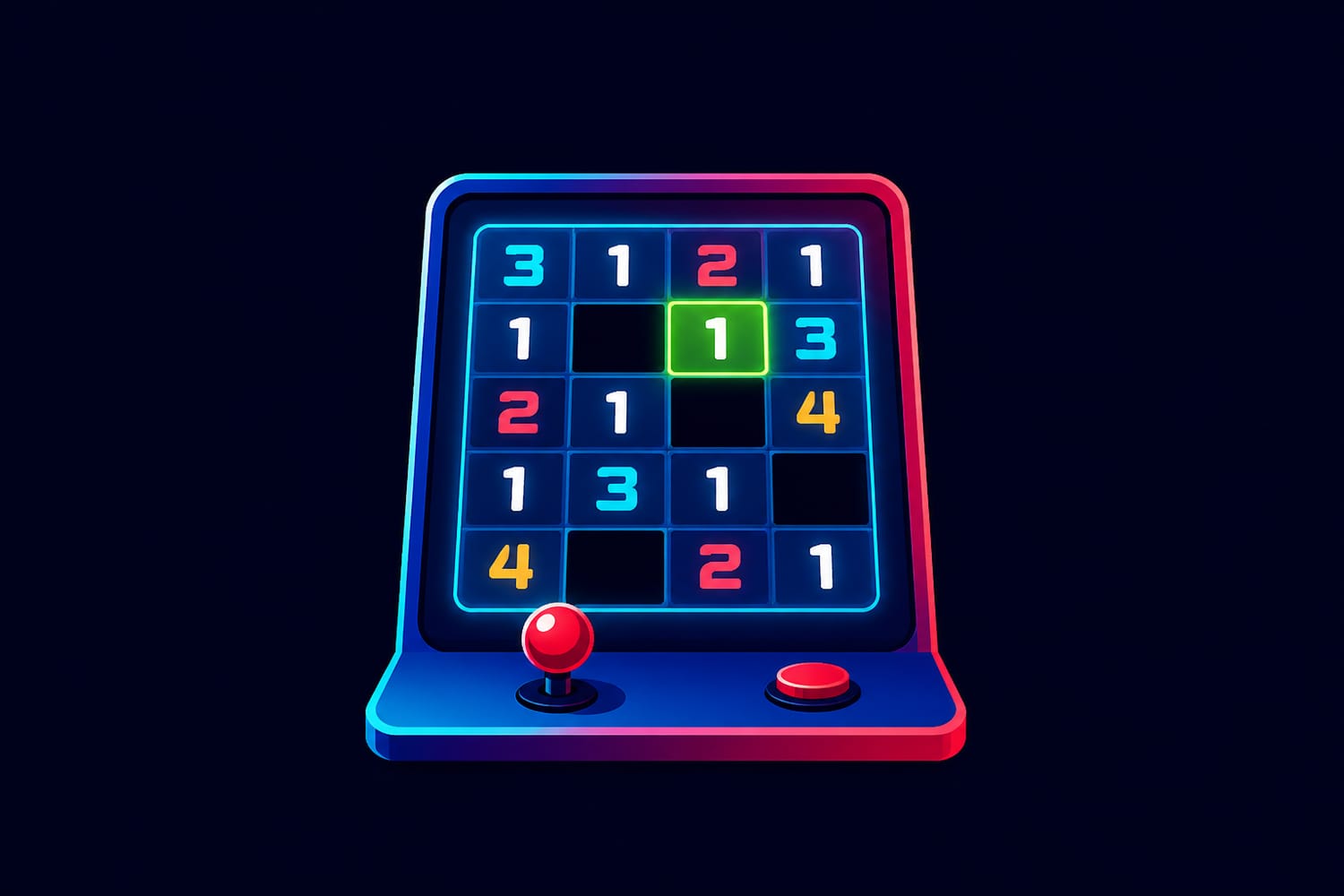
Meet Hitori: Japan’s Number Puzzle That Needs No Translation
A Number Puzzle That Starts With Everything Filled In
Hitori is a Japanese logic puzzle with an unusual invitation: instead of adding numbers to an empty grid, you decide which printed numbers to hide. The goal is to leave no repeated number in any row or column—while obeying two rules about how the shaded and unshaded squares fit together. No arithmetic, vocabulary, or translation is needed to solve it.
At first, the grid may look like a jumble of duplicates. Then a pair of matching numbers catches your eye. One square must go—but which one? That small question can send a chain of clues across the board.
From Japan to a Grid Anyone Can Read
Hitori first appeared in a publication by the Japanese puzzle publisher Nikoli in 1990. Its longer name, Hitori ni shite kure, is commonly translated as “leave me alone.” The name suits the task: among the numbers left visible, each number must stand alone in its row and its column.
That does not mean a number can appear only once in the entire grid. A 3 can remain in several places, provided no two surviving 3s share a row or column. The distinction is small, but it is the key to understanding the puzzle.
Hitori’s use of numbers also makes it welcoming across languages. You need to recognize whether two symbols match, not pronounce them or calculate with them. If you enjoy that wordless quality, Puzzles Arcade explores a related idea in why Sudoku became a global language without words. Hitori, though, gives you a different job: remove selected cells rather than fill blank ones.
The Three Rules of Hitori
Every square begins with a number. To solve the puzzle, shade some squares black and leave the others white. The finished grid must satisfy all three rules:
- No repeated visible numbers: Among the white squares, a number appears at most once in each row and at most once in each column.
- No black squares sharing an edge: Shaded squares cannot touch horizontally or vertically. They can touch at a corner.
- One connected white area: You must be able to travel from any white square to any other by stepping through white squares that share an edge. A diagonal step does not count.
These are the rules given by Nikoli’s Hitori guide. The last two rules are what make the first one interesting. You cannot simply shade every duplicate you spot: two choices might put black squares side by side, or leave a white square cut off from the rest.
Picture the white cells as walkable floor tiles. You may turn some tiles black, but the remaining floor must still form one connected space. It is a useful image when a possible move looks harmless in its own row but threatens a route elsewhere.
Your First Move: Find What Must Happen
Start by scanning each row and column for repeated numbers. Suppose part of a row reads 5 · 5. At least one of those two squares must be shaded. Because they share an edge, they cannot both be shaded. You do not yet know which 5 stays white, but you know exactly one must.
Now imagine that same row also contains a third 5 farther away. That distant 5 must be black. If it stayed white, both adjacent 5s would have to be black to avoid a repeat—and two black squares would touch. A simple pair has settled the fate of a square elsewhere in the row. This is one of the beginner deductions described in Puzzler’s Hitori guide.
An even quicker pattern is 4 · 4 · 4 in three consecutive squares. The middle 4 must stay white. If you shaded it, each outer 4 would also need shading to remove the duplicate, putting black squares beside the middle black square. Once the center stays white, the two outer 4s must be shaded. The same reasoning works vertically.
Let Every Decision Create the Next Clue
Hitori becomes easier when you treat each firm decision as new information. If you know a square is black, its neighbors above, below, left, and right—where those neighbors exist—must be white. If you know a square is white, any other square with the same number in its row or column must be black.
That creates a satisfying rhythm: shade, mark the neighbors white, check their matching numbers, and repeat. A clue in one corner may settle a choice several rows away. Rather than trying to solve a whole row in one glance, follow the consequences of the squares you have already proved.
It helps to use two distinct marks. On paper, you might shade confirmed black squares lightly and circle confirmed white numbers. On a screen, use the puzzle’s available markings if it offers them. Keep uncertain squares unmarked: a duplicate tells you that something must be shaded, but it does not always tell you which square.
Don’t Strand a White Square
The connectivity rule asks you to look beyond matching numbers. Imagine a corner square whose only two edge-sharing neighbors are the square beside it and the square below it. If one neighbor becomes black, the other must remain white if that corner is to stay white and connected to the grid. Two diagonal white squares would not provide a route.
A similar concern can arise in the middle of a puzzle. Before shading a square that seems to form a narrow passage, ask: Can the white squares on either side still reach one another by another path? If not, that passage must stay white. Puzzler identifies this “white island” check as a useful solving strategy.
You need not trace a route after every move. Pay particular attention to corners, narrow gaps, and clusters of shaded squares. That is where a locally sensible choice is most likely to create a disconnected patch.
How Hitori Differs From Other Japanese Grid Puzzles
If you know Sudoku, Hitori’s row-and-column rule may feel familiar. But Sudoku asks you to place digits and, in its classic form, also checks smaller boxes. Hitori prints every number at the start. Your task is to decide which cells disappear, while keeping black cells apart and white cells connected.
It is also different from KenKen, where arithmetic clues help determine which numbers belong in outlined groups. Hitori requires no adding or multiplying. Its challenge comes from the way three simple restrictions interact. Readers curious about another approach to a Japanese number grid can explore KenKen’s journey from classroom puzzle to global game.
And while Hitori involves shading squares, it is not a picture-reveal puzzle. In nonograms, also known as Picross, numbered clues tell you which squares to fill to reveal an image. In Hitori, the finished pattern is the record of your logic, not a hidden drawing.
A Friendly Way to Try Your First Grid
Choose a small Hitori puzzle and keep the three rules nearby. Scan for consecutive matching numbers first, especially a run of three. Make only marks you can explain, then revisit the row, column, and neighboring squares affected by each mark. If you get stuck, look for a possible black square that would leave a white area with no way out.
At the end, do three separate checks: Are all visible numbers unique within their rows and columns? Do any black squares share an edge? Can every white square reach every other through edge-sharing white squares? A solution is complete only when all three answers agree.
That is Hitori’s charm. The grid hands you every number before you begin, but it is your careful choices—what stays, what goes, and what remains connected—that reveal the answer.

