
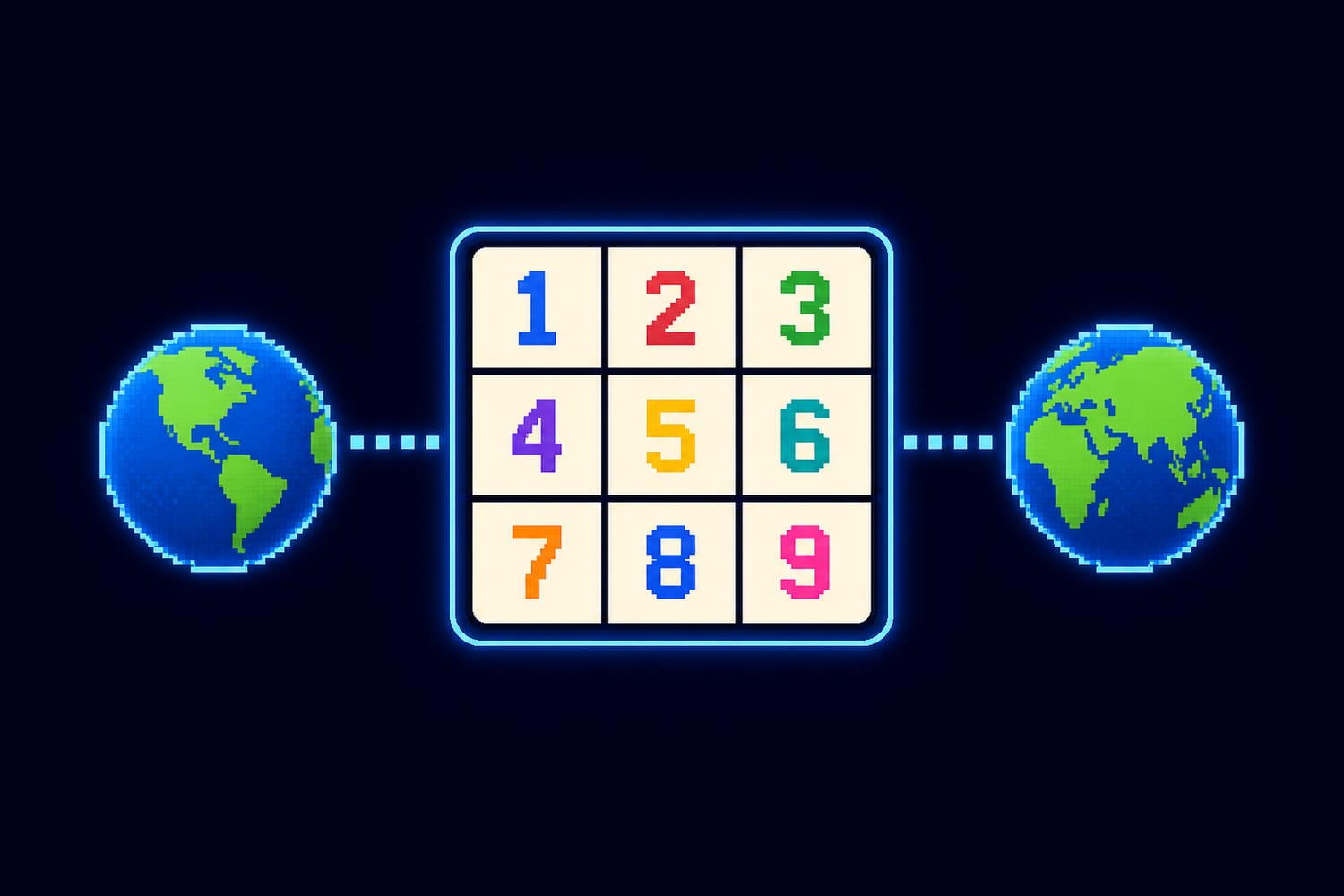
Why Sudoku Became a Global Language Without Words
A Puzzle That Needs No Translation
Walk into a train station in Tokyo, a café in Paris, a classroom in Nairobi, or an airport lounge in São Paulo, and you may see the same quiet scene: someone staring at a 9-by-9 grid, pencil in hand, filling empty squares with numbers. They might not speak the same language as the person sitting next to them, but if both are solving Sudoku, they understand the rules of the game almost instantly.
That is one of Sudoku’s most remarkable qualities. It travels easily. It does not need a long instruction manual, a shared alphabet, or cultural background knowledge. A person who knows Arabic numerals can play the most common version, but even the digits themselves are not truly essential. Sudoku could be made with letters, colors, shapes, or symbols. The numbers are not for calculating; they are simply labels.
At its heart, Sudoku is a logic puzzle. The classic version uses a 9-by-9 grid divided into nine smaller 3-by-3 boxes. The goal is to fill the empty squares so that each row, each column, and each box contains the digits 1 through 9 exactly once. That simple rule creates a surprisingly deep world of reasoning, pattern recognition, and satisfying “aha!” moments.
Sudoku became a global language without words because it combines simplicity with depth. Anyone can understand the goal, but the path to the solution can challenge beginners and experts alike. It is quiet, portable, inexpensive, and endlessly repeatable. It belongs equally to newspapers, puzzle books, mobile apps, classrooms, competitions, and lazy Sunday mornings.
The Long Journey Before Sudoku Had a Name
Although Sudoku feels modern, its roots go back much further than the puzzle boom of the early 2000s. One important ancestor is the “Latin square,” a mathematical arrangement studied by Swiss mathematician Leonhard Euler in the 18th century. In a Latin square, symbols are arranged so that each symbol appears exactly once in each row and column. This idea is related to Sudoku’s structure, though Sudoku adds the extra rule of smaller boxes.
The puzzle we now recognize as Sudoku first appeared in the United States under the name “Number Place.” It was published by Dell Magazines in 1979 and is widely credited to Howard Garns, a retired architect and freelance puzzle constructor. The basic grid and rules were already there: fill in numbers so that rows, columns, and regions contain each digit once.
But the puzzle’s global identity formed in Japan. In 1984, the Japanese puzzle company Nikoli published it under a longer name, “Sūji wa dokushin ni kagiru,” which roughly means “the digits must remain single” or “the numbers must be unmarried.” This was soon shortened to “Sudoku,” a name that became famous worldwide. Nikoli’s president, Maki Kaji, often called the “Godfather of Sudoku,” helped popularize the puzzle by promoting elegant, handcrafted grids that emphasized logic over guessing.
A key feature of Nikoli-style Sudoku was that the puzzle should have a single solution and be solvable through reasoning. That philosophy helped shape how Sudoku is still judged today. A good Sudoku puzzle is not just a random collection of clues. It is designed to lead the solver through a path of logical discoveries.
The next major leap came in the 2000s. Wayne Gould, a retired judge from New Zealand, discovered Sudoku in Japan and developed computer software to generate puzzles. He persuaded The Times newspaper in London to publish Sudoku in 2004. From there, the puzzle spread rapidly through British newspapers, then across Europe, North America, and much of the world. By 2005, Sudoku had become an international phenomenon.
Why Numbers Work Everywhere
At first glance, Sudoku seems to be about numbers, but it is not about mathematics in the usual sense. You do not add, subtract, multiply, or divide. The digits 1 through 9 could be replaced with nine animals, nine fruits, or nine planets, and the puzzle would work exactly the same way.
This is one reason Sudoku became so universal. Many puzzles depend on language: crosswords require vocabulary, riddles require wordplay, and trivia games require specific knowledge. Sudoku asks for something more general: can you notice what is missing, what is impossible, and what must be true?
The use of digits helps because numbers are widely recognized across countries. The symbols 1, 2, 3, and so on are familiar to billions of people. Even when countries use different spoken languages or writing systems, these numerals often appear in education, science, technology, business, and travel. That gives Sudoku a shared visual toolkit.
But Sudoku’s deeper language is logic. If a 7 already appears in a row, you know no other square in that row can be 7. If only one empty square in a box can hold a 4, then that square must be 4. These deductions do not need translation. They feel the same in any country.
This makes Sudoku a kind of silent conversation between puzzle maker and solver. The puzzle maker places clues. The solver follows them. Each correct step reveals another hidden piece of the pattern. No words are exchanged, yet meaning is communicated.
The Pleasure of Order in a Busy World
Part of Sudoku’s worldwide appeal comes from the emotional experience of solving it. Life can be noisy, unpredictable, and complicated. Sudoku offers a small square universe where everything has a place. Every digit belongs somewhere. Every clue matters. Every solved puzzle ends in balance.
That sense of order can be deeply satisfying. When you begin a Sudoku, the grid may look chaotic: scattered numbers, empty spaces, no obvious path forward. But as you work, the fog lifts. A number fits here. Another must go there. Slowly, the grid becomes clearer until the final square clicks into place.
This feeling is not limited by age or culture. Children can enjoy simpler Sudoku puzzles, such as 4-by-4 or 6-by-6 grids. Adults may use Sudoku as a relaxing break from work. Older adults may enjoy it as a mentally engaging daily habit. Expert solvers can explore difficult puzzles with advanced techniques and timed competitions.
Sudoku also gives a special kind of confidence. You do not need to be “good at math” to enjoy it. You need patience, attention, and a willingness to think carefully. Many people who feel nervous about numbers are surprised to discover that Sudoku is friendly rather than frightening.
A Puzzle Built for Newspapers, Books, and Screens
Sudoku spread so quickly partly because it fits perfectly into many forms of media. For newspapers, it is ideal: compact, inexpensive to print, and appealing to a wide audience. A Sudoku grid takes up little space but can keep a reader engaged for minutes or hours.
For puzzle books, Sudoku offers variety. Easy puzzles help beginners build confidence. Medium puzzles introduce new techniques. Hard and expert puzzles challenge experienced solvers. Publishers can create collections for commuters, children, seniors, competitors, or holiday travelers.
Then came digital Sudoku. On computers, tablets, and phones, Sudoku gained new features: automatic error checking, hints, timers, difficulty ratings, note-taking tools, and endless puzzle generation. Digital versions made it even easier for people around the world to play anytime.
Yet Sudoku also remained friendly to pencil and paper. This balance matters. Some puzzles become less popular when technology changes, but Sudoku adapts. It is enjoyable in a printed newspaper, on a glossy app, on a classroom worksheet, or drawn by hand in a notebook.
Its design is beautifully efficient. A Sudoku puzzle is just a grid and a few starting clues. That simplicity allows it to cross borders, devices, and generations.
The Logic Techniques That Create the Magic
For beginners, Sudoku often starts with scanning. You look across rows, down columns, and inside boxes to find where a number can or cannot go. For example, if a certain box needs a 5, and two rows in that box already contain 5s elsewhere, only one row may remain possible.
Another beginner-friendly strategy is “single candidates.” If a square can only be one number, fill it in. Similarly, if a row has only one place where a number can go, that number belongs there.
As puzzles become harder, solvers may use pencil marks: small notes showing possible numbers for each empty square. These notes help reveal patterns. Techniques with names like “naked pairs,” “hidden singles,” “pointing pairs,” and “X-wings” may sound mysterious, but they are all extensions of the same basic idea: eliminate impossibilities until certainty appears.
A well-designed Sudoku puzzle does not require guessing. Guessing can sometimes lead to a solution, but it misses much of the joy. The best Sudoku puzzles feel like a trail of clues. Each deduction is a step forward, and each step is justified.
This logical structure is another reason Sudoku became a global language. The techniques can be taught visually. A teacher can point to a row, circle a box, or highlight a column, and the idea becomes clear even with very few words.
Sudoku Around the World
Sudoku’s global popularity has produced communities of solvers everywhere. Newspapers in many countries publish daily puzzles. International competitions bring together top solvers who race through grids at astonishing speed. Online forums allow fans to discuss techniques, compare solving times, and share unusual puzzle designs.
The World Sudoku Championship, first held in 2006, helped turn Sudoku into a competitive international activity. Participants solve classic Sudoku as well as creative variants. These may include irregular regions, diagonal rules, overlapping grids, or puzzles that combine Sudoku with other logic challenges.
Different cultures have also embraced Sudoku in their own ways. Japan is famous for carefully crafted logic puzzles and remains deeply connected to Sudoku’s identity. The United Kingdom played a major role in the 2000s newspaper boom. The United States helped produce the puzzle’s early form as Number Place. Today, apps and websites have made Sudoku accessible almost everywhere.
In classrooms, Sudoku can support logical thinking, concentration, and perseverance. Teachers may use smaller grids for younger students or themed symbol-based versions for variety. Because the puzzle does not require advanced language skills, it can be useful in multilingual settings.
Sudoku also appears in unexpected places: airline magazines, hotel lobbies, waiting rooms, community centers, and brain-training collections. It has become one of those rare activities that feels both local and global. Wherever it appears, people know what to do: look, think, place, repeat.
Why It Still Matters
Many fads rise quickly and disappear just as fast. Sudoku’s global boom was dramatic, but its staying power is even more impressive. It remains popular because it offers something timeless: a clear challenge, fair rules, and the pleasure of discovery.
Sudoku does not require expensive equipment. It does not depend on luck. It does not exclude people who lack specialized knowledge. It rewards calm attention. It teaches that difficult problems can be solved one step at a time.
That lesson travels well. Whether you are solving in a bustling city, a quiet village, a school desk, or a long-distance train, Sudoku creates a small moment of focus. The grid may be silent, but it speaks in patterns. It invites you to notice, reason, and complete what is unfinished.
In that way, Sudoku truly is a global language without words. Its grammar is rows, columns, and boxes. Its vocabulary is symbols. Its meaning is logic. And its reward is the same everywhere: the satisfying final number placed exactly where it belongs.

