
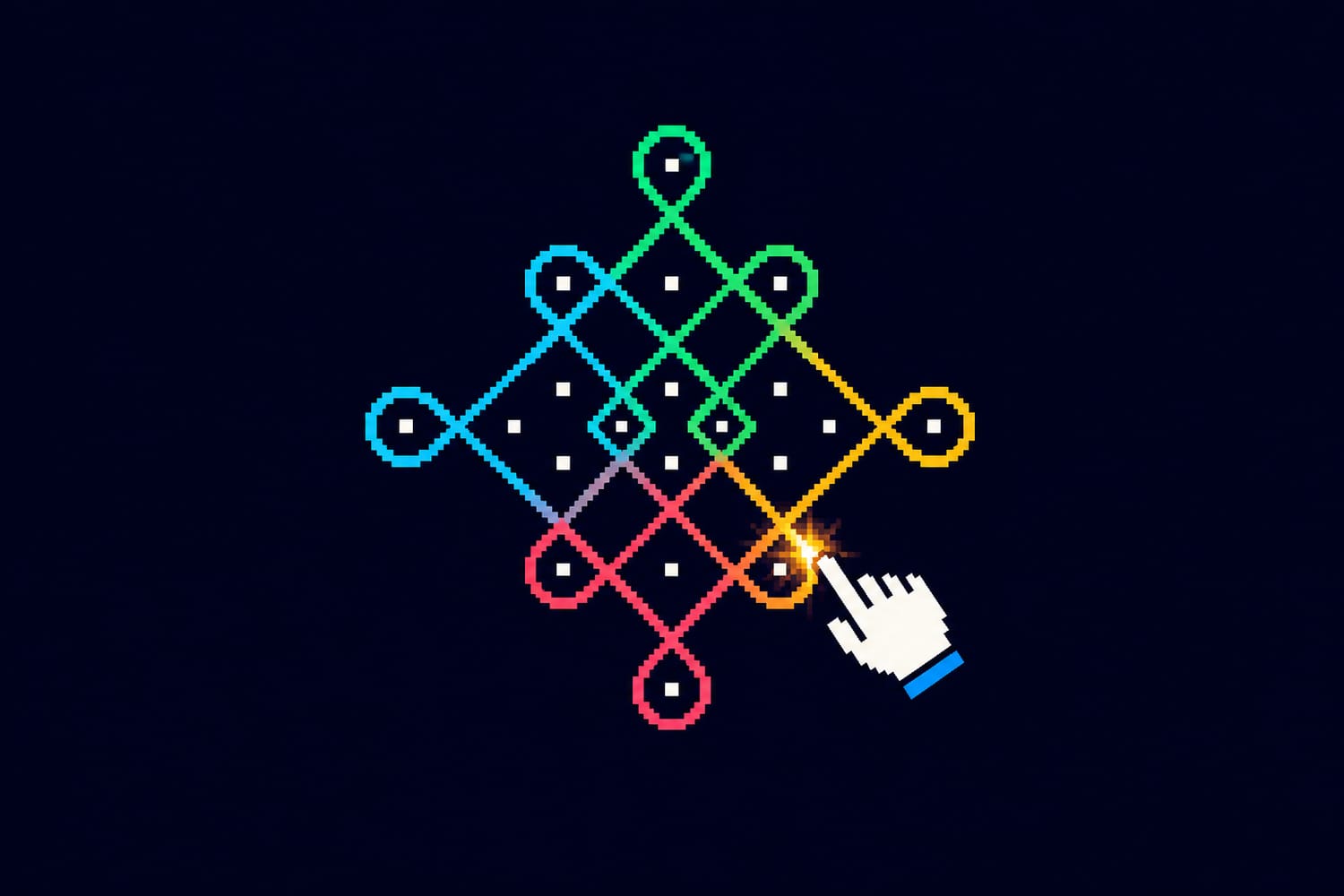
Kolam: The South Indian Line-Drawing Tradition That Works Like a Logic Puzzle
A Drawing That Thinks Like a Puzzle
Kolam is a South Indian threshold-drawing tradition in which dots, curves, loops, symmetry, and repetition come together to form elegant patterns. It is not formally a puzzle game, but many kolams behave like visual logic problems: the artist must follow structural rules, surround every dot, avoid loose ends, and create a balanced design.
At first glance, a kolam may resemble decorative lace drawn directly on the ground. Look closer, however, and the challenge becomes clear. How can one line travel around a field of dots, return to its starting point, and preserve the pattern’s symmetry? That combination of art and orderly problem-solving makes kolam fascinating to artists, mathematicians, programmers, and puzzle lovers alike.
What Is a Kolam?
A kolam is a floor or ground drawing most closely associated with Tamil Nadu, although related practices appear elsewhere in South India. It is commonly created near the entrance to a home, temple, or business, traditionally using rice flour or rice powder. Chalk, stone powder, rice paste, and colored powders are also used today.
Many designs begin with a carefully arranged grid of dots known as pullis. The artist then draws straight or curved lines that connect, weave between, or loop around those dots. Other kolams are more freely drawn and may include flowers, lamps, birds, or symbolic geometric shapes.
Kolam belongs to a wider family of Indian floor-art traditions, but regional names, materials, designs, and customs differ. Rangoli is often used as a broad label for decorative floor art, while Tamil kolam is particularly known for its daily use, geometric organization, and dot-based patterns.
The practice has traditionally been passed between generations, especially among women learning by watching relatives, copying patterns into notebooks, and gradually attempting more difficult designs. A detailed overview from Sahapedia’s guide to kolam in Tamil culture describes how concentration, memory, and controlled hand movements all play a role in its creation.
A Daily Welcome at the Threshold
The location of a kolam is important. A household threshold is neither completely inside nor completely outside; it is the place where home and street meet. Drawing there can serve as a gesture of welcome, auspiciousness, care, renewal, and respect for the space.
In many households, the ground is swept and prepared before the design is made, often early in the morning. The kolam may last only a few hours before wind, rain, footsteps, animals, or ordinary daily activity disturb it. Rather than making the artwork meaningless, this impermanence is part of its character. A fresh pattern can be created the next day.
Rice flour has traditionally made kolam more than a visual offering because ants, birds, and other small creatures may eat it. Modern artists may instead use stone or chalk powder, particularly where durability, cost, weather, or local conditions make rice flour impractical.
Kolams may become larger and more elaborate for festivals and celebrations. The Tamil month of Margazhi is especially associated with ambitious designs and friendly kolam competitions. Pongal, the Tamil harvest festival, is another occasion when entrances may be filled with colorful, expansive patterns.
The Dots Are Clues, Not Decoration
For a puzzle enthusiast, the most intriguing form is the pulli kolam: a design organized around a grid of dots. These dots function somewhat like clues in a logic puzzle. They establish the available space, reveal the pattern’s scale, and limit where the line can travel.
A looping variety often called sikku or chikku kolam is especially puzzle-like. While traditions and individual designs vary, commonly described structural goals include:
- Every dot should be surrounded by a line.
- The line should form one or more closed loops.
- No line should end abruptly.
- Extended sections should not simply be traced twice.
- The completed design should preserve its intended symmetry and flow.
Crossings may appear, but the line usually seems to weave smoothly rather than collide awkwardly. In a one-line kolam, the challenge becomes even sharper: the entire design must be completed as a single closed journey.
This resembles the challenge of tracing a figure without lifting your pencil or repeating an edge. It also shares something with labyrinths and their continuous winding paths, although a kolam is constructed around a dot grid rather than followed toward a central destination.
How Simple Rules Produce Complex Art
Kolam demonstrates a favorite principle of puzzle design: a few understandable rules can generate enormous complexity. A small grid might allow a beginner to see the entire route immediately. A larger grid can support interlocking loops that are difficult to memorize, copy, or complete correctly.
The artist has several questions to solve:
- Where should the first curve begin?
- How closely should the line pass each dot?
- Which part of the design should be repeated or reflected?
- Will every section reconnect without leaving an open end?
- Can the pattern be completed without losing its rhythm?
Symmetry helps manage these decisions. An artist may create one section and reflect it horizontally, vertically, diagonally, or around a central point. Repeated units can also be combined into a larger design, much as a solver uses smaller deductions to complete a full puzzle.
The same principle appears in other international puzzle traditions. For example, magic squares transform a simple number grid into a balanced mathematical challenge. Kolam replaces numbers with movement, but both depend on relationships across the whole grid.
The Mathematics Hidden in the Curves
Kolam artists do not need to describe their work using formal mathematics, yet the designs naturally contain mathematical ideas. These include counting, grids, proportion, reflection, rotation, repetition, closed curves, and spatial reasoning.
A dot grid acts like a coordinate system. Each local decision—turning left, curving around a dot, crossing another line, or reflecting a shape—affects the global design. This local-to-global relationship is one reason kolam has attracted attention from researchers in mathematics and computer science.
Some patterns can be analyzed using graph theory, in which routes and junctions become parts of a connected network. One-line kolams raise questions similar to those found in path-tracing problems: under what conditions can a route cover the required structure and return to its starting point?
Kolams can also be described through algorithms. A computer can be given instructions for placing dots, selecting curves, repeating units, checking connections, and rejecting designs with loose ends. Research discussed by the India China Institute’s exploration of kolam and programming highlights how rule-based generation can help reveal the logical structure within the tradition.
Importantly, computer analysis does not replace the knowledge of practicing artists. A technically valid loop is not automatically a graceful kolam. Spacing, line control, cultural meaning, learned conventions, and the movement of the artist’s hand all contribute to the finished work.
Try a Beginner Kolam on Paper
You do not need rice flour or a stone doorstep to explore the underlying logic. Graph paper, plain paper, and a pencil are enough for a simple experiment.
A Small Practice Challenge
- Draw nine evenly spaced dots in a three-by-three square.
- Begin near one outer dot.
- Curve around it without touching it.
- Continue toward the next dot in one smooth motion.
- Try to surround every dot.
- Return the line to its starting point.
- Check for open ends, isolated dots, or unintended repeated sections.
If the route becomes trapped, do not treat that as failure. Work backward and identify the decision that caused the problem. That is exactly what puzzle solvers do when an assumption produces a contradiction.
Once the design works, try changing one curve while keeping the same dot grid. You may discover that identical “clues” can produce several valid patterns. That creative flexibility distinguishes kolam from puzzles that have only one correct answer.
More Than a Brain Teaser
Calling kolam “puzzle-like” can help newcomers understand its logic, but kolam should not be reduced to a recreational challenge. It is also a living cultural practice connected with household routines, spirituality, celebration, hospitality, artistic skill, and knowledge shared across generations.
Its history is not completely settled. Floor decoration in India has deep roots, but scholars caution against assigning a single ancient origin or precise age to the kolam tradition in its present form. Written references are limited and sometimes ambiguous, while practices have changed across places and periods. That uncertainty is a reminder that living traditions rarely develop as neatly as a puzzle solution.
Kolam also demonstrates how sophisticated thinking can exist outside textbooks and formal institutions. Skills involving geometry, memory, planning, and algorithmic repetition have long been practiced through everyday creative work. Recognizing that knowledge gives us a broader picture of where mathematics lives and who contributes to it.
A Pattern That Can Always Begin Again
Kolam turns an ordinary patch of ground into a meeting place for art, mathematics, memory, and daily life. Its dots invite structure, its lines invite experimentation, and its closed loops reward careful planning. Like many traditions explored in the worldwide history of drawings and grid puzzles, it shows that problem-solving does not have to begin on a printed puzzle page.
Perhaps the most appealing lesson of kolam is that completion is temporary. The finished pattern may disappear, but the method remains in the artist’s memory. The next morning brings a clean surface, another grid of dots, and a new opportunity to solve the space beautifully.

