
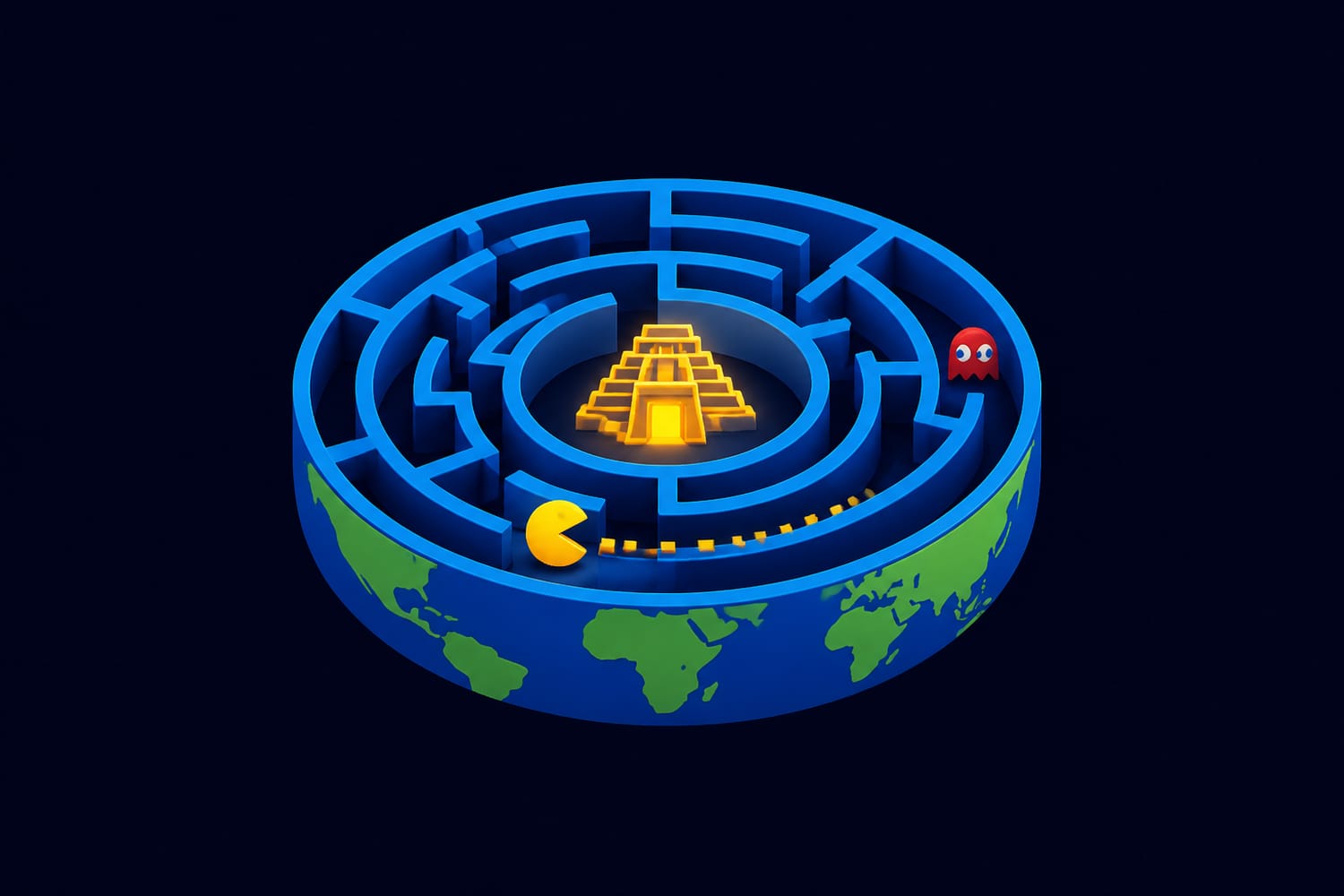
Labyrinths Around the World: How Ancient Paths Became Modern Puzzle Mazes
One Ancient Idea, Countless Winding Paths
Labyrinths began as powerful symbols of journeys, danger, discovery, and transformation. Over centuries, their single winding paths appeared on coins, mosaics, church floors, turf, and stone. Later, branching garden mazes turned the idea into a navigational challenge—the direct ancestor of today’s printed, digital, and real-world puzzle mazes.
Although the words labyrinth and maze are often used interchangeably, puzzle enthusiasts usually make a helpful distinction:
- A labyrinth has one continuous route leading toward the center and back out. It may be long and winding, but it presents no true navigational choices.
- A maze has branching routes, junctions, loops, and often dead ends. Its purpose is to make the traveler choose—and occasionally choose incorrectly.
In other words, a labyrinth is a path to follow, while a maze is a problem to solve. Yet both begin with the same fascinating idea: a complicated journey contained within a carefully designed space.
The Minotaur and the Most Famous Labyrinth of All
The best-known ancient labyrinth comes from Greek mythology. According to the story, King Minos of Crete ordered the skilled inventor Daedalus to build a confusing structure that could contain the Minotaur, a creature described as part human and part bull.
The Athenian hero Theseus entered the Labyrinth to defeat the monster. Ariadne, the daughter of Minos, gave him a thread that he could unwind as he traveled. After facing the Minotaur, Theseus followed the thread back to the entrance.
No confirmed archaeological discovery has proved that a literal Minotaur maze existed at Knossos. The story is mythology, not a historical report. However, it had a genuine influence on ancient art and culture. Coins produced at Knossos displayed labyrinth designs, sometimes with the Minotaur at their center. Interestingly, many of these images show one continuous path rather than a branching maze. The Ashmolean Museum’s exploration of the Cretan Labyrinth shows how myth, archaeology, coins, and later imagination became closely connected.
The story also established several ideas that remain essential to modern maze puzzles:
- An entrance begins the challenge.
- A center or goal gives the journey a purpose.
- Confusion and obstacles make progress difficult.
- A method or clue helps the traveler succeed.
- A safe exit completes the adventure.
Ariadne’s thread may therefore be one of history’s earliest and most memorable maze-solving tools.
From Ancient Coins to Roman Floors
The Romans carried Greek stories across their empire and frequently used labyrinth designs in mosaics. Some Roman examples place Theseus and the Minotaur at the center, surrounded by a geometric network of paths.
A floor mosaic changed how people experienced the design. Instead of hearing a story about a hidden structure, viewers could look down on the entire route. The labyrinth became a map, pattern, decoration, and storytelling device all at once.
Roman labyrinth mosaics have been discovered in different parts of the former empire, including Britain and continental Europe. Their designs were commonly square or circular, demonstrating that the basic concept could be adapted to different spaces without losing its identity.
This visual tradition matters to puzzle history. A modern printed maze also presents a complicated route from above. The player becomes both traveler and map reader, using sight rather than physical movement to explore the design.
Readers interested in other ways that early ideas developed into recognizable brain games can explore ancient puzzle traditions from sand drawings to number grids.
Medieval Labyrinths and the Journey Inward
During the Middle Ages, labyrinths appeared in European churches and cathedrals. Rather than being built to trap monsters, these designs were connected with Christian symbolism, reflection, pilgrimage, and the difficult spiritual journey through life.
The most famous surviving example is set into the floor of Chartres Cathedral in France. Created in the early 13th century, the circular design is approximately 12.9 meters—or 42 feet—across. Its single path runs for more than 260 meters before reaching the center. There are no dead ends, but the route repeatedly carries the traveler toward and away from the destination.
The precise ways in which medieval worshippers used church labyrinths are not completely documented, so popular stories about specific rituals should be treated cautiously. What is certain is that the Chartres design joined geometry, architecture, classical mythology, and religious meaning in one monumental path. The official Chartres Cathedral guide to its remarkable features provides measurements and historical details about the labyrinth.
This type of labyrinth offers a very different challenge from a puzzle maze. Success does not depend on selecting the correct branch. Instead, the experience comes from patience, movement, and the changing perspective created by the winding route.
When Labyrinths Moved Outdoors
Labyrinths were not limited to palace legends and cathedral floors. Turf labyrinths were cut into grassy ground in parts of northern Europe, while stone labyrinths appeared around Baltic and Scandinavian coastal areas. Their exact dates and purposes vary, and some were maintained or reconstructed over generations.
Garden design eventually helped transform the single-path labyrinth into the branching maze familiar today. Formal European gardens used hedges, paths, symmetry, and hidden spaces to create controlled encounters with nature. A hedge maze made those encounters playful: visitors could become lost, reach dead ends, hear companions on the other side of a wall, and search for the center.
Hampton Court Palace near London contains the United Kingdom’s oldest surviving hedge maze. Commissioned around 1700 for William III and designed by George London and Henry Wise, it uses a multicursal—or branching—layout. Its trapezoidal plan covers roughly one-third of an acre and was originally planted with hornbeam before later being replanted with yew.
Unlike a traditional labyrinth, the Hampton Court Palace Maze is deliberately designed to confuse. Visitors must remember turns, recognize repeated locations, and recover from mistakes. The path has become a game.
How a Landscape Became a Paper Puzzle
Once maze designs could be viewed as maps, they no longer required stone, grass, or hedges. A maze could be drawn with ink and solved with a pencil.
Printed mazes made the experience portable, affordable, and endlessly adaptable. Designers could create castles, caves, city streets, forests, spaceships, underwater tunnels, or abstract geometric patterns. A page could represent a place far larger—or stranger—than any physical garden.
Modern puzzle mazes generally include several design elements:
- Junctions, where the solver must make a decision
- Dead ends, which punish an incorrect choice
- Loops, which can return the solver to a familiar area
- Islands, or sections of wall separated from the outer boundary
- Multiple entrances or goals, which create alternative challenges
- Rules and hazards, such as keys, locked doors, enemies, or collectible objects
These additions turn route-finding into storytelling. The player may be helping a knight reach a castle, guiding an astronaut back to a spacecraft, or moving a hungry animal toward its lunch. The maze becomes a miniature adventure.
The Logic Hidden Inside Every Maze
Underneath its artwork, a maze is a network of connected points. Mathematicians and computer scientists can represent intersections as vertices and passages as edges, turning a maze into a type of graph.
This explains why maze-solving is closely related to search algorithms. A solver explores possible routes, records progress, rejects failures, and continues until a route reaches the goal.
Human solvers often use similar strategies:
- Trace from the finish backward to spot promising routes.
- Mark confirmed dead ends lightly.
- Pause at junctions and remember the direction already tested.
- Divide a complicated maze into smaller visual regions.
- Avoid guessing quickly when careful observation can eliminate a route.
The well-known “keep one hand on the wall” method works for certain simply connected physical mazes, but it is not universal. A maze containing disconnected wall sections or loops may cause the traveler to circle an internal island without reaching the intended destination.
Mazes in Cornfields, Escape Rooms, and Digital Worlds
Today’s mazes can be enormous seasonal attractions, pocket-sized activity pages, or vast digital environments. Corn mazes use paths cut through fields, often forming pictures visible from above. Mirror mazes multiply passages through reflection, while wooden panel mazes can be rebuilt with new routes.
The maze idea also thrives in video games. Digital designers can hide doors, change passages, move walls, limit visibility, and generate new layouts automatically. Players may need to collect objects, avoid hazards, or solve additional riddles before an exit opens.
Escape rooms extend the idea even further. The “maze” may not be a network of corridors at all; it can be a sequence of connected clues. Each solution leads to another puzzle until the team reaches the final objective. This evolution is explored in Puzzles Arcade’s guide to how escape rooms became a global puzzle phenomenon.
Real-world maze attractions have also become destinations in their own right. Travelers can explore garden mazes, puzzle trails, interactive museums, and immersive rooms as part of the growing world of puzzle tourism.
Why We Still Love Getting Lost
Labyrinths and mazes offer two versions of the same timeless experience. One asks us to trust the path. The other asks us to choose wisely.
Both transform confusion into something safe and enjoyable. We can enter an uncertain space knowing that patience, observation, or logic will eventually guide us through. A wrong turn is not a disaster—it is useful information.
That may be why the ancient symbol has survived so many changes. The path once associated with the Minotaur became a Roman mosaic, a medieval journey, a garden amusement, a pencil puzzle, and a digital challenge. Materials and meanings changed, but the central promise remained: somewhere inside the twists and turns, there is a way forward.

