
Karuta: Japan’s Poetry Card Game Where Memory Meets Reflexes
A Poem Begins. Two Hands Move.
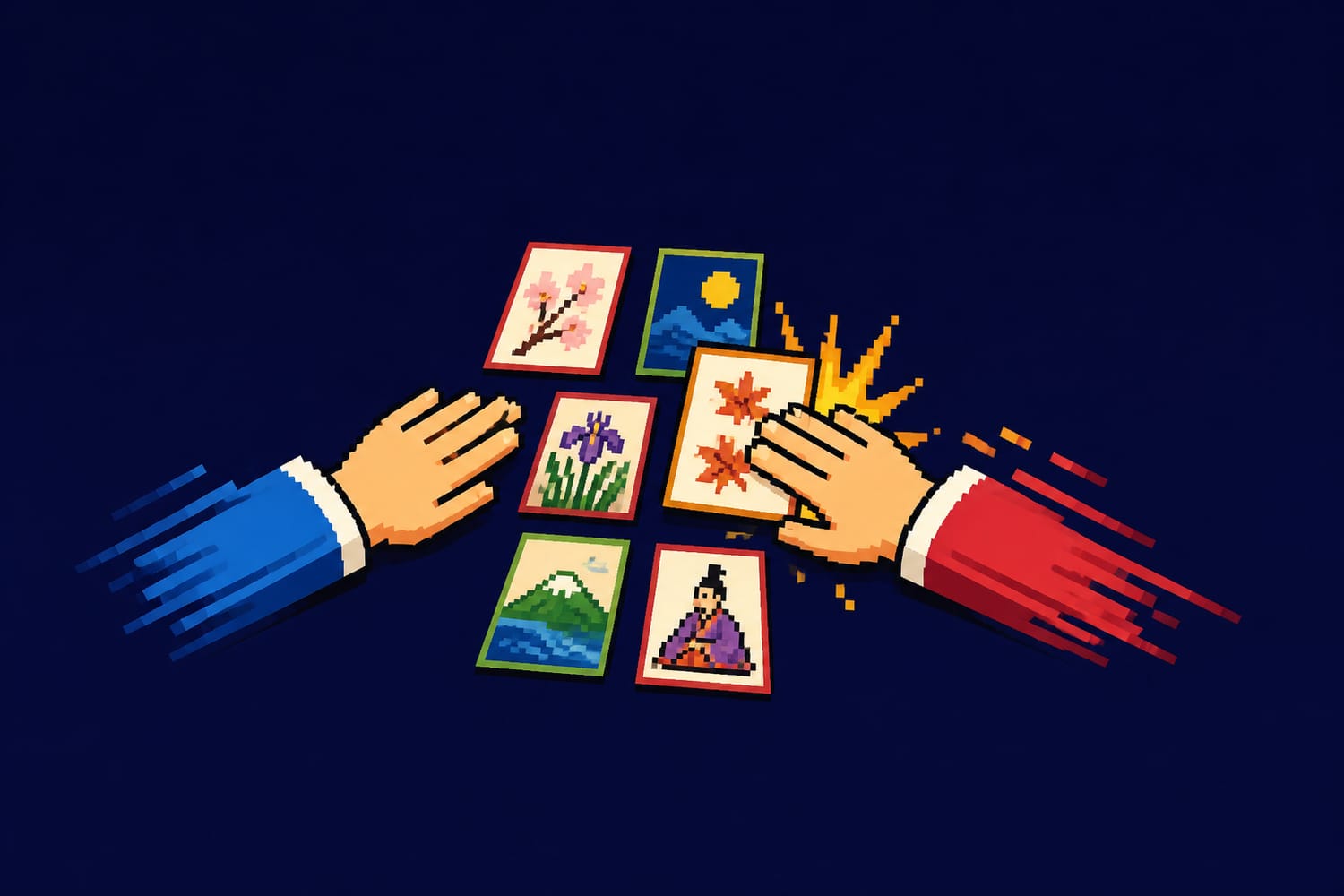
Karuta is a Japanese card game that turns poetry into a test of listening, memory, and reflexes. In its best-known competitive form, two players face a spread of cards while a reader recites from a collection of 100 poems. The challenge is to recognize which poem has begun and touch its matching card first—sometimes before the reader has finished the opening phrase.
Imagine sitting opposite another player on a quiet floor. You know where the cards are, but you do not know which poem will come next. A voice breaks the silence. For an instant, both players listen; then a hand flashes across the cards. That shift from stillness to movement is part of karuta’s appeal.
From a Poetry Collection to a Card Game
The poems used in competitive karuta come from the Ogura Hyakunin Isshu, commonly translated as “One Hundred Poems by One Hundred Poets.” The collection is associated with the 13th-century poet Fujiwara no Teika. Its short poems contain images of changing seasons, landscapes, longing, and love—subjects that give players much more to discover than a set of phrases to memorize.
In this form of karuta, each poem has two matching cards. A reading card, or yomi-fuda, carries the complete poem and is used by the reader. A playing card, or tori-fuda, carries its second half, written in Japanese hiragana. Players hear the beginning of the poem and search for the card showing its ending. It is a matching game in which the clue arrives by ear, while the answer waits in plain sight.
Karuta is a broad word for Japanese card games; the poetry game is often called uta-garuta, or “poem cards.” The word karuta itself comes from the Portuguese carta, meaning “card.” Over time, this meeting of cards and Japanese verse developed into a game with formal competitive rules. If you enjoy seeing how language shapes play in different places, explore word games beyond the alphabet in Puzzles Arcade’s around-the-world collection.
How a Competitive Match Works
A full set has 100 playing cards, one for each poem. A competitive match uses only 50 of them: each player selects 25 and arranges those cards face up in their own territory. The other 50 playing cards stay out of the layout. Before play begins, the competitors have 15 minutes to memorize the positions of the cards on both sides.
Once the reader begins, each poem creates a small race. If its matching playing card is on the floor, both players may try to take it. A player can take a card from their own territory or the opponent’s. Taking one from the opponent’s side brings an extra advantage: the player may send one of their own cards across, reducing the number left in their territory. The first player to clear their own territory wins. The All Japan Karuta Association’s illustrated rules show each stage of a match.
But the reader might recite one of the 50 poems whose playing cards are not on the floor. These absent cards are called kara-fuda. In that case, the right move is no move at all. Touching a card when an absent poem is read is a foul, and the opponent sends a card into the offending player’s territory. Speed matters, but an impulsive reach can set you back.
Competitive karuta also has room for courtesy. Players bow to the opponent and the reader at the beginning and end of a match. Even when the contest grows fast and tense, that moment of respect frames it as something shared.
The Clue Hidden in the First Sounds
How can someone know which card to reach for before hearing the whole poem? The answer is kimari-ji: the opening sound or sounds that distinguish one poem from the others. Some poems can be identified after their first Japanese sound; others require listeners to wait longer. The All Japan Karuta Association describes poems that take as many as six sounds to distinguish.
Think of two familiar song titles that begin with the same word. Hearing that word alone would not tell you which song someone means. You would wait for the next sound that separates them. Karuta players do something similar, but they must also remember where each possible answer lies and be ready to move the moment the uncertainty disappears.
The puzzle changes during the match. Suppose two poems share an opening, but one has already been read. The surviving poem may now be recognizable sooner. A skilled player is therefore doing more than reciting memorized answers: they are updating the possibilities as cards leave play.
Why Memory and Reflexes Need Each Other
Karuta rewards several kinds of attention at once. First, players learn the link between a poem’s opening and the second half printed on its card. Next, they memorize where that card sits in this particular match. Finally, they listen closely enough to recognize its opening and move toward the correct place.
None of those skills is sufficient alone. Knowing a poem does not help if you have forgotten whether its card is near your left hand or across from you. Memorizing the layout does not help if you mistake one opening for another. And moving quickly is no advantage when the correct card is absent.
The physical technique can be surprising, too. Players need not delicately lift a single card. Under competitive rules, touching the correct card—or sweeping it out along with nearby cards—can count as taking it. The result is a game that feels unlike a quiet poetry reading without losing its connection to the poems.
This blend of concentration and movement will feel familiar to anyone who likes games that ask for focus under pressure. Puzzles Arcade also explores how puzzle games challenge planning, focus, and self-control. Karuta offers a particularly vivid example: a player must sometimes hold back at the very moment they most want to move.
Try the Idea Without Memorizing 100 Poems
You do not need to learn the entire Hyakunin Isshu to appreciate karuta. Start by listening to a reading and noticing its rhythm, then try matching the openings and endings of a few poems. Learning what a poem evokes can make it easier to remember than treating it as an unfamiliar string of sounds.
For a karuta-inspired practice game, make a small set of your own cards:
- Choose five short, family-friendly poems or sentences.
- Write each beginning on a card for a reader and its matching ending on a separate card for players.
- Spread the ending cards face up and have the reader call out beginnings in random order.
- Add a few calls with no matching card on the floor, so players practice waiting as well as reaching.
This is an adaptation, not the formal Japanese competitive game. It does, however, reveal the central delight: a sound becomes a clue, memory supplies the answer, and the players decide when to act. If hands-on traditions spark your curiosity, Japan’s secret puzzle boxes offer another way to explore the meeting of careful observation and play.
A Game That Keeps the Poems Moving
Karuta makes an old poetry collection feel immediate. Each match rearranges the cards, asks players to listen again, and gives familiar verses a fresh moment of suspense. You can enjoy the poems, admire the quick reactions, or simply wonder how someone knew where to reach.
The best part is that the game never makes you choose between those interests. In karuta, a line of poetry can be beautiful, a memory cue, and the starting signal for a race—all at once.

