
Hedgehog in a Cage: How an Adventure Story Made a Puzzle a Czech Icon
Hedgehog in a Cage, or ježek v kleci in Czech, is a mechanical puzzle that became a Czech cultural icon through Jaroslav Foglar’s adventure fiction. His story Záhada hlavolamu placed the puzzle at the heart of a mystery involving five friends, a secretive neighborhood, and plans for a flying bicycle.
It is an irresistible setup: an object small enough to hold in your hand, difficult enough to frustrate you, and important enough for fictional rivals to pursue through shadowy streets.
But the real history contains another twist. Foglar did not invent the underlying puzzle. His achievement was something different: he gave it a story that made people care about what might be inside. As Czech Radio’s introduction to Foglar explains, the famous puzzle had American origins before becoming closely associated with Czech adventure literature.
What Exactly Is the Hedgehog in a Cage?
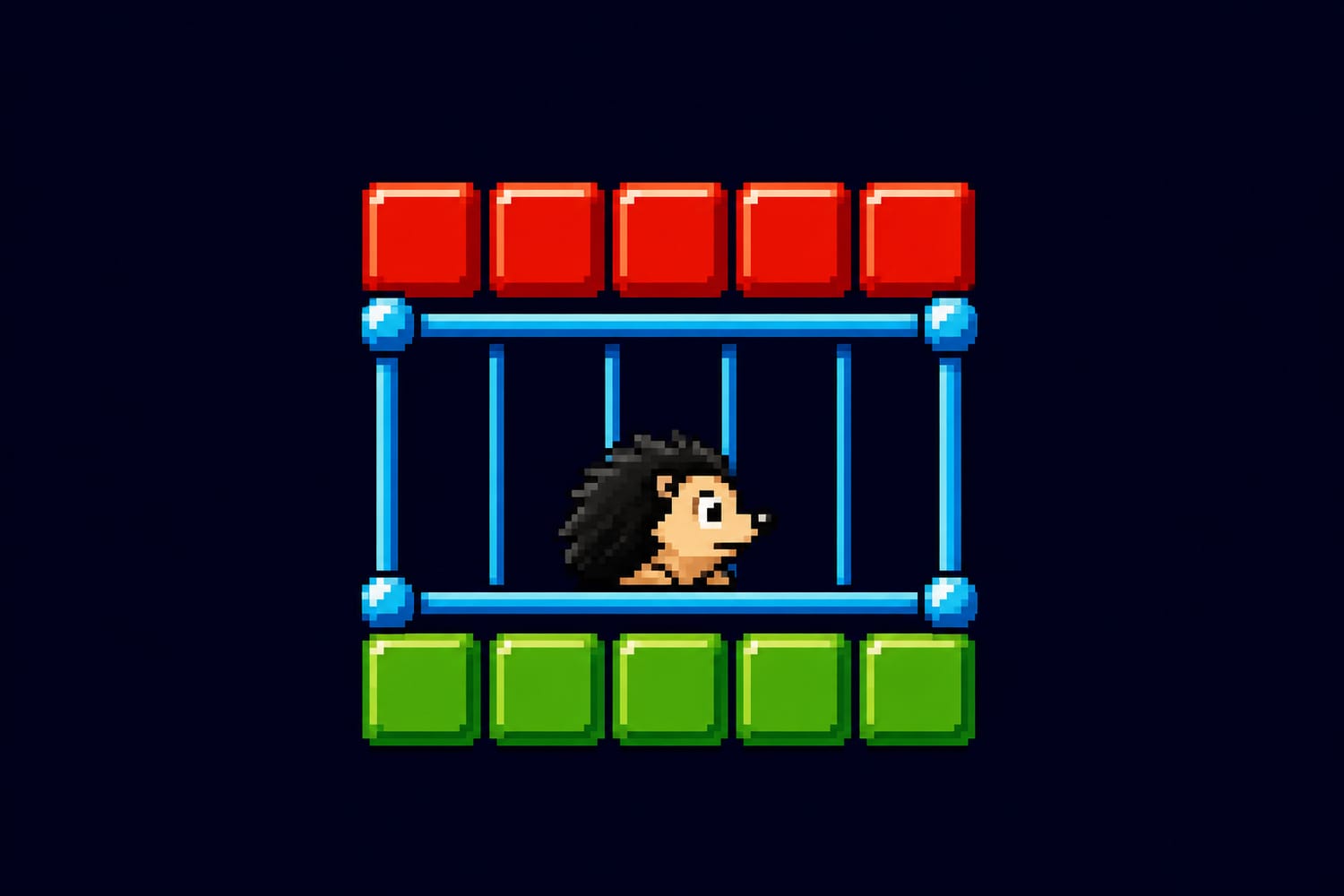
Forget a miniature animal behind bars. The “hedgehog” is a small central body with spikes projecting outward. It sits inside a cage, commonly cylindrical, whose openings appear too restrictive to let the spiky object escape. The challenge is to remove it without damaging either part.
The name makes the task immediately understandable. You are not merely separating two geometric objects; you are freeing a hedgehog.
In familiar versions, the solution depends on the relationship between the spikes and the cage openings. Careful positioning allows the apparently trapped object to pass through. Different designs vary, however, so a sequence that works on one model may not solve another.
That contrast is the puzzle’s great attraction. The goal could hardly be simpler, yet understanding the space around those spikes requires close attention.
A Puzzle With Roots Beyond Czechia
The puzzle’s Czech identity should not be confused with a Czech invention claim. Related American puzzles existed in the nineteenth century, well before Foglar’s story. Czech puzzle designer and researcher Radek Micopulos documents an American predecessor called Trilby dating to 1895.
The important distinction is between mechanical ancestry and cultural meaning. An object can originate in one place and acquire its strongest associations somewhere else.
For readers interested in that wider pattern, the global journey of tangrams offers another example of a puzzle crossing borders and reaching audiences far beyond its original setting.
With Hedgehog in a Cage, the crucial transformation happened through fiction. Foglar took an intriguing mechanical challenge and made it something readers could recognize as a doorway into adventure. Czech Radio explicitly distinguishes his popularization of the puzzle from its invention.
Meet Jaroslav Foglar and the Rapid Arrows
Jaroslav Foglar was a Czech writer, magazine editor, and Scout leader whose work connected adventure with friendship and youthful initiative. Among his best-known creations were the Rychlé šípy, usually translated as the Rapid Arrows, whose comic adventures began appearing in December 1938.
The group consists of five boys: Mirek Dušín, Jarka Metelka, Jindra Hojer, Červenáček, and Rychlonožka. They also became the central characters in prose adventures, including the mystery that made the hedgehog famous.
Záhada hlavolamu, commonly translated as The Mystery of the Puzzle, began appearing in the magazine Mladý hlasatel in 1940. Its first book edition followed in 1941. Those dates describe different stages of publication, rather than competing accounts of when the story appeared.
That distinction also helps newcomers navigate Foglar’s work: the Rapid Arrows were comic-strip heroes, but their celebrated search for the hedgehog unfolded as a prose novel.
Into Stínadla, Where a Toy Becomes a Treasure
The adventure takes the boys into Stínadla, a mysterious old district associated with a youth organization called the Vonts. Its narrow streets and secretive social world turn an ordinary city neighborhood into territory that must be explored and understood. The hedgehog is bound up with the Vonts’ history and authority.
This gives the puzzle importance beyond its clever mechanism. Finding it means entering a community with its own rules, rivalries, and guarded knowledge.
Another strand of the mystery concerns Jan Tleskač, a young locksmith’s apprentice whose past the boys investigate. His extraordinary invention is a flying bicycle, and its plans are hidden inside the hedgehog. The television adaptation preserves this central revelation.
The bicycle is fictional, but its role is wonderfully effective. Readers are not simply wondering how to extract a spiky ball. They want to know what the object protects and why so many people want it.
Foglar thus creates two connected mysteries: how does the puzzle work, and what larger secret will solving it reveal?
Why the Story Made Such a Difference
A useful way to understand the hedgehog’s appeal is to notice how closely the object matches the adventure surrounding it.
Both reward investigation. The boys must interpret clues and uncover connections; the solver must examine openings, spikes, and possible movements.
Both make appearances unreliable. A neighborhood contains hidden histories. A cage that looks inescapable contains a route out.
Both make discovery feel earned. The satisfying moment comes when scattered observations finally fit together.
These parallels help explain why the puzzle is more than an incidental prop. It gives physical form to the experience of reading a mystery.
Its secret interior adds another layer. As Mensa Czech Republic’s discussion of Foglar notes, his distinctive contribution included the idea of an opening hedgehog that could conceal closely guarded information. That literary feature should not be assumed to exist in every real-world version.
There is a useful comparison with Japan’s secret puzzle boxes: in both cases, the possibility of something concealed makes the mechanism especially intriguing. The designs are different, but each invites the same question: what will understanding this object allow me to discover?
From Printed Adventure to Shared Cultural Symbol
The story’s reach extended beyond the page. Director Hynek Bočan made a nine-part television adaptation in 1969, drawing on Záhada hlavolamu and its sequel, Stínadla se bouří. Czech Television’s archive account records both the production and a later gathering attended by Foglar, cast members, and the series’ creators.
Real puzzles also gave readers something tangible to handle. Wooden versions were being produced in Czechoslovakia in 1941, and later decades brought further wooden, plastic, and metal interpretations. The surviving examples show how differently makers could realize the same basic challenge.
The association remains recognizable enough to inspire public art. Prague City Gallery’s exhibition description for Patrik Proško’s Hedgehog in a Cage explicitly identifies Foglar’s adventure novels as the reason this American-origin mechanical puzzle became famous in the Czech cultural context.
That is a remarkable journey: from a handheld challenge to a literary treasure, a television prop, and a cultural reference.
How to Approach the Puzzle Without Spoiling It
You do not need to know the novels to enjoy the challenge. For a first attempt, try this gentle, spoiler-light approach:
- Inspect before moving. Compare the cage openings and the lengths and directions of the spikes.
- Test one idea at a time. Change the orientation deliberately rather than shaking everything at once.
- Avoid force. Do not bend bars or spikes to create an escape route.
- Pause when frustrated. Return with a fresh question about what is blocking the movement.
- Try replacing the hedgehog afterward. Use the return journey to check whether you understood the successful sequence.
For familiar designs, RADEMIC’s illustrated history and explanation identifies the largest cage opening and longest spike as important clues. Treat that as a hint, not a universal solution: the puzzle exists in many variants.
A Small Object With a Story Inside
Hedgehog in a Cage shows how storytelling can change the way an object is understood. Its mechanical challenge gives the hands something to investigate. Foglar’s adventure gives the imagination somewhere to go.
You can approach it as a puzzle, a piece of Czech popular culture, or an invitation to discover the Rapid Arrows. Its enduring charm lies in how comfortably those experiences fit together: a little cage, an unlikely escape, and the promise that patient curiosity may uncover something wonderful.

