
Hashiwokakero: The Japanese Logic Puzzle Where You Build Bridges Between Islands
A Puzzle That Starts With Islands
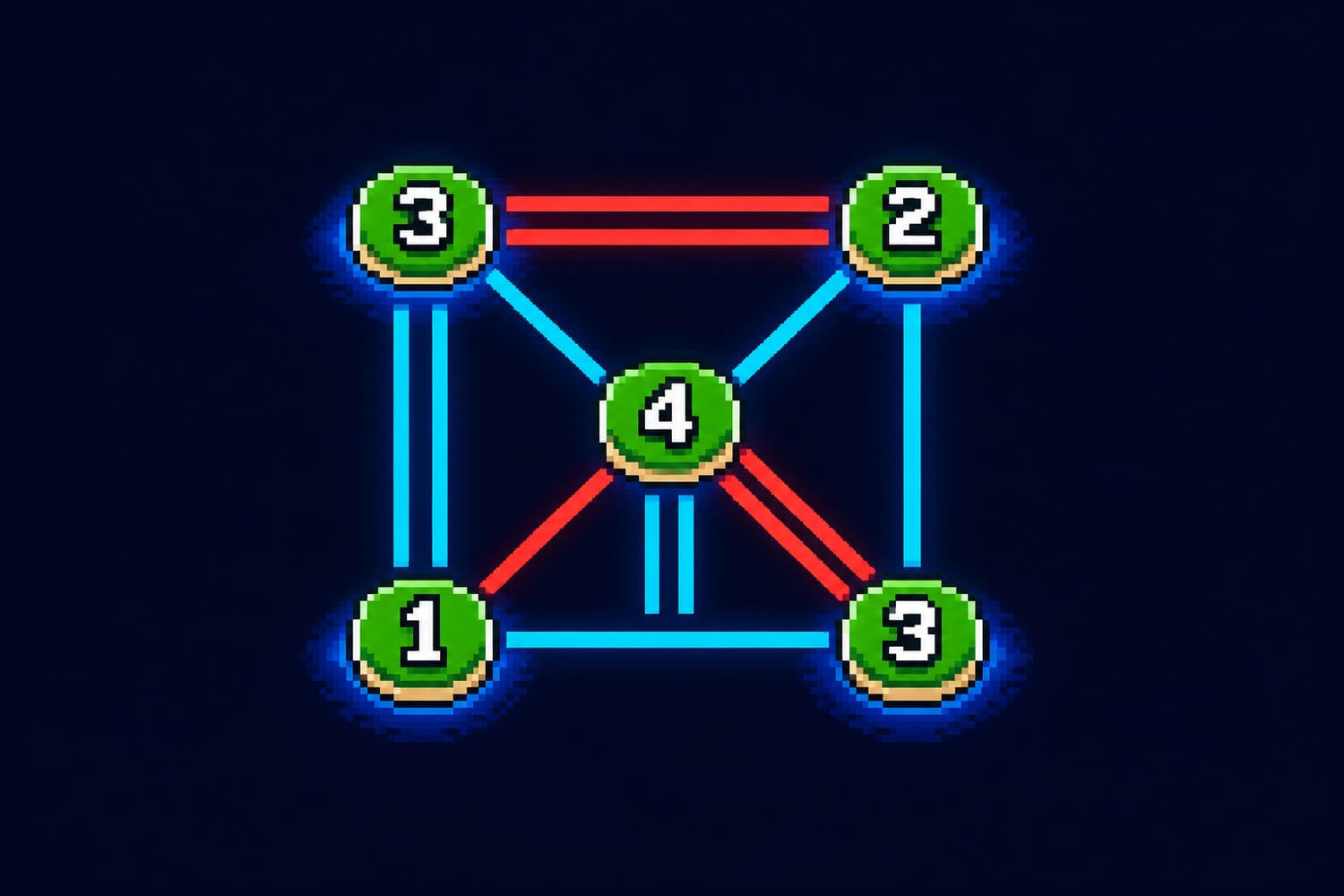
Hashiwokakero is a Japanese logic puzzle about building bridges between numbered islands. Each number tells you how many bridges must reach that island. You can draw one or two bridges between a pair, but bridges cannot cross, and every island must belong to one connected network. It is usually shortened to Hashi, or simply called Bridges.
Imagine looking down at a scattered group of islands. A tiny island marked 1 needs just one bridge. A busy island marked 6 needs six. Your job is to make all those individual demands fit together without blocking a route—or leaving anyone stranded.
That last part gives Hashi its character. Matching the numbers is only half the challenge. You are also designing a map on which someone could travel from any island to any other, perhaps by passing through several islands along the way.
From Japan to the Puzzle Page
Hashiwokakero belongs to the family of logic puzzles published by the Japanese puzzle company Nikoli. Like many puzzles in that family, it has a compact set of rules and needs little language once you know how to play. Its clues are numbers, but solving it is more about spotting possibilities than doing difficult arithmetic.
That makes it inviting whether you are opening a puzzle book for the first time or looking for a change from Sudoku. If you enjoy the way a few clues gradually reveal a complete design, you might also like Puzzles Arcade’s look at how Japanese picture puzzles became known around the world. Hashi offers a different reward: instead of uncovering a picture, you construct a working network.
How to Build a Legal Bridge
An island can connect to another island directly across its row or column, provided no island lies between them. Bridges run horizontally or vertically, never diagonally. You may draw one bridge, two parallel bridges, or no bridge along a possible connection. Two is the maximum between the same pair of islands.
A double bridge counts as two at both ends. For example, if an island marked 3 has a double bridge to its right and a single bridge above it, its count is complete: 2 + 1 = 3. It cannot accept another bridge.
There are two more checks. Bridges must not cross other bridges or pass through islands. And when the map is finished, all its islands must form one connected group. Getting every number right does not make a solution valid if the result contains separate groups. Nikoli’s official Hashiwokakero rules include all four conditions.
Your First Three Deductions
The best place to start is often an island with very few possible neighbors. Rather than asking, “Where would a bridge look good?”, ask, “How could this island possibly reach its number?”
1. Find a forced single or double. Suppose a 1 can see only one other island. It needs one bridge in that direction. If an island marked 2 has only one possible neighbor, it needs a double bridge there. As always, keep an eye on whether that choice can still fit into the whole network.
2. Look for islands with no spare capacity. Imagine a corner island marked 4 that can connect in only two directions. Each direction can hold at most two bridges, so both must be doubles. For a corner 3 with two available directions, one must be a double and the other a single—even if you do not yet know which is which.
3. Place what is certain before deciding everything. If an island marked 5 has three possible directions, it cannot leave any one of them empty: the other two could supply at most four bridges. You can mark at least one bridge in each direction and wait for neighboring clues to tell you where the remaining two go.
This is the rhythm of Hashi. A clue limits a bridge; that bridge changes a neighbor’s options; the neighbor reveals the next move.
A Three-Island Example
Picture three islands in one row, with no others on the board:
1 — 3 — 2
The middle 3 is the nearest island to both ends. The 1 on the left can supply only one bridge, and the 2 on the right needs two bridges to its only neighbor. So draw a single bridge between 1 and 3, then a double bridge between 3 and 2.
Now check the middle: it receives 1 + 2 = 3 bridges. All three clues match, no lines cross, and every island is connected. A larger Hashi puzzle uses exactly these small deductions, repeated across a more complicated map.
Think Beyond the Nearest Island
Numbers tell you what each island needs, but connectivity tells you what the whole map needs. Suppose two islands marked 1 can see each other and there are more islands elsewhere. Connecting those two would use up both of their bridge counts. They would become a sealed-off pair with no way to join the rest, so that tempting bridge cannot be part of the final solution.
The same warning applies to a larger cluster. If every island in a group has reached its number but the group has no bridge to the outside, it is cut off. Before completing a cluster, check that it already joins the wider network—or still has a possible route out.
There is a subtle distinction here: a loop is not automatically wrong. Bridges may form a loop as long as the finished network obeys the other rules and all islands remain connected. The problem is an isolated loop or group, not the shape of a loop itself. Simon Tatham’s playable Bridges puzzle is one place to see this rule stated explicitly and try the puzzle on a screen.
A Calm Way to Tackle a Bigger Map
A crowded board can feel overwhelming if you try to solve every island at once. Instead, make a pass across the map for obvious counts, then revisit it whenever you add a bridge. This approach turns one large problem into a series of manageable ones.
- Scan the edges and corners. They often have fewer possible connections.
- Count what is already drawn. A 4 with three bridges in place needs exactly one more.
- Notice blocked routes. A bridge you have drawn may make a crossing bridge impossible.
- Mark completed islands. This helps you avoid adding to an island whose number is already satisfied.
- Trace the network before finishing. Follow the bridges and check that you can reach every island.
On paper, light pencil marks can distinguish a confirmed bridge from a possible one. If you are stuck, move to another part of the map rather than guessing immediately. A deduction elsewhere may settle the choice that looked uncertain.
Why the Bridges Are So Satisfying
Hashi asks you to think at two scales. Up close, you count carefully: does this island need one bridge or two? From a distance, you consider the entire archipelago: will these choices produce a connected map? Neither view works quite as well without the other.
It is also a welcoming puzzle to share. A younger solver can hunt for an island with only one possible neighbor; a more practiced solver can examine how several distant choices affect connectivity. Both are contributing to the same map. That blend of simple clues and far-reaching consequences appears in other logic traditions explored in Puzzles Arcade’s story about Sudoku’s wordless appeal.
When you complete a Hashi puzzle, you have done more than fill in numbers. You have built a little world in which every island has exactly what it needs—and every island has a way to reach the others.

