
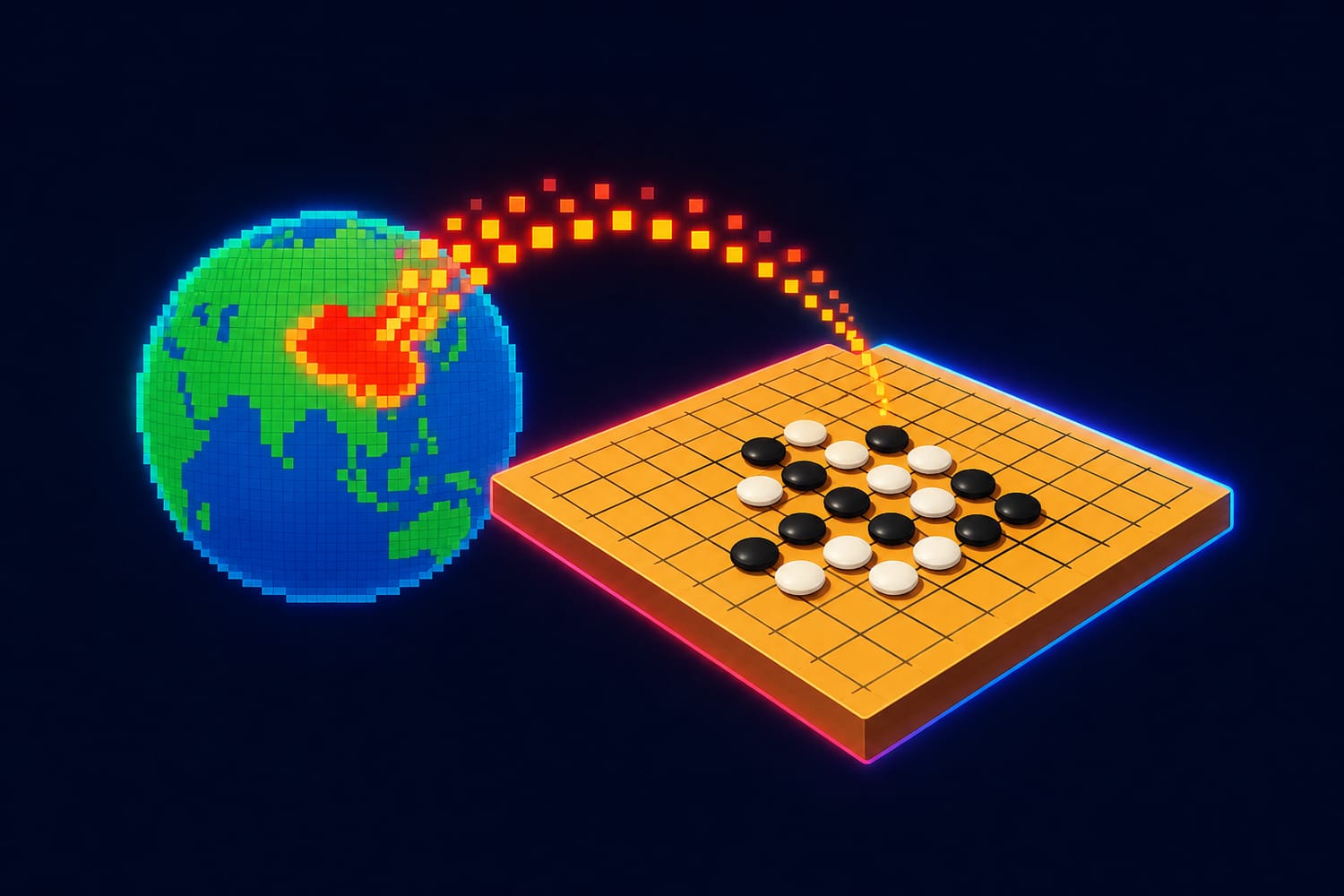
From China to the World: How Go Puzzles Teach Players to See the Board
A Small Position, a New Way to See
Go puzzles teach players to see more than black and white stones. A small arrangement on the board might ask whether a group can escape, whether an opponent can be captured, or which empty point matters most. Solving it means looking at the spaces around the stones, imagining a reply, and checking whether your plan still works.
That is an inviting way into a game with a long journey behind it. Go began in ancient China and spread across East Asia before finding players around the world. Today, a beginner can study the same essential questions on a little paper diagram, a digital board, or a full-sized wooden one.
From China to Boards Around the World
Go’s exact beginnings are unknown, but its roots lie in ancient China, where it is called weiqi. In Korea it is known as baduk, and the English name “Go” comes from its Japanese name. As the game traveled, communities developed their own teaching traditions, competitions, and ways of discussing positions. The shared board made those ideas remarkably easy to exchange: you need not speak the same language to ask, “What happens if Black plays here?”
Go is not alone in making that journey from a local tradition to a worldwide pastime. China’s seven-piece tangram puzzle offers another example of a simple-looking challenge with room for countless discoveries. A Go position has a similar appeal: a few stones can pose a question that takes careful thought to answer.
Puzzles also give Go an approachable doorway. You do not need to understand an entire game before enjoying one interesting corner. First, though, it helps to learn what the stones and empty points are telling you.
The Spaces That Matter More Than They Seem
Go is played on the intersections of a grid, not inside its squares. Players take turns placing black or white stones, and stones remain where they are placed unless captured. The standard board has 19 lines in each direction, but a 9-by-9 board makes a friendlier starting place.
Every stone needs access to empty neighboring intersections, called liberties. Count only along the grid lines—up, down, left, and right—not diagonally. Two stones of the same color touching along a line form a connected group and share its liberties. When the last liberty of a stone or group is filled by the opponent, that stone or group is captured and removed.
Imagine a single white stone in the middle of an otherwise empty board. It has four liberties. If Black occupies three of them, only one remains: White is in atari, meaning it faces capture on Black’s next turn unless White can save it. Suddenly, an empty point is the most important place in the picture.
This is the first change in how puzzles teach you to see. A new player may notice the stones first; a puzzle solver learns to notice the spaces they depend on.
Why a Group Can Be Alive Even When Surrounded
Capturing a single stone is easy to picture. A surrounded group raises a more surprising question: can the opponent fill every space it needs?
A protected empty space inside a group is called an eye. If a group has two separate, genuine eyes, the opponent cannot fill both to capture it. Filling the first would ordinarily place the attacking stone where it has no liberties while the defending group still has its second eye. That makes the first move illegal under the usual rule against self-capture. Such a group is described as alive.
One eye is different. If it becomes the group’s last liberty, an opponent may play there to capture the group; the capture makes that move legal. Nor is every empty space that resembles an eye necessarily secure. A gap in the surrounding stones might let the opponent enter and change the shape. Go puzzles ask you to test appearances rather than trust them.
Many of these challenges are called tsumego. A typical puzzle presents a local position and asks a player to make a group live or prevent an opposing group from living. Others focus on capturing, connecting, or finding a strong move in a tight space. The British Go Association’s collection of Go problem resources shows how many forms those little questions can take.
A Puzzle You Can Try Without a Diagram
Picture a black group near the edge of the board. Its outside is blocked by white stones, but it surrounds three connected empty points in a straight row. Assume there are no other liberties or escape routes. Black to play: where should Black place a stone to make the group safe?
Take a moment before reading on. Could White divide those three empty points so that Black never gets two eyes?
Black should play at the middle point. That divides the row into two separate one-point eyes, one on either side of the new stone. If Black instead plays at an end, two connected empty points remain. White may then play between them and stop Black from forming two eyes. The middle is not special because it looks central; it matters because of the two spaces it creates.
That is the pleasure of a Go puzzle. The answer changes when you imagine the other player’s best reply. A move is not a solution merely because it looks safe right now.
How Puzzles Train Your Eyes—and Your Thinking
Solving Go puzzles is often called reading a position. You picture a possible move, picture the reply, and continue until you can tell what happens. It is less like memorizing a secret trick and more like following paths through a maze.
Start with questions you can answer by looking:
- Whose turn is it, and what is the goal? Saving a group is a different task from capturing one.
- Which groups have few liberties? A threatened group may need immediate attention.
- Can either group make two eyes or connect to safety? Look beyond the most obvious empty point.
- What is the opponent’s strongest reply? Test your idea against resistance, not cooperation.
Then try to hold a short sequence in your mind before placing stones or checking the answer. If you get it wrong, look for the first move where your imagined sequence and the actual one differ. Perhaps two stones were only diagonally adjacent, not connected. Perhaps you counted an occupied point as a liberty. Those discoveries are useful; they sharpen what you will notice next time.
Choose approachable problems at first. A handful you can work through thoughtfully is more useful than staring at a difficult position whose stones you cannot yet read. Pair puzzles with games on a 9-by-9 board, where the same ideas have room to appear in play. The British Go Association’s beginner guide introduces both that board size and the rules behind the puzzles.
A Conversation That Crosses Borders
A Go puzzle can stand on its own, but it also belongs to a larger tradition of people sharing positions and asking one another to look again. Like the chess problems that traveled across cultures, a Go puzzle turns a moment in a game into a challenge someone else can carry, study, and discuss.
The best part is that “seeing the board” does not mean spotting every answer at once. It means noticing one more liberty, questioning one promising move, or discovering why a group that looked trapped can survive. From its beginnings in China to puzzle pages and boards around the world, Go keeps offering the same welcome: look closely, make a plan, and see what the other player might see.

