
From Persian Chess Problems to Modern Compositions: How the Chess Puzzle Traveled the World
A Small Position With a World-Spanning History
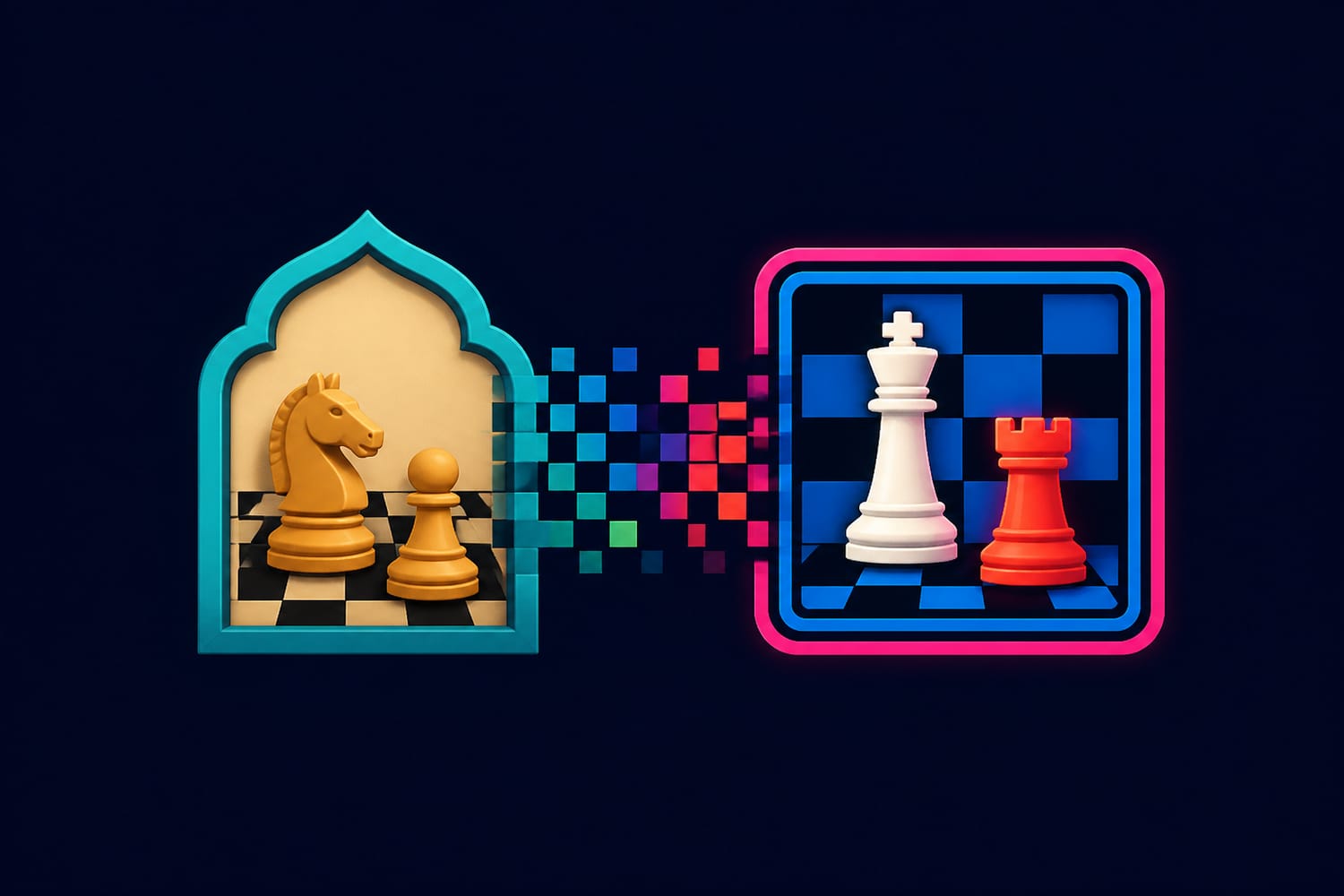
The chess puzzle began as a carefully arranged position in the medieval Persian and Arabic chess tradition. It traveled through manuscripts, royal courts, translations, printed books, newspapers, international competitions, and eventually digital platforms. Along the way, it evolved from a lesson in winning into a distinct art form built around logic, surprise, and beauty.
Today, millions of players solve “mate in two” challenges or search for winning tactics without realizing that they are participating in a tradition more than a thousand years old. The pieces have changed, the rules have changed, and the puzzles have multiplied—but the pleasure of discovering one hidden move remains wonderfully familiar.
Before Modern Chess: India, Persia, and Shatranj
Most historians trace chess to an Indian game called chaturanga, which appeared around the sixth century. Its pieces represented four divisions of an army: infantry, cavalry, elephants, and chariots. The game moved westward into Sasanian Persia, where it became known as chatrang, and then spread through the Islamic world as shatranj.
Shatranj resembled chess, but it was not identical to the game played today. Its elephant moved only two squares diagonally and could jump over another piece. The piece beside the king was a relatively weak counselor, or ferz, rather than the powerful modern queen. Pawns could not make an opening two-square move, and castling did not exist.
These differences made shatranj slower and gave its attacks a geometry that can seem strange to modern players. Even so, its masters were already studying openings, classifying players, recording games, and creating composed positions.
Readers interested in the game’s Indian background can explore why India developed such a lasting love for chess puzzles. The journey from India into Persia was not simply the movement of a board game. It was the beginning of an international exchange of strategic ideas.
The Mansuba: An Ancestor of the Chess Problem
A composed shatranj position was known as a mansuba, with mansubat as the plural. The word can mean an arrangement, position, or situation. Collections of these problems survive in medieval manuscripts, making them some of the earliest recognizable ancestors of modern chess composition.
A mansuba usually presented a dramatic challenge such as “White to play and win.” Many began with one side facing an immediate threat, leaving no time for a slow plan. The solution might require continuous checks, unexpected sacrifices, or a forced mating sequence.
One famous example is the Dilaram Problem. According to the story attached to it, a nobleman had recklessly wagered his beloved Dilaram on a game. When defeat appeared unavoidable, she called out a poetic clue that inspired a spectacular sequence involving the sacrifice of both rooks.
The tale is legend rather than reliable biography, but it shows how early chess problems could be more than exercises. They were miniature dramas, combining calculation with storytelling.
Why These Early Problems Mattered
The mansubat performed several jobs at once. They entertained readers, preserved memorable ideas, and trained players to recognize tactical patterns. Before video lessons or interactive analysis, a diagram accompanied by a solution could act as a compact chess lesson.
Their structure also introduced several qualities that remain central to chess puzzles:
- A precise starting position
- A clearly stated goal
- A forced or demonstrably correct solution
- An unexpected central idea
- Economy, with each important piece serving a purpose
A great composition does not merely ask whether you can find a strong move. It invites you to discover why that move works and why tempting alternatives fail.
The Journey Into Medieval Europe
Chess entered Europe along several routes, including the Islamic territories of Iberia, Mediterranean trade networks, and contacts with the Byzantine world. As it crossed languages and borders, manuscripts helped carry both the game and its problems.
One of the most important surviving works is the Libro de los juegos, or Book of Games, commissioned by Alfonso X of Castile and completed in Seville in 1283. The richly illustrated manuscript covers chess, dice, and tables games, and its chess section includes numerous problems. Spain’s Patrimonio Nacional confirms that the manuscript was begun and completed in 1283.
The book reveals a world in which people from different social, cultural, and religious backgrounds shared an interest in games. Its illustrations also demonstrate something fundamental about puzzles: a position can travel more easily than a long explanation. Once the board is understood, the challenge becomes visual.
European chess continued to develop, but the greatest transformation came near the end of the 15th century. The queen gained her modern sweeping movement, the bishop became a long-range piece, and other rules gradually moved toward their present forms. Chess became faster and more tactical—and its composed problems changed with it.
Printing Turns Positions Into Popular Puzzles
Printed chess books appeared as Europe adopted the new rules. Authors such as Luis Ramírez de Lucena and Pedro Damiano included positions that taught combinations, mating patterns, and practical play.
The printing press allowed the same position to reach readers far beyond a single court or circle of scholars. Instead of being copied by hand, a problem could be reproduced hundreds or thousands of times. Later, newspapers and chess magazines made puzzle solving a regular habit.
By the 19th century, chess columns invited readers to submit solutions and compositions. A puzzle could be created in one country, published in another, and debated through letters from solvers elsewhere. Chess composition was becoming an international conversation.
The Birth of the Modern Chess Problem
The 19th century marked a turning point. Composers increasingly created positions not simply to imitate practical games but to express a particular theme.
A celebrated milestone was the Indian Problem, published by Howard Staunton in The Chess Player’s Chronicle in 1845. It was eventually attributed to the Reverend Henry Augustus Loveday, a British composer living in India. The problem became famous for an idea in which one long-range piece deliberately crosses a critical square, allowing another piece to occupy it later without blocking the final mating line.
This was important because the solution was appreciated as a designed work. Its value came from the relationship between the moves, not merely from the final checkmate.
Different composition traditions developed across Europe. Some composers favored complex variations, while others valued economical positions, strategic themes, model mates, or surprising key moves. Problemists began naming and classifying recurring ideas, giving the art its own vocabulary.
Problems, Studies, and Everyday Tactics
Not every chess puzzle is a composition in the strict artistic sense. Modern readers commonly encounter several related forms:
Tactical puzzles
These usually come from real or realistic games. The solver must find the best continuation, often involving a fork, pin, discovered attack, sacrifice, or mating combination.
Directmate problems
The composer specifies a goal such as “White to move and mate in two.” Black is assumed to resist as effectively as possible.
Endgame studies
These typically ask White to win or draw from a carefully constructed position. They often resemble real endings but contain unusually precise ideas, including stalemate resources, promotions, and long tactical maneuvers.
Helpmates and selfmates
In a helpmate, both sides cooperate to produce a mating position. In a selfmate, White forces Black to deliver checkmate. These forms turn normal competitive assumptions upside down.
Fairy and retrograde problems
Fairy compositions may introduce altered rules, unusual boards, or invented pieces. Retrograde problems ask solvers to reason backward—for example, determining the last move or explaining how the position could legally have arisen.
The World Federation for Chess Composition now promotes composing and solving internationally. It traces its institutional history to the Permanent Commission for Chess Composition, established in Budapest on May 15, 1956, and operating independently as the WFCC since 2010.
The Chessboard Also Became a Mathematical Playground
Not every famous chessboard puzzle involves checkmate. Challenges such as the Knight’s Tour and Eight Queens problem use chess movement as the foundation for mathematical exploration.
In the Knight’s Tour, one knight must visit every square exactly once. It has fascinated poets, mathematicians, programmers, and recreational solvers across cultures. Anyone curious about this different branch of the tradition can explore the centuries-old history of the Knight’s Tour.
These challenges helped connect chess with graph theory, algorithms, combinatorics, and computer science. The board became more than an arena for two armies—it became a laboratory for studying paths, patterns, symmetry, and logical constraints.
Computers Change the Tools, Not the Appeal
Computers have transformed both chess solving and composition. Programs can verify whether a solution is sound, test thousands of defenses, search endgame databases, and uncover resources that might escape human analysis.
Digital platforms have also removed geographical barriers. A composition created in Argentina, India, Finland, or Japan can be shared globally within seconds. Solvers can receive instant feedback, compare variations, and discuss themes with people they may never meet in person.
Yet computers have not made the human side irrelevant. A machine may confirm that a move works, but people still decide whether the idea is elegant, surprising, clear, or emotionally satisfying. Composition remains a creative activity because correctness is only the beginning.
One Puzzle Tradition, Many Cultures
The history of the chess puzzle is not a straight line from one inventor to one final form. It is a network of contributions.
Indian game traditions supplied the early foundation. Persian and Arabic-speaking players developed shatranj literature and preserved mansubat. Medieval translators and patrons carried positions into European manuscripts. Printers, editors, and newspaper columnists created international audiences. Composers developed new artistic genres, while federations and digital communities connected solvers around the world.
Every chess puzzle is therefore a small traveling object. Its pieces may stand still on the page, but its ideas have crossed languages, empires, oceans, and centuries.
The next time you pause over a “White to move” diagram, remember that the challenge belongs to a remarkable global story. You are not simply searching for a move. You are continuing a conversation begun by players who arranged pieces by hand more than a thousand years ago—and trusted that someone, somewhere, would delight in finding the answer.

