
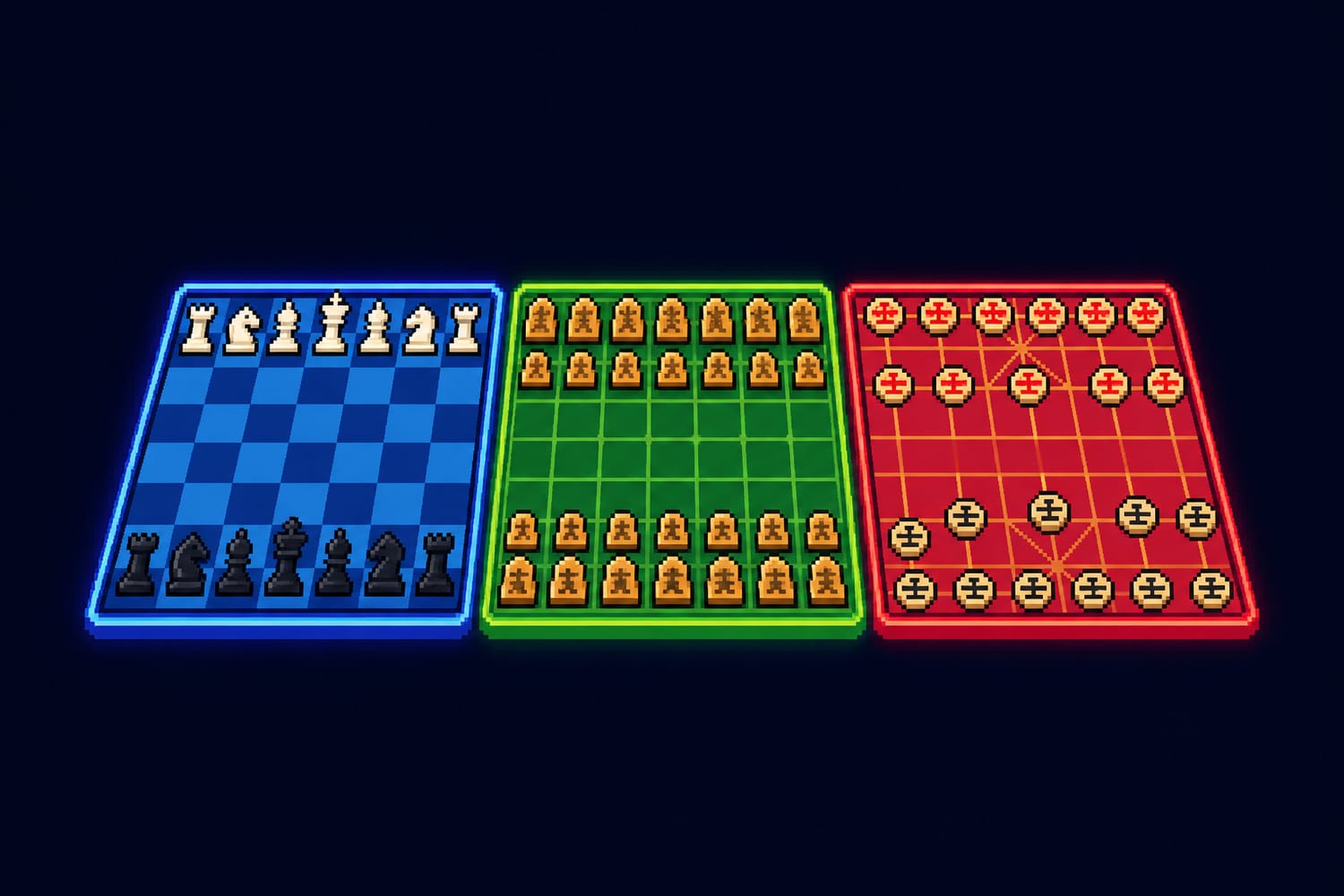
Chess Has Cousins: How Shogi and Xiangqi Reinvent the Board
Imagine losing a piece in chess—and then seeing your opponent place it back on the board as part of their army. That is ordinary play in shogi, Japan’s chess cousin. In xiangqi, the Chinese game, you might instead face a cannon that needs another piece to launch an attack. Both games share chess’s contest of strategy and king safety, but each asks you to see the board in a new way.
One Family, Different Paths
Chess, shogi, and xiangqi belong to a family of games with ancient roots in Asia. Historians generally connect them to early Indian chess-like games, although the precise routes by which those ideas spread—and the details of the earliest rules—are not fully settled. If you enjoy following the journey of a game across cultures, Puzzles Arcade also explores how chess problems traveled from Persia around the world.
The family resemblance is easy to spot. Two players take turns directing pieces with different powers, and each must protect a crucial leader. Yet the differences go far beyond names. Shogi changes what happens after a capture; xiangqi changes how the board itself shapes a battle. Neither is chess with a few pieces swapped out. Each is a complete game with its own delightful logic.
Shogi: The Army That Never Quite Disappears
Shogi is played on a 9-by-9 grid of squares. Each player begins with 20 pieces, including a king, rook, bishop, gold and silver generals, knights, lances, and pawns. The pieces are typically marked with Japanese characters rather than divided into light and dark armies; their pointed ends show which player controls them.
Some movements will feel familiar. The rook travels along rows and columns, while the bishop travels diagonally. Others invite a fresh mental picture: a shogi pawn moves and captures one square straight forward, unlike a chess pawn, which captures diagonally. A shogi knight jumps forward in an L-shape but cannot make the backward or sideways leaps available to a chess knight.
A captured piece can return
Shogi’s great surprise is the drop. When you capture an opponent’s piece, you keep it beside the board, ready to use as your own. On a later turn, instead of moving a piece already in play, you may place—or drop—one of these captured pieces onto an empty square, subject to the rules for legal drops. A captured promoted piece returns to its unpromoted form.
Suppose you have captured a silver general. It is not gone from the game: it is a future move waiting beside the board. You could drop it near your king to strengthen a defense or closer to your opponent’s king to join an attack. That makes every capture a little more complicated than it first appears. You gain a piece, but you must also consider what your opponent could do with yours if they capture it.
There are important limits. You cannot drop a pawn on a file where you already have an unpromoted pawn, and you cannot use a pawn drop to deliver immediate checkmate. You also cannot drop a piece somewhere it would have no legal move. Those restrictions keep the endlessly changing armies within a clear set of rules.
Promotion adds another twist
Shogi also has promotion zones: the three ranks nearest each player’s opponent. When an eligible piece moves into, out of, or within that zone, it can generally promote; in some circumstances, promotion is required because the piece would otherwise have no future move. Pawns, lances, knights, and silver generals gain the movement of a gold general when promoted. The rook and bishop keep their long-range moves and gain additional one-square moves. Kings and gold generals do not promote.
The result is a game in which an advancing piece may become stronger, a captured piece may change sides, and a quiet-looking empty square may be the perfect place for a drop. Shogi rewards you for watching not only what is on the board, but what could suddenly arrive there.
Xiangqi: A River, Two Palaces, and a Cannon
Xiangqi looks different the moment you set it up. Its board has nine vertical lines and ten horizontal lines, and pieces stand on their intersections—not inside squares. A river crosses the middle. At each end, a marked three-by-three palace holds that side’s general and two advisors. Red moves first against Black.
The general, the leader you must protect, moves one point horizontally or vertically and cannot leave its palace. Advisors also stay in the palace but move one point diagonally. The two generals may not face each other on the same open file with no piece between them. That last rule means an apparently harmless move can suddenly be illegal if it clears the line between the leaders.
Other pieces show how much the shape of the board matters. An elephant moves exactly two points diagonally, provided the point halfway along its path is empty; it cannot cross the river. A horse reaches an L-shaped destination reminiscent of a chess knight’s, but it can be blocked at the first point of its journey. Xiangqi’s chariot, by contrast, is reassuringly rook-like: it moves any unobstructed distance along a row or column.
The cannon needs a screen
The cannon is xiangqi’s unforgettable piece. When it moves without capturing, it travels along an open row or column like a chariot. To capture, however, there must be exactly one piece between the cannon and its target. That intervening piece, friendly or enemy, acts as a screen.
Picture a cannon, a soldier, and an enemy chariot lined up in that order, with no other pieces between them. The cannon can leap over the soldier to capture the chariot. Remove the soldier and the capture no longer works; add another piece between cannon and chariot and it no longer works either. In xiangqi, a piece in the way can sometimes make an attack possible.
Xiangqi’s soldiers have their own river story. Before crossing, a soldier moves and captures one point forward. After crossing, it may also move and capture one point sideways—but never backward. Soldiers do not promote into stronger pieces. The river changes their choices without changing what they are.
Three Boards, Three Ways to Think Ahead
Put the games side by side and their personalities come into focus:
| Game | Board | A question worth asking | | --- | --- | --- | | Chess | 8-by-8 squares | What can my pieces control from here? | | Shogi | 9-by-9 squares | What could either player drop next? | | Xiangqi | 90 intersections, divided by a river | What do the palace, river, and pieces in the way make possible? |
All three reward careful planning, but they teach different habits of attention. In chess, a captured piece normally stays out of play. In shogi, it becomes part of the capturing player’s future possibilities. In xiangqi, the river and palace give locations special meaning, while a single piece can block a horse or enable a cannon.
That is also why these games make such inviting puzzles. You can pause at almost any position and ask: What changed when that piece moved? Did it open a line between generals? Give a cannon a screen? Free a square for a shogi drop? If the pleasure of spotting hidden possibilities appeals to you, try Puzzles Arcade’s Eight Queens Challenge, another way to explore how piece movement creates a puzzle.
Where Should a Curious Beginner Start?
You do not need to master a whole new army at once. With shogi, start by learning the king, rook, bishop, and pawn, then play through a few captures and drops. With xiangqi, set out the general, soldiers, and cannon first; test how crossing the river changes a soldier and how removing a screen changes a cannon’s attack. Add the remaining pieces as their movements begin to make sense.
Most of all, resist the urge to treat either game as a list of exceptions to chess. Shogi asks, “What if captured pieces came back?” Xiangqi asks, “What if the board’s geography changed the battle?” Each answer opens up a new landscape of choices. Once you see that, the unfamiliar characters and lines stop being obstacles: they become an invitation to discover just how many ways a board game can make you think.

