
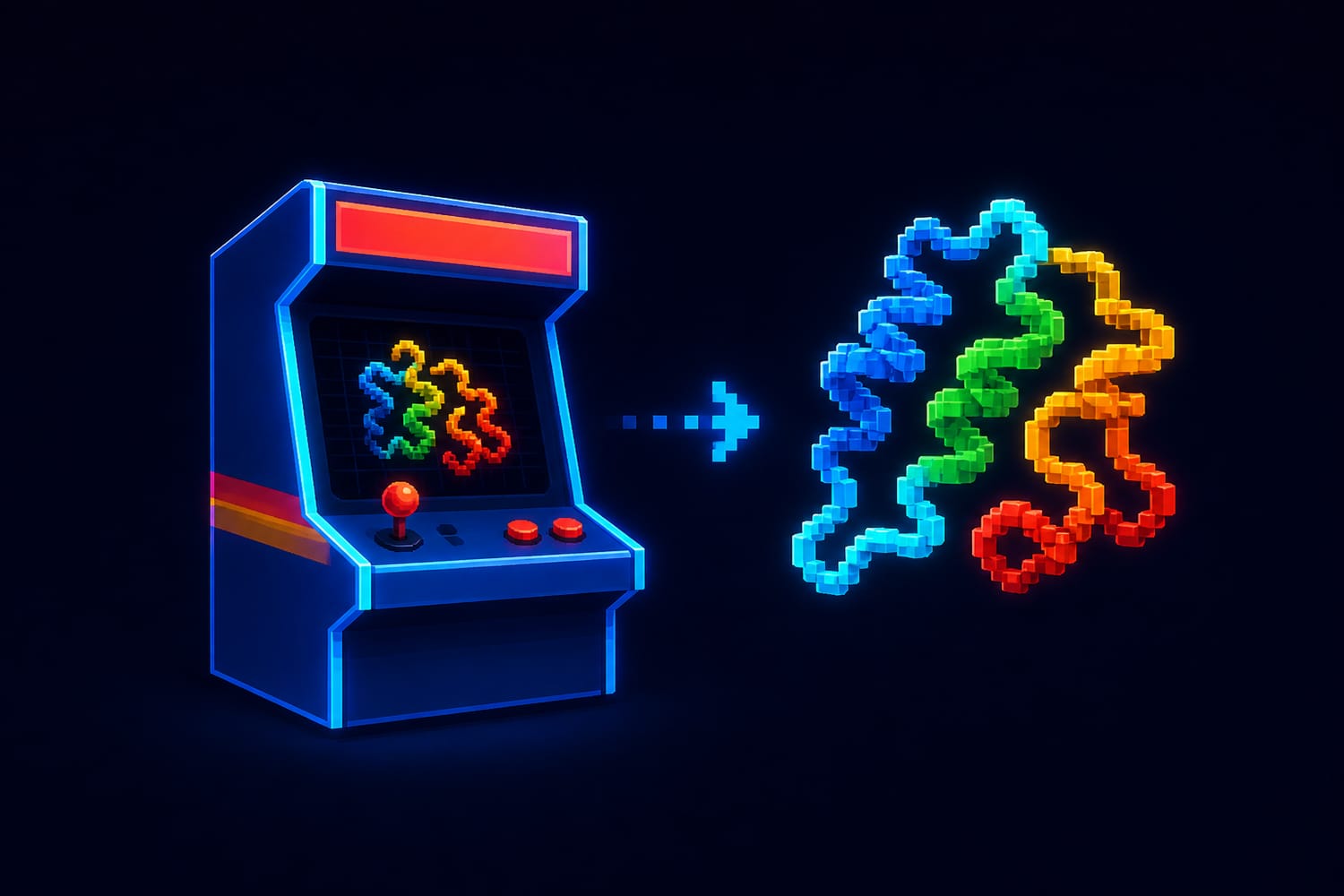
Foldit: How Puzzle Gamers Helped Solve a Protein Mystery in Three Weeks
In 2011, players of the online puzzle game Foldit helped researchers determine the structure of a monkey-virus enzyme that had resisted investigation for more than a decade. During a three-week challenge, gamers produced models accurate enough to unlock the next stage of the scientific analysis.
There was no secret laboratory hidden inside the game. Players manipulated colorful molecular shapes on their screens, experimenting with arrangements and building on one another’s progress. Yet their virtual puzzle-solving supplied something researchers genuinely needed: a better model of a real protein.
The remarkable part was not that gaming replaced science. It was that scientists found a way to make puzzle-solving part of science.
Why a Protein’s Shape Matters
Proteins are chains of smaller building blocks called amino acids. Those chains fold into three-dimensional structures, and their shapes help determine what they can do. Understanding the relationship between structure and function is a central reason scientists study proteins in such detail.
Imagine a key made from a flexible chain. Knowing the order of its links would not tell you exactly how the finished key fits a lock. You would also need to understand its final shape.
The Foldit mystery involved a protease, an enzyme that cuts proteins. More specifically, it concerned the protease from Mason–Pfizer monkey virus, usually shortened to M-PMV.
Why investigate molecular scissors? Consider the related example of HIV: its protease cuts long protein chains into smaller pieces needed for the virus to mature. Blocking that cutting action is an established strategy for HIV treatment, and structural knowledge helped scientists develop protease-blocking drugs.
M-PMV is not HIV, however, and the Foldit achievement was not the discovery of a cure for AIDS. It was a structural breakthrough involving another retrovirus, with potential relevance to broader antiviral research.
A Game Built Around Real Molecular Rules
Foldit emerged from a collaboration between computer scientists and protein researchers at the University of Washington. Announced in May 2008, it invited players to tackle molecular problems through an approachable game rather than specialist research software. Introductory levels taught the basic ideas before players attempted harder challenges.
Instead of confronting players with pages of equations, the game displayed manipulable protein models. Players could pull on sections, adjust arrangements, and use automated tools to improve a structure. The interface highlighted trouble spots, including atoms crowding too closely together.
Some tools sounded more like dance instructions than laboratory techniques:
- Shake searched for improved arrangements of amino-acid side chains—the groups branching from the protein’s backbone.
- Wiggle adjusted the structure to improve its calculated energy.
- Rebuild explored alternative shapes for a section of the chain.
- Freeze held selected portions in place while other areas changed.
The score was linked to a computational estimate of molecular energy: more favorable modeled arrangements generally earned higher scores. This turned a complicated scientific search into a challenge with visible feedback and measurable progress.
But a high score was a guide—not experimental proof that a model was correct. Laboratory evaluation remained essential.
The Mystery Waiting Behind the Screen
For more than a decade, researchers had struggled to determine the M-PMV protease’s crystal structure. They already had protein crystals and earlier structural models, but those models had not been accurate enough to solve the problem using a technique called molecular replacement.
In simplified terms, molecular replacement uses a sufficiently similar model to help researchers interpret crystallographic data. The obstacle was therefore unusually well suited to a modeling game: could players reshape an imperfect starting point into something useful?
Researchers gave the Foldit community ten models derived from nuclear magnetic resonance, or NMR, studies. These were starting clues, not finished answers.
Think of receiving several rough sketches of the same folded object. Each gives you something to work with, but none captures the shape precisely enough. Your task is to improve the sketches—not invent an object without evidence.
Three Weeks of Play, With a Scientific Payoff
The challenge lasted three weeks. Its decisive progress came through the Foldit Contenders Group, whose members improved one another’s models rather than treating every attempt as a separate, private solution.
The original research paper highlights a sequence of contributions:
- spvincent substantially improved the starting model.
- grabhorn built on that work, improving the protein’s interior.
- mimi adjusted a loop, producing a model accurate enough for an unambiguous molecular-replacement solution.
That sequence is worth pausing over. The breakthrough was not simply one person making one miraculous move. It was a chain of useful improvements, with each player leaving a stronger starting point for someone else.
The same appeal of coordinated effort runs through team speed puzzling: individual contributions become parts of a shared solution.
Researchers then tested the submitted models with crystallographic software. The successful model enabled rapid structure determination, and the final refined structure was completed a few days later.
The University of Washington’s contemporary account describes the achievement as a three-week success. That is the right way to understand the headline: a short gaming challenge helped break a longstanding bottleneck, supported by years of earlier research.
Why People and Computers Made a Powerful Team
It is tempting to describe this story as humans defeating computers. A more accurate—and more interesting—description is humans working through computers.
Foldit relied on Rosetta, a sophisticated protein-modeling system. Players supplied decisions about what to change and which possibilities to explore; computational tools supplied calculations and structural adjustments.
An analogy is searching a landscape of hills and valleys. If every step must take you downhill, you can become stuck in a shallow valley even when a deeper one lies beyond the next ridge. Likewise, a modeling search can settle into an arrangement that is better than nearby alternatives without being the best overall solution.
Foldit’s developers investigated whether human judgment could help guide those searches, including recognizing when temporarily less favorable changes might open a better route.
This was not evidence that players always outperformed automated methods. The research also documented limitations and cases where other approaches performed better. The lesson was that the combination could succeed on a difficult problem—not that either partner had become unnecessary.
For another perspective on games and computation, explore how checkers was solved through an 18-year computer-search project.
Recognition Beyond the Leaderboard
The results were published online on September 18, 2011, in Nature Structural & Molecular Biology. Both the Foldit Contenders Group and the Foldit Void Crushers Group appeared among the paper’s authors, recognizing player contributions across the work it reported.
The achievement also did not stand alone forever. Later research demonstrated that Foldit players could help design entirely new proteins. The Protein Data Bank’s educational resource explains this broader development in its overview of protein design and citizen science.
That extends the story from discovering a molecule’s shape to helping imagine new molecular possibilities.
An Amazing Feat With a Bigger Lesson
Foldit’s three-week breakthrough deserves its reputation, but the accurate version is more inspiring than the exaggerated one.
Gamers did not cure a disease overnight. They joined an existing scientific effort, used carefully designed tools, and produced models that helped researchers overcome a stubborn obstacle. Their contribution became part of a peer-reviewed discovery.
For puzzle lovers, that is the lasting wonder of Foldit. A game did not merely imitate the feeling of discovery. With the right problem, tools, and scientific checks, playing became one of the ways discovery happened.

