
Inside Speed Puzzling: How Teams Finish 500-Piece Jigsaws in Under an Hour
How a 500-Piece Puzzle Disappears in Under an Hour
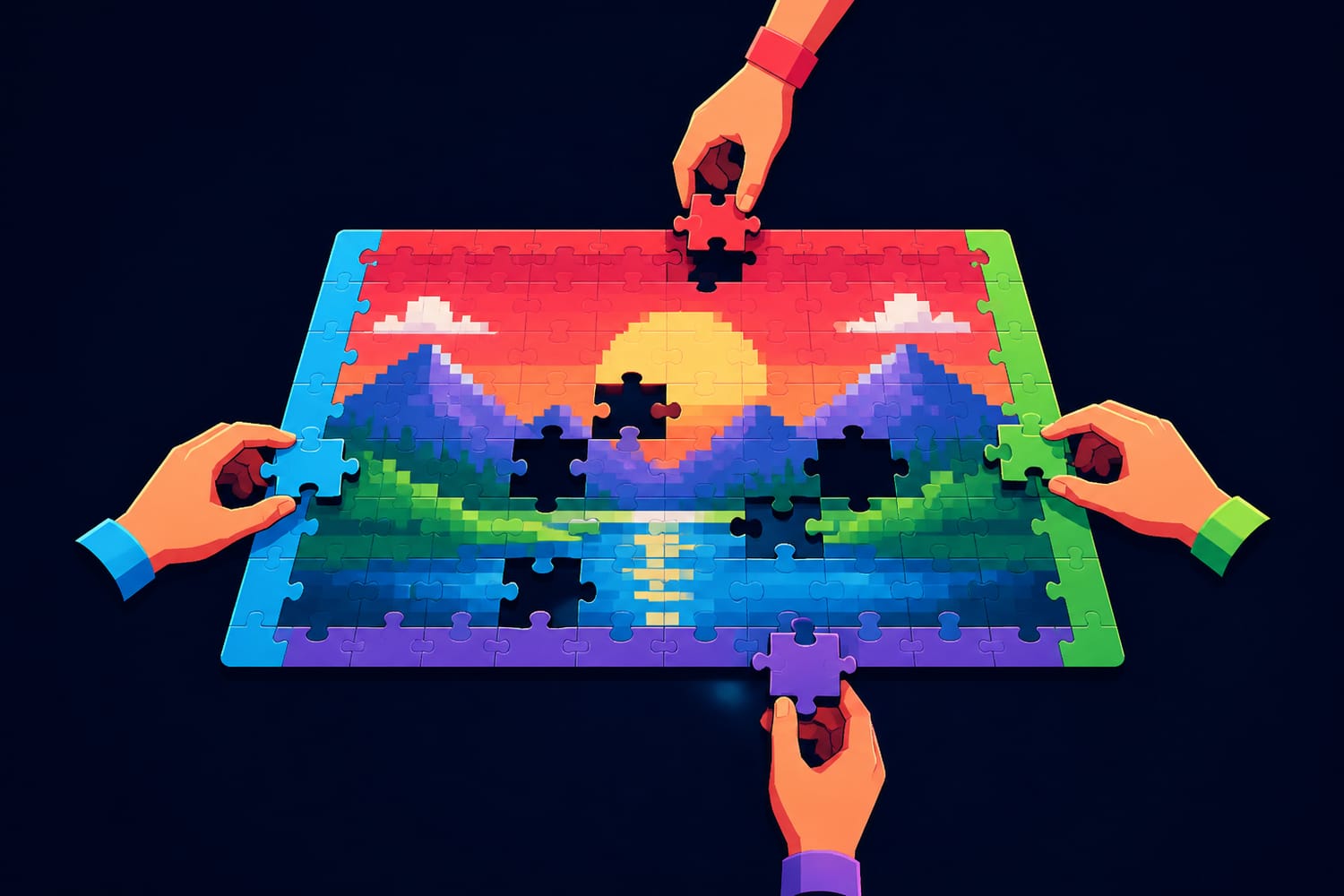
Speed puzzling turns a traditionally relaxing pastime into a fast, coordinated race. Teams open a sealed puzzle, study an unfamiliar image, sort hundreds of pieces and assemble the whole design against the clock. Finishing within 60 minutes requires more than quick hands: it demands organization, visual recognition, communication and constant adjustment.
At that pace, a team must place an average of more than eight pieces per minute from the moment the box opens. In reality, progress is uneven. The first few minutes may produce only scattered clusters, while the final stretch can see entire sections joined in seconds.
The result looks almost magical—but the methods behind it can be learned.
What Happens at a Speed Puzzling Competition?
The exact rules vary between events. In a typical team race, every group receives the same previously unseen puzzle. The box or sealed bag remains closed until an official starts the clock. The first team to assemble the puzzle correctly wins, although unfinished teams may be ranked by the number of pieces they have connected.
Team sizes and puzzle counts also differ. Many community events use one 500-piece puzzle for teams of up to four people. At larger championships, competitors may face several puzzles in sequence. For example, the 2026 USA Jigsaw Nationals team preliminaries combined one 500-piece puzzle with one 1,000-piece puzzle, while the finals used two 1,000-piece puzzles.
The official 2026 World Jigsaw Puzzle Championship rules allow teams of three or four and require them to complete two 1,000-piece puzzles. The same rules limit the number and size of sorting trays, prohibit digital image enlargement and require officials to confirm completion.
These restrictions keep the contest focused on human observation, teamwork and physical puzzle-solving skill.
The First Minute: Study Before You Scatter
When the timer begins, inexperienced teams may immediately dump every piece into a heap. Fast teams are more deliberate.
One person usually lifts the box image where everyone can see it. The team takes a few seconds to identify the puzzle’s most useful visual landmarks:
- Bright lettering or signs
- Human faces and animal features
- Buildings, windows or vehicles
- Strong color changes
- Repeated objects
- Large areas of sky, water or foliage
- Clear lines separating one region from another
This rapid inspection creates a shared map. A teammate can claim the red bicycle, another can take the yellow house, and someone else can collect border pieces.
Choosing sections by visual distinctiveness is usually better than dividing the image into four equal quarters. A quarter containing blue sky may be far harder than a smaller area filled with colorful objects.
Sorting Is Useful—Until It Becomes the Whole Job
Sorting reduces the number of possibilities a solver must examine. Instead of searching through 500 pieces for one match, a person might search through a group of 30 pieces sharing the same color or pattern.
The challenge is knowing when to stop.
A detailed sort into dozens of tiny categories may look wonderfully organized, but it consumes valuable time. Competitive teams often perform a quick first pass:
- Turn every piece face-up.
- pull out obvious edge and corner pieces.
- Separate highly recognizable colors, words and objects.
- Move uncertain pieces into broad groups.
- Begin assembling as soon as useful groups exist.
Sorting and building should overlap. If one player discovers several pieces from a striped umbrella, another can begin connecting them while the remaining pieces are still being turned over.
Fast solvers also keep pieces visible. Stacked or overlapping pieces create hidden information, forcing the team to search the same area repeatedly.
Why the Border Is Not Always First
“Start with the edge” is classic jigsaw advice, and it remains useful. Flat-sided pieces are easy to recognize, and a finished border shows the puzzle’s dimensions.
In speed puzzling, however, the border is not automatically the best opening move.
A nearly uniform border—perhaps a frame of blue sky—can take longer than a bright central object. Meanwhile, interior sections may provide easy connections and reveal exactly where difficult border pieces belong.
Strong teams therefore treat the border as one project among several. One person may construct it while the others attack the most recognizable interior areas. If the border proves slow, that player can temporarily switch to a more productive section.
This flexible approach relies heavily on pattern recognition: noticing gradients, repeated textures, tiny lines and shape relationships before testing every possible fit.
How Team Members Divide the Work
The fastest groups do not operate as four solo puzzlers sharing one table. They behave like a single system.
Useful roles include:
- The image reader: studies the box and identifies where unusual pieces belong.
- The rapid sorter: keeps turning and grouping loose pieces.
- The section builder: concentrates on a distinctive object or color family.
- The connector: watches for opportunities to combine clusters and position them correctly.
These are not permanent assignments. A player who finishes a red car might move to the border, help with a difficult face or begin organizing the remaining pieces by shape.
Good teams also divide sections according to individual strengths. One person may be excellent at faces and printed text, while another quickly reads piece shapes. A third may be especially good at subtle color gradients.
The principle is similar to the teamwork required for a giant jigsaw puzzle project, only compressed into a frantic hour.
Communication Without Creating Chaos
Speed puzzlers need to talk, but not constantly. Too much conversation becomes distracting; too little causes duplicated effort.
The most useful communication is short and specific:
- “I’m collecting the green roof.”
- “The border is missing a dark-blue piece.”
- “Who has the letters?”
- “This cluster belongs in the upper left.”
- “I’m finished with the flowers—what needs help?”
Announcing completed or abandoned sections prevents two people from unknowingly searching for the same pieces. Teammates should also say when they move a shared group or sorting tray.
Physical space matters too. Arms crossing repeatedly over the center waste time and can break completed sections. Teams often create informal zones around the table while leaving a central area for the main puzzle.
The Hidden Skill: Reading Piece Shape
Color and image details dominate the early game, but shape becomes increasingly important as the puzzle fills.
A solver may search for a piece with:
- Two opposite tabs
- Two neighboring blanks
- One tab and three blanks
- A particularly wide connector
- An unusually narrow neck
- A near-symmetrical outline
Competitive puzzlers learn to look at the empty space first. Instead of picking up random pieces and trying them, they study the shape of the gap and scan for a matching outline.
Orientation is equally important. Keeping loose pieces facing the same general direction reduces the mental effort needed to rotate them. A piece that seems wrong may simply be upside down relative to the image.
None of this requires a special type of intelligence. It develops through repetition. Each completed puzzle teaches the brain to recognize small differences more quickly.
Why Some 500-Piece Puzzles Are Much Faster Than Others
Piece count alone does not determine difficulty. Two 500-piece puzzles can produce dramatically different finishing times.
A fast competition image often contains:
- Many distinct colors
- Clearly separated objects
- Sharp lines
- Recognizable details
- Limited repetition
A difficult image may include:
- Large areas of nearly identical sky or water
- Repeated windows, flowers or leaves
- Soft-focus artwork
- Subtle gradients
- Similar piece shapes
- A border with little visual information
Puzzle cut also matters. Highly varied shapes provide extra clues, while a repetitive grid cut can make neighboring pieces harder to distinguish.
This is why a team should not judge its ability from one result. A 45-minute solve on a bright collage and a 70-minute solve on a misty landscape may represent equally strong performances.
Individual results show just how far trained recognition can go. At the 2023 World Jigsaw Puzzle Championship, the fastest individual completed a 500-piece final puzzle in 37 minutes and 59 seconds—without teammates dividing the search.
The Final 10 Minutes
As the puzzle nears completion, the team’s strategy changes. Broad color sorting becomes less valuable because every remaining piece has only a few possible locations.
Players should now:
- Spread every unused piece into a single visible layer.
- Sort pieces by exact connector arrangement.
- Check completed clusters for unnoticed gaps.
- Move uncertain pieces closer to likely locations.
- Scan the table, trays, box and floor for missing pieces.
- Avoid forcing a connection that could damage a piece.
The last few pieces can be surprisingly difficult. Fatigue encourages frantic trial and error, but careful observation is usually faster.
If one gap remains, the team should describe it aloud: color, number of tabs, number of blanks and orientation. Four people can then search for the same precise target.
How to Train for Your Own Sub-Hour Solve
A stopwatch and a collection of unfamiliar 500-piece puzzles are enough to begin.
Start by recording a normal team time. Afterward, discuss where minutes were lost. Did sorting continue too long? Was the box image hard to see? Did two players work on the same section? Were pieces buried beneath one another?
Then practice individual parts of the process:
- Race to turn 500 pieces face-up.
- Sort a puzzle without assembling it.
- Build only the border against the clock.
- Practice calling out colors and landmarks.
- Repeat puzzles with different image styles.
- Rotate roles so the team remains adaptable.
Aim first for smooth cooperation rather than a particular result. Breaking 90 minutes, then 75 and finally 60 is more realistic than expecting instant championship speed.
More Than Fast Hands
A sub-hour 500-piece solve is an amazing feat because hundreds of tiny decisions must be made correctly. Team members must notice details, reduce search areas, share information and change tactics without losing momentum.
Yet speed puzzling remains welcoming. Beginners can understand the goal immediately, families can compete together, and every completed puzzle provides visible proof of progress.
The clock adds excitement, but the real achievement is coordination. By the final piece, four people have transformed a chaotic pile into one complete image—not through luck, but through observation, practice and teamwork.

