
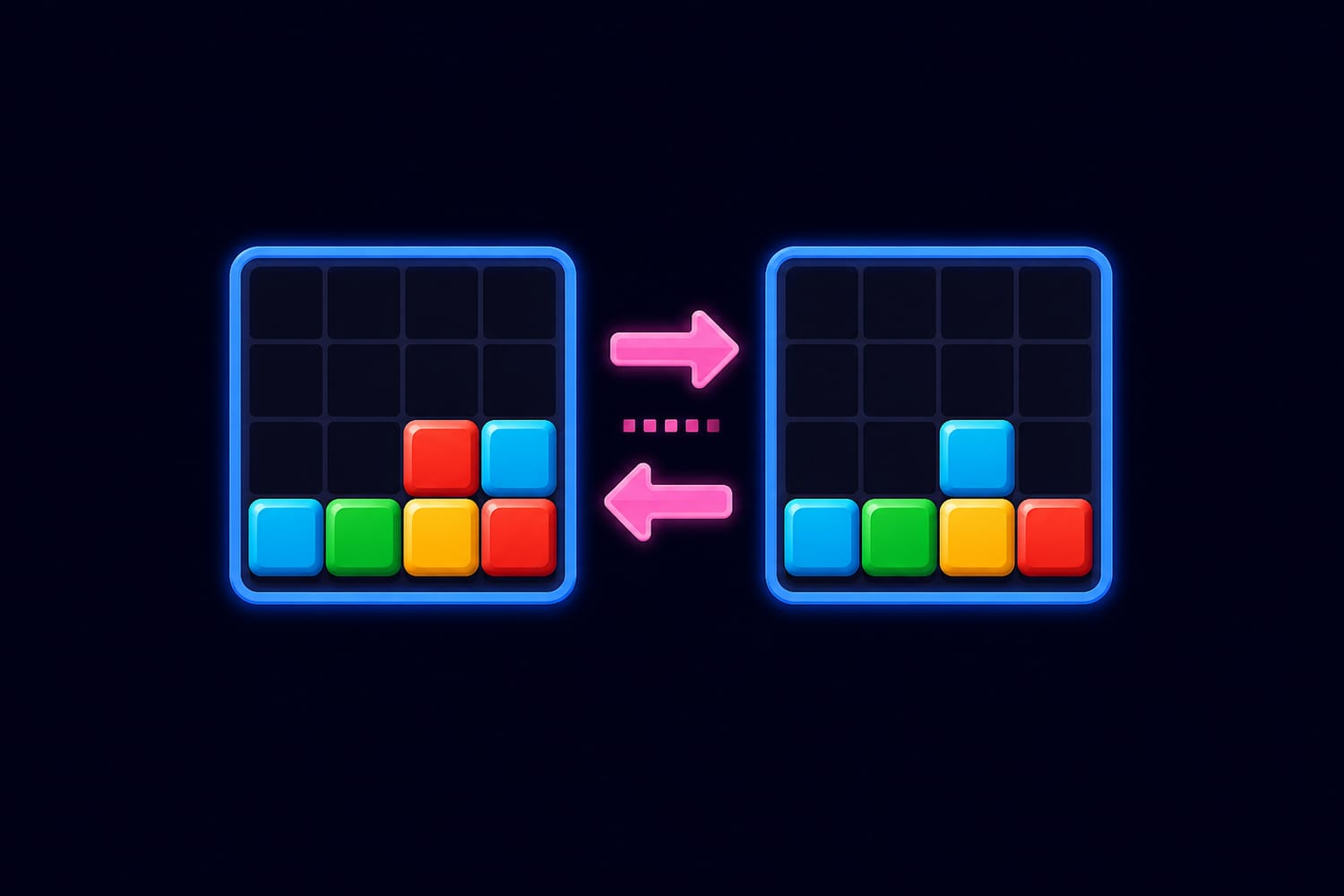
The Reversibility Rule: How to Test Puzzle Moves Without Getting Trapped
What Is the Reversibility Rule?
The reversibility rule is a simple safety check: before making an uncertain puzzle move, ask whether you can restore the current position if the idea fails. If the answer is yes, you can experiment with limited risk. If the answer is no, pause and demand stronger evidence before committing.
This rule works across sliding puzzles, Sudoku, solitaire, block games, mazes, logic grids, word games, and many other challenges. It does not mean you should fear every permanent choice. Instead, it helps you separate safe tests from moves that may consume space, information, turns, or future options.
Why Puzzle Moves Create Traps
A move can look helpful because it produces an immediate reward: a row disappears, a card becomes playable, or a box moves closer to its target. The danger is that visible progress and useful progress are not always the same.
A move may also:
- Block an important route
- Fill space needed later
- Separate pieces that must interact
- Consume a limited guess or turn
- Hide information that was previously available
- Force several additional moves to repair
- Create a position from which no legal solution remains
Puzzle solving can be viewed as moving through a collection of states. Each arrangement is a state, and every legal move creates a transition to another state. A solution is a path from the starting state to a goal state, as explained in this introduction to state-space search.
The reversibility rule protects your path. It encourages exploration while reducing the chance that one attractive move will close every useful branch behind you.
The Three Levels of Reversibility
Not every move is simply “reversible” or “irreversible.” It is more useful to place moves into three groups.
Fully Reversible Moves
A fully reversible move lets you return to the exact previous position without losing anything important.
For example, sliding a tile into an empty square can usually be reversed immediately by sliding it back. Similarly, walking down one branch of a maze is reversible if you can retrace your route.
These moves are excellent for testing:
- Record or remember the current state.
- Make one controlled change.
- Observe what becomes possible.
- Reverse the move if it reveals nothing useful.
Be careful, however: a reversible move is not automatically productive. Repeatedly moving a tile left and right only creates a loop. A safe experiment should reveal information or help you compare alternatives.
Conditionally Reversible Moves
A conditionally reversible move can be undone only while certain resources remain available.
Imagine moving a card onto a temporary pile in solitaire. You may be able to retrieve it now, but not after placing another card on top. In a block puzzle, a piece may be movable in both directions until another piece occupies the return space.
These moves have an expiration point. Before continuing, identify what would make the original move impossible to reverse.
Irreversible Moves
An irreversible move permanently changes the puzzle or spends a limited resource.
Common examples include:
- Pushing a box into a corner in a push-only puzzle
- Merging two tiles when they cannot be separated again
- Submitting a guess in a game with limited attempts
- Revealing, removing, or locking a piece
- Placing a permanent entry without recording alternatives
- Using a one-time tool, hint, swap, or power-up
Irreversible moves are not bad. Every puzzle eventually requires commitment. The important question is whether the move is supported by enough evidence.
Use the Return-Path Test
Before an uncertain move, perform this quick test:
- Name the move. What exactly are you changing?
- Find the inverse. What action would restore the previous state?
- Check the route. Will the required space, piece, or option remain available?
- Count the cost. Does reversing consume moves, time, points, or limited resources?
- Look one move farther. Could your next action accidentally remove the return path?
- Record the state. Can you reliably reconstruct the position if needed?
If the inverse move is legal, affordable, and protected, the test is relatively safe. If any part of the return path is uncertain, explore other possibilities first.
This short pause fits naturally beside the mental models that build puzzle-solving confidence. It replaces impulsive play with a repeatable decision process.
How the Rule Works in Different Puzzle Types
Sliding-Tile and Block Puzzles
In a traditional sliding-tile puzzle, an individual slide can usually be undone. The larger sequence may still become confusing, however, especially when several tiles have similar positions.
Use a short move budget for experiments. Try two or three moves, evaluate the result, and return if the board has not improved. Avoid exploring so deeply that you forget the exact route back.
Push-only block puzzles require more caution. A box against a wall may still move along that wall, but a box pushed into a non-goal corner is often trapped because the player cannot stand behind it to push it out. Check both the box’s destination and the space your character will need for the next push.
Sudoku and Logic Grids
Pure deduction is preferable because a logically forced entry needs no reversal. When testing a candidate, write it lightly or use a digital note rather than placing it as though it were proven.
Record the assumption clearly:
- “Assume this cell is 4.”
- Follow only deductions caused by that assumption.
- Stop if a contradiction appears.
- Remove the complete branch, not merely the final incorrect entry.
This is a human-friendly form of backtracking. In formal search, backtracking follows a path until it reaches a goal or dead end, then returns to the latest point with an unexplored alternative.
Solitaire and Card Puzzles
Card moves often change access rather than merely changing position. Moving one visible card might uncover another, but it may also block a useful sequence or send a card to a foundation pile too early.
Before moving, ask:
- Can this card return?
- What card will cover it?
- Am I giving up a useful color, rank, or empty column?
- Does the move reveal new information?
For more game-specific planning, see these strategies for winning solitaire with fewer moves.
Word and Guessing Games
A submitted guess usually cannot be taken back, but it can still be a good move if it produces valuable information. Here, reversibility is less about restoring the board and more about protecting limited attempts.
Compare two possible guesses by asking which one:
- Tests more unknown letters or possibilities
- Avoids repeating information you already know
- Distinguishes between the strongest remaining answers
- Preserves enough turns to use the result
An irreversible guess should either have a strong chance of solving the puzzle or sharply reduce uncertainty.
Fast Block and Merge Games
In falling-block, packing, and merging games, occupied space is a resource. A move that scores immediately may leave a deep hole, isolate a small gap, or move an important tile away from a safe edge.
Because later pieces or tile spawns may change the board, an opposite input does not necessarily restore the previous state. Evaluate the resulting shape rather than assuming that “left” can always be canceled by “right.”
Reversibility Is About Information Too
A move can fail to improve the board and still be useful if it teaches you something.
Suppose you test a route through a maze and discover that it ends at a wall. After returning, the board looks unchanged, but your knowledge has improved. That branch is no longer a mystery.
A good reversible test should answer a question such as:
- Can this piece reach the upper section?
- Does this candidate create a contradiction?
- Will moving this card expose a playable sequence?
- Can the box be approached from the other side?
- Does this word separate the remaining possibilities?
Thinking in questions prevents random experimentation. Computer-search lessons make a similar distinction between exploring possible states and avoiding repeated states or dead ends; different move sequences can sometimes return to the same puzzle arrangement.
Avoid the Undo Trap
An undo button is helpful, but it does not replace planning. Unlimited undo can encourage rapid, unobservant moves in which you learn nothing from failure.
After reversing a test, pause and state the result:
- What caused the branch to fail?
- Which move first removed flexibility?
- What new constraint did you discover?
- Which alternative remains untested?
If you undo without identifying the lesson, you may repeat the same mistake in a slightly different form. When repeated attempts begin narrowing your attention, use the techniques in How to Avoid Tunnel Vision in Puzzle Solving.
Know When to Commit
Eventually, safe testing must lead to action. Commit to an irreversible move when at least one of these conditions is true:
- Logic proves the move is necessary.
- Every alternative has been eliminated.
- The move creates significantly more options than it removes.
- The risk is small and the information gained is valuable.
- Delay would create a greater danger, especially in a timed game.
- You have preserved a recovery plan for the surrounding position.
The strongest move is not always the one that produces the biggest immediate change. It is often the move that improves the position while preserving several useful next steps.
Make Safer Experiments a Habit
The reversibility rule turns trial and error into controlled exploration. Before testing a move, preserve the current state, identify the route back, protect the resources required for that return, and decide what the experiment is meant to reveal.
With practice, this process becomes quick and natural. You will still make mistakes—every active puzzle solver does—but fewer of those mistakes will become traps. Instead, they will become short, informative detours on the way to the solution.

