
Puzzle Cross-Training: How to Get Better by Switching Game Types
Why Switching Puzzle Types Makes You Stronger
If you want to get better at puzzles, the most natural instinct is to play the same kind of puzzle over and over. Love Sudoku? Do more Sudoku. Stuck on word games? Practice more word games. That approach absolutely helps—but it is not the only way to improve.
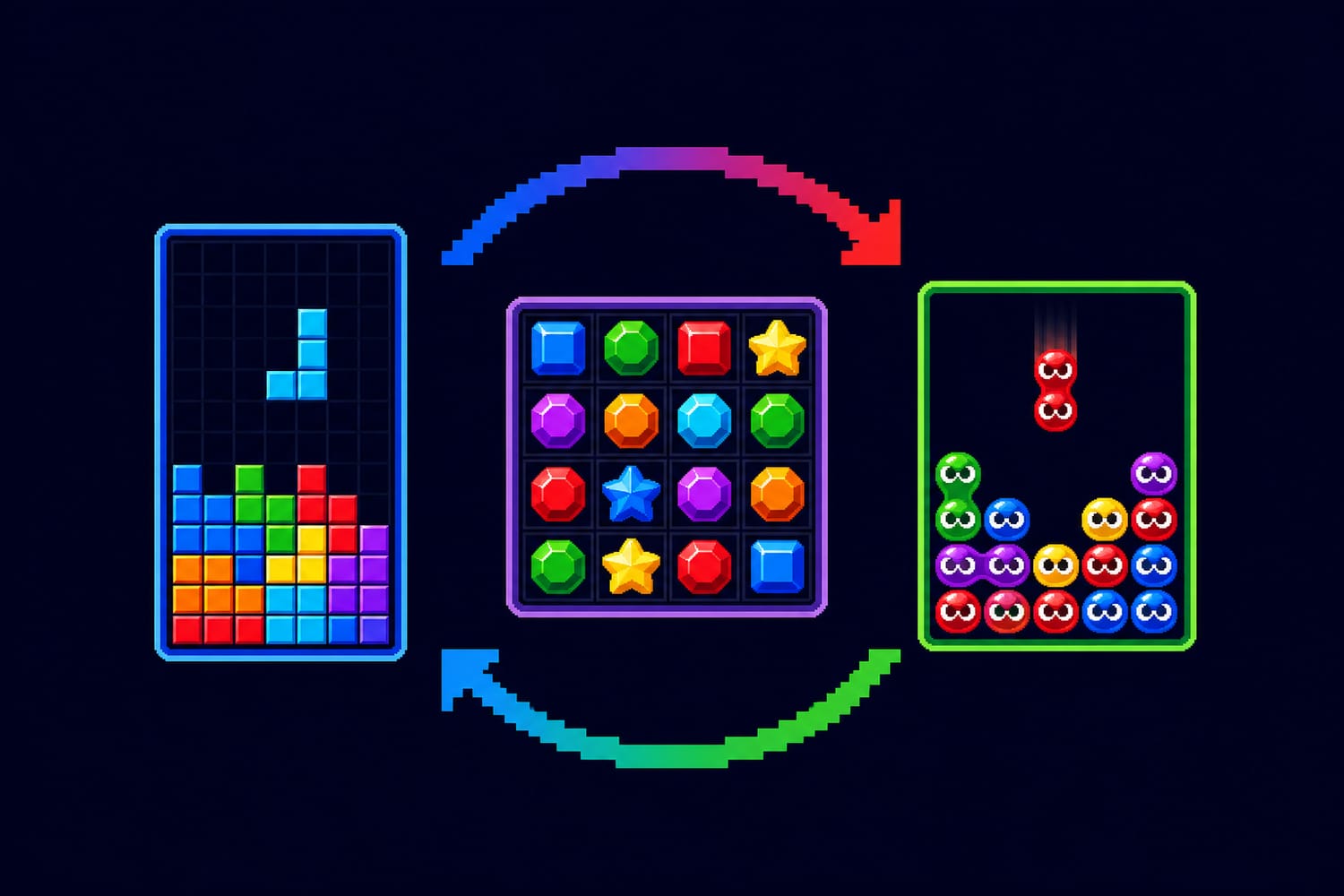
Puzzle cross-training means building your skills by switching between different types of puzzle games. Just like athletes train different muscles, puzzle players can train different thinking skills. A runner might lift weights to become stronger. A chess player might solve pattern-recognition exercises. A puzzle fan can improve by moving between logic puzzles, word puzzles, visual puzzles, memory games, number challenges, and spatial games.
The idea is simple: different puzzles exercise different mental habits. When you rotate between them, you become more flexible, patient, observant, and strategic. You also reduce the chance of getting bored or stuck in one way of thinking.
This is useful for beginners, casual players, and experienced puzzle fans alike. Whether you play for fun, relaxation, challenge, or competition, cross-training can make your puzzle time more rewarding.
The “Mental Muscles” Behind Puzzle Games
Most puzzles are not just about being “smart.” They involve a collection of smaller skills, and each game type emphasizes different ones.
For example, a jigsaw puzzle trains visual scanning, shape recognition, and spatial awareness. Sudoku trains logical deduction and number placement. Word searches strengthen pattern spotting and vocabulary familiarity. Match-3 games develop planning, quick recognition, and move efficiency. Hidden object games sharpen attention to detail. Nonograms combine visual reasoning with logic. Memory games train concentration and recall.
When you play only one type of puzzle, you may become excellent at that specific skill set. But when you switch puzzle types, you learn to approach problems from multiple angles. You become better at asking useful questions, such as:
- What information do I already have?
- What can I rule out?
- Is there a pattern I have missed?
- Should I focus on the big picture or the small details?
- Is speed important, or should I slow down?
These questions apply across many puzzle genres. The more often you practice them in different settings, the more naturally they appear when you face something new.
Logic Puzzles Teach Careful Thinking
Logic puzzles include games like Sudoku, Kakuro, logic grids, minesweeper-style puzzles, and deduction challenges. These games reward careful step-by-step reasoning. Instead of guessing, you learn to build from what is certain.
This skill transfers beautifully to other puzzle types. In a word puzzle, deduction helps you narrow possible answers. In a hidden object game, it helps you decide where an item is likely to appear. In a match-3 or tile puzzle, it helps you think ahead instead of reacting only to the current board.
Logic puzzles also teach patience. Many players make mistakes because they move too quickly. Cross-training with logic games encourages you to pause and ask, “What do I know for sure?” That single habit can improve almost every kind of puzzle play.
A good way to use logic puzzles for cross-training is to start with easier levels and focus on accuracy rather than speed. As you improve, increase the difficulty gradually. The goal is not to suffer through impossible puzzles; it is to strengthen your reasoning in a way that feels satisfying.
Word Puzzles Build Pattern Recognition and Flexibility
Word puzzles are more than vocabulary tests. Crosswords, anagrams, word searches, spelling games, and word association puzzles all train pattern recognition. You learn to see letter combinations, common prefixes, suffixes, rhymes, and hidden meanings.
This helps in surprising ways. Pattern recognition is useful in number puzzles, shape puzzles, and even visual puzzles. Once your brain becomes comfortable spotting repeated structures, you begin to notice clues faster in many games.
Word puzzles also encourage flexible thinking. A clue may have more than one meaning. A word may be hidden backward or diagonally. An anagram may require you to stop seeing the letters as fixed and start rearranging them mentally. That flexibility is valuable when a puzzle does not behave the way you first expect.
For example, if you are playing a sliding block puzzle, you might first try the most obvious move. But word puzzle training can remind you to experiment with alternate arrangements. If one interpretation does not work, look for another.
Visual Puzzles Improve Observation
Visual puzzles include jigsaws, spot-the-difference games, hidden object puzzles, tile-matching games, mazes, and image-based riddles. These games train your eyes to notice shapes, colors, edges, shadows, and small details.
Observation is one of the most underrated puzzle skills. Many players do not fail because they lack intelligence; they fail because they overlook something important. A small symbol, a repeated color, a corner piece, or a slightly different shape can change everything.
Visual puzzle training can improve how you scan a puzzle. Instead of looking randomly, you learn to search systematically. In a jigsaw puzzle, you might sort by edge pieces, color zones, or texture. In a hidden object game, you might scan left to right or divide the screen into sections. In a spot-the-difference game, you might compare one area at a time instead of jumping around.
These habits carry over to other games. In Sudoku, better scanning helps you spot empty cells with limited options. In match-3 games, it helps you notice potential combos. In word searches, it helps you detect letter patterns more quickly.
Spatial Games Strengthen Planning
Spatial puzzles involve movement, positioning, rotation, and arrangement. Examples include tangrams, block puzzles, sliding tiles, maze games, pipe-connecting puzzles, and certain physics-based puzzles.
These games teach you to think about space and sequence. If you move one piece, what happens next? If you rotate a shape, where will it fit? If you push a block into a corner, can you get it out again?
This kind of planning is useful far beyond spatial games. Match-3 players need to think about how one move changes the board. Logic puzzle players need to understand how one placement affects future choices. Even word puzzle players can benefit from planning when deciding which clue or section to solve first.
Spatial games also teach the value of working backward. If you know the final arrangement, you can ask, “What must happen immediately before that?” This technique is common in many puzzle types. In a maze, you might trace backward from the exit. In a Sudoku, you might think about what must be true for a number to fit. In a word puzzle, you might use the ending of a word to find the beginning.
Memory Games Improve Focus and Recall
Memory puzzles often involve matching pairs, remembering sequences, recalling positions, or tracking changes. They may seem simple, but they train concentration and mental organization.
Good memory is not only about storing information. It is also about deciding what matters. In a puzzle game, you may need to remember where a piece was, which path failed, which letters you already tried, or which rule applies to a certain area.
Memory training helps reduce repeated mistakes. For example, in a logic puzzle, you may remember that a certain option was already ruled out. In a hidden object game, you may remember which areas you checked carefully. In a word game, you may remember a useful letter combination for later.
One helpful approach is to say important information quietly in your mind: “The red key is near the clock,” or “This row still needs a 4 and a 7.” This simple technique can strengthen attention, especially during longer puzzles.
Speed Puzzles Teach Decision-Making Under Pressure
Some puzzle games are calm and untimed. Others challenge you to think quickly. Timed word games, falling block puzzles, action puzzle games, and rapid match-3 levels all train decision-making under pressure.
Speed puzzles teach you to recognize “good enough” moves. In a slow logic puzzle, you may search for the perfect move. In a timed game, you often need to choose a strong move quickly and keep going. This can help you become less afraid of making decisions.
However, speed should be balanced with accuracy. If you only play fast games, you may develop rushed habits. That is why cross-training matters. Slow puzzles teach careful reasoning; fast puzzles teach quick recognition. Together, they create a well-rounded player.
If timed games make you nervous, start with short sessions. Try one or two rounds, then switch to a calmer puzzle. Over time, you may find that pressure feels less stressful and more exciting.
How to Build a Simple Puzzle Cross-Training Routine
You do not need a complicated schedule to cross-train. The best routine is one you enjoy enough to keep doing. A balanced puzzle session might include three different types of games:
- One logic puzzle for careful reasoning
- One visual or spatial puzzle for observation and planning
- One word, memory, or speed puzzle for flexibility and focus
For example, you might play 10 minutes of Sudoku, 10 minutes of jigsaw or hidden object puzzles, and 10 minutes of word games. Another day, you might try nonograms, sliding blocks, and match-3.
The goal is variety, not perfection. If you only have five minutes, play one quick puzzle. If you have more time, rotate between several. Even small changes can help keep your brain engaged.
A helpful weekly rotation could look like this:
- Monday: Logic puzzles
- Tuesday: Word puzzles
- Wednesday: Visual puzzles
- Thursday: Spatial puzzles
- Friday: Speed or match puzzles
- Weekend: Your favorite games, plus one new challenge
This structure gives you direction while leaving room for fun.
What to Do When You Hit a Plateau
A plateau happens when you keep practicing but stop noticing improvement. This is common in puzzle games. It does not mean you are bad at puzzles. It usually means your brain has become comfortable with familiar patterns.
Cross-training is one of the best ways to break a plateau. If your Sudoku progress stalls, try nonograms or logic grids. If word games feel repetitive, try visual puzzles. If match-3 levels are frustrating, spend time with slower planning puzzles like sliding blocks or mazes.
You can also change how you play. Instead of trying to finish quickly, focus on using fewer hints. Instead of solving the whole puzzle at once, practice one technique. Instead of choosing the hardest level, return to medium difficulty and aim for clean, confident solutions.
Plateaus are not failures. They are signs that you are ready to learn in a new way.
Keep It Fun, Curious, and Balanced
The most important part of puzzle cross-training is enjoyment. Puzzles are meant to challenge you, but they should also be fun. If a certain game type feels frustrating, take a break or choose an easier version. If you love one genre most, keep it as your “home base” and use other puzzle types as helpful side training.
A balanced puzzle habit can improve patience, observation, reasoning, focus, and creativity. It can also make you more confident when trying unfamiliar games. The more types of puzzles you explore, the more strategies you collect.
Think of every puzzle as a teacher. Logic puzzles teach you to reason. Word puzzles teach you to see patterns. Visual puzzles teach you to observe. Spatial puzzles teach you to plan. Memory puzzles teach you to focus. Speed puzzles teach you to act decisively.
By switching game types, you are not starting over—you are building a wider toolbox. And the next time you face a tricky level, a stubborn clue, or a confusing board, you may discover that a skill from a completely different puzzle is exactly what you need.

