
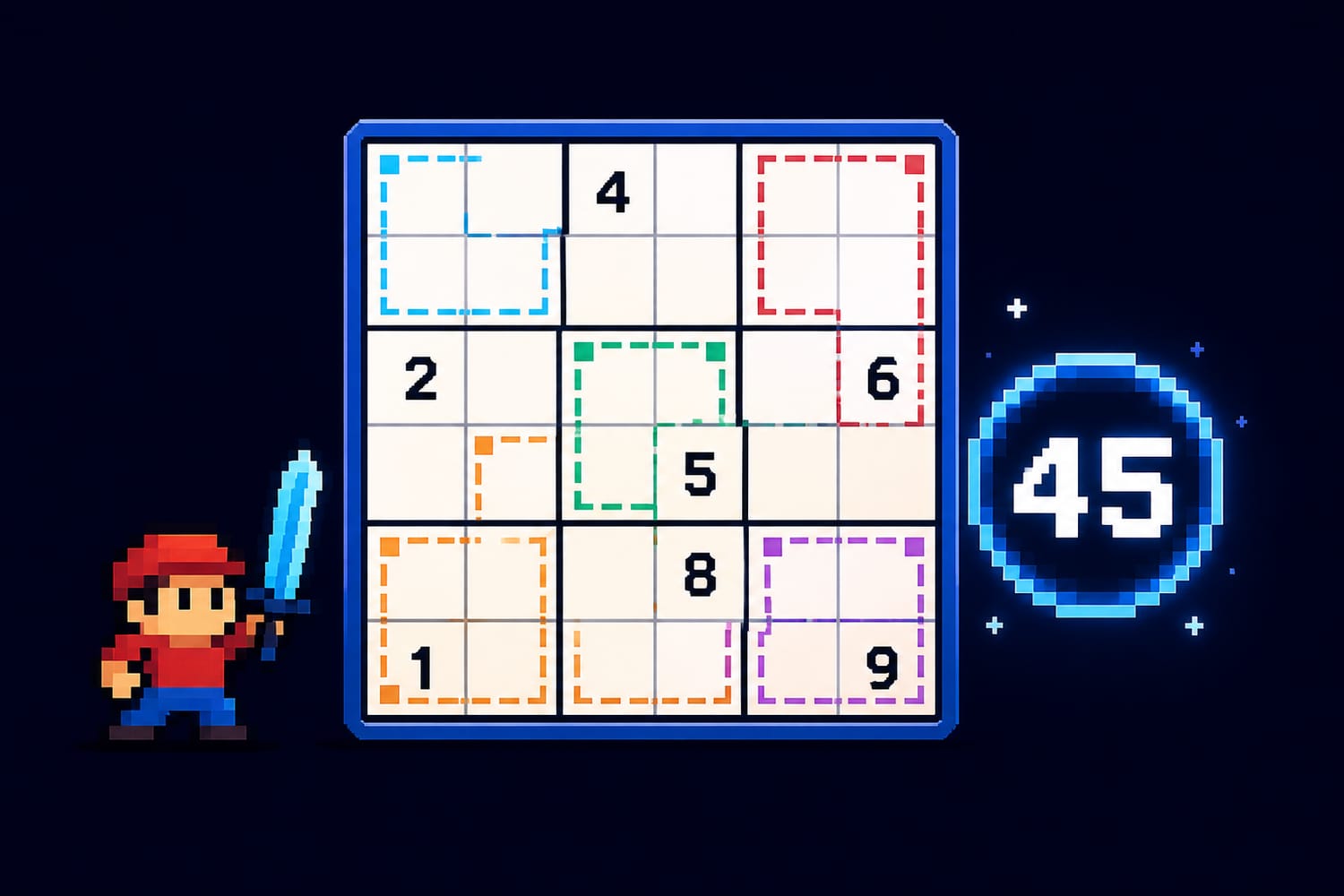
Killer Sudoku for Beginners: How to Use Cage Sums and the 45 Rule
Killer Sudoku Starts With Two Simple Ideas
Killer Sudoku combines the familiar rules of Sudoku with small groups of cells called cages. Each cage has a target sum. To solve the puzzle, you use those sums to narrow down possible digits, then apply the 45 rule: every row, column, and 3×3 box adds up to 45.
That may sound like a lot to track, but you do not need to calculate the whole grid at once. Start with one cage or one box, make a small deduction, and let it guide your next move.
Learn the Rules Before You Add
A standard Killer Sudoku grid has nine rows, nine columns, and nine 3×3 boxes. As in ordinary Sudoku, each must contain the digits 1 through 9 exactly once. The extra clues are the cages, usually marked by dotted outlines: the digits inside a cage must add up to its printed total, without repeating a digit in that cage. A cage can cross a box boundary, so always follow its outline rather than assuming it stops at a thick grid line. For a visual introduction, see Sudoku.com’s Killer Sudoku rules and example.
Most Killer Sudoku puzzles begin without any digits filled in. The cage totals give you your starting information. Instead of asking, “What number goes in this empty square?” try asking, “Which groups of digits could make this sum?”
Turn Cage Sums Into Possibilities
The number of cells matters as much as the printed total. A two-cell cage marked 4 must contain 1 and 3: although 2 + 2 also equals 4, repeated digits are not allowed in a cage. A two-cell cage marked 17 must contain 8 and 9, because no other two different digits from 1 through 9 reach 17.
Not every sum gives you a single combination. A two-cell cage marked 10 could contain 1 and 9, 2 and 8, 3 and 7, or 4 and 6. The sum tells you the pair, not which digit belongs in which cell. To settle the order—or rule out a pair altogether—check the rows, columns, and boxes that the cells touch.
Three-cell cages work the same way. A three-cell cage totaling 7 must hold 1, 2, and 4, though you may not yet know their positions. Note those possibilities lightly and move on; another part of the grid may supply the deciding clue. If your notes begin to crowd the board, Puzzles Arcade’s guide to using pencil marks in Sudoku without clutter is a useful companion.
Why Every Row, Column, and Box Totals 45
The 45 rule comes from one addition:
1 + 2 + 3 + 4 + 5 + 6 + 7 + 8 + 9 = 45
Because each row contains those nine digits exactly once, every completed row totals 45. The same is true of every column and 3×3 box—even when none of its digits has been filled in yet. Cage sums let you compare what you know with that guaranteed total.
Imagine a 3×3 box containing four cages of two cells each. All four cages sit entirely inside the box, cover eight of its nine cells, and have sums of 8, 10, 11, and 12. Add their totals:
8 + 10 + 11 + 12 = 41
The whole box must total 45, so its remaining cell is 45 − 41 = 4. You have placed a digit without knowing the individual values in any of those four cages.
The crucial words are entirely inside. If even one of the cages extends beyond the box, its printed sum includes an outside cell. You cannot simply subtract that full sum from 45 as though every cell were in the box.
What If Two Cells Are Left Over?
The 45 rule is still useful when it does not reveal a single digit. Suppose the cages lying wholly inside a row cover seven cells and total 36. The two remaining cells must add up to 45 − 36 = 9.
That leaves several distinct-digit pairs: 1 and 8, 2 and 7, 3 and 6, or 4 and 5. You cannot choose a pair just from the total. But the row has gained a new restriction. If a crossing column rules out 8 in both remaining cells, for example, the 1-and-8 pair is impossible.
Be careful not to apply a cage rule to a group that is not a cage. Two leftover cells in a row cannot repeat a digit because they share that row. If you were instead counting leftover cells in a larger region that did not share a row, column, box, or cage, you would need to check repetition according to the rules that actually connect them.
Meet the Innie and the Outie
Once you are comfortable subtracting internal cages from 45, you can handle cages that cross a boundary.
An innie is a cell inside the row, column, or box you are counting that your chosen cage totals have not covered. In the earlier box example, the lone cell worth 4 was an innie. Subtract the fully contained cage sums from 45 to find the value of one innie—or the combined value of several.
An outie is a cell outside the region that has been included in the cage totals you added. Imagine cages that together cover all nine cells of a box plus exactly one cell outside it. If those cage totals add up to 52, the extra cell must be 52 − 45 = 7. The box contributes 45; the outie accounts for everything beyond that. This approach works for rows and columns too.
Before doing either subtraction, trace the dotted outlines and count cells. Have you covered every cell in the region exactly once? How many cells outside it have you included? If there are two outies, subtracting 45 gives their combined value, not either digit individually.
A Beginner’s Routine for Each New Grid
You do not need to memorize a long list of combinations. A repeatable order of attack is more helpful:
- Scan small cages. Look for totals with few possibilities, such as a two-cell 4 or 17.
- Check rows, columns, and boxes. Use Sudoku’s no-repeat rules to eliminate cage combinations or decide where their digits go.
- Look for nearly complete regions. Add cages wholly inside a row, column, or box; subtract from 45 to find the uncovered value.
- Check crossing cages. When cage totals cover a complete region plus one outside cell, subtract 45 to find the outie.
- Update your notes. Each confirmed digit changes the possibilities in its cage, row, column, and box.
If you are new to Sudoku as well as Killer Sudoku, a few rounds of classic Sudoku practice on Puzzles Arcade can make those row-and-column checks feel more natural.
When You Get Stuck, Change What You Are Counting
A cage sum might not give you a digit immediately. Neither might the 45 rule. That is normal: a useful deduction can be as small as “these two cells total 9” or “this cage cannot contain an 8.” Keep those facts available, then scan another region.
The satisfying part of Killer Sudoku is how its clues work together. A cage limits the possible digits; a row rules out one arrangement; the 45 rule exposes a missing value. Start with the smallest calculation you can justify, check that you have counted the right cells, and let each certain step make the next one easier.

